Summary
Getting a loan once meant paperwork, branch visits, and weeks of waiting.
Today, many borrowers can apply for credit, receive approval, and access funds within minutes on their smartphones.
This dramatic shift is being powered by digital lending startups. By combining advanced technologies such as artificial intelligence, cloud infrastructure, and automated underwriting systems, these companies are transforming how credit is evaluated and delivered.
The result is a faster, more accessible form of online lending that is reshaping financial services. As fintech continues to evolve, digital lending startups are emerging as one of the most influential drivers of fintech innovation, enabling new credit models that traditional banking systems struggled to support.

The Rise of Digital Lending Startups
Digital lending refers to the use of technology platforms that automate loan origination, risk assessment, approval, and disbursement processes online. Instead of relying on manual reviews and physical documentation, lenders can process applications digitally through integrated platforms.
The rapid growth of digital lending startups has been driven by several structural changes within the financial ecosystem.
Changing borrower expectations
Modern consumers expect financial services to be fast, convenient, and accessible through mobile devices. The traditional loan approval process no longer meets the speed demanded by digital economies.
Expanding digital infrastructure
The growth of smartphones, digital identity systems, and online payment ecosystems has enabled lenders to reach borrowers without requiring physical branches.
Bridging financial inclusion gaps
Traditional financial institutions often struggle to serve individuals and small businesses with limited credit histories. Digital lending startups leverage alternative data sources to expand access to credit.
Together, these developments have accelerated the growth of online lending platforms that deliver faster and more flexible financial products.
How Digital Lending Startups Are Reshaping Fintech
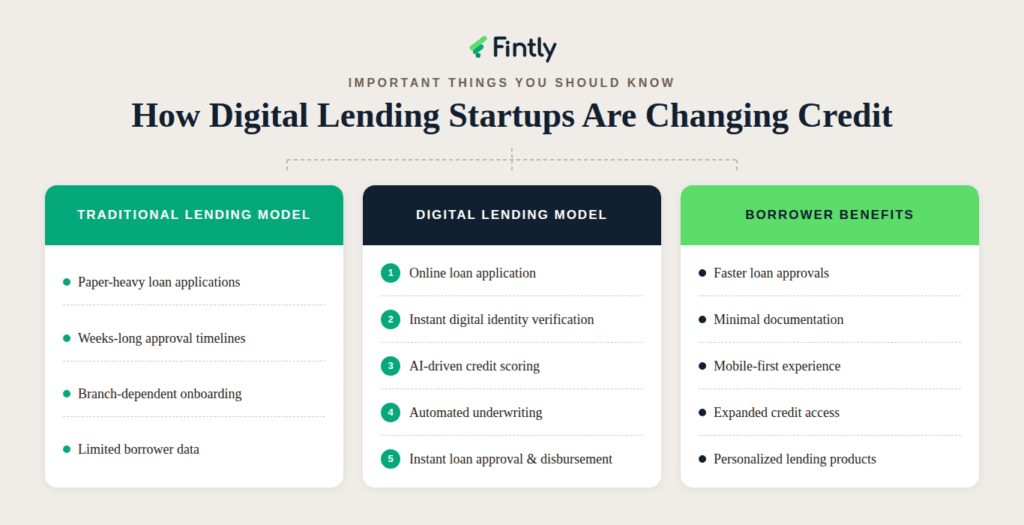
Digital lending startups are not simply digitizing existing loan processes. They are introducing new approaches that redefine the entire lending lifecycle.
Faster loan approvals
Automated underwriting systems allow lenders to evaluate borrower profiles instantly. Loan decisions that previously required days can now be completed within minutes.
Data-driven credit evaluation
Digital lenders analyze multiple data points including transaction histories, income patterns, and behavioral signals to assess borrower risk more accurately.
Scalable fintech lending platforms
Cloud-based systems allow digital lending startups to process large volumes of loan applications while maintaining operational efficiency.
Flexible lending products
Fintech lenders can quickly introduce new credit products tailored to different borrower segments, including small businesses, gig workers, and first-time borrowers.
These innovations demonstrate the growing role of digital lending startups in fintech, where technology-driven credit systems are reshaping financial access.
Technology Stack Used by Digital Lending Platforms
Behind every successful digital lending platform is a sophisticated technology stack designed to automate lending operations.
Artificial Intelligence and Machine Learning
AI-driven models analyze borrower behavior, transaction data, and repayment patterns to improve risk assessment. The adoption of machine learning in finance has significantly enhanced credit scoring capabilities.
Cloud Infrastructure
Cloud platforms enable lenders to scale rapidly without investing in expensive on-premise systems. They also allow lenders to process applications and borrower data in real time.
Open Banking APIs
Open banking frameworks enable lenders to access verified financial data from banking systems, improving credit decision accuracy.
Digital Identity Verification
Technologies such as eKYC, biometric authentication, and document recognition allow borrowers to complete onboarding digitally within minutes.
Fraud Detection Systems
Modern digital lenders deploy real-time monitoring systems to detect suspicious loan applications. Strong fraud detection in fintech capabilities help protect lenders from identity manipulation and financial crime.
These technologies collectively enable digital lending startups to build fully automated online lending systems.
Impact of Online Lending on Borrowers
The rise of digital lending startups has dramatically improved borrower experiences and credit accessibility.
Instant loan access
Borrowers can apply for loans through mobile apps and receive decisions almost instantly.
Reduced documentation
Digital verification systems allow applicants to submit information electronically rather than providing physical documents.
Expanded credit access
Alternative credit scoring models enable lenders to serve individuals with limited traditional credit histories.
New financial products
Digital lending platforms have introduced innovative financial products such as:
- Buy Now Pay Later (BNPL)
- Microloans
- Merchant financing
- Salary-based lending
- Embedded lending solutions
These innovations make online lending more flexible and accessible for individuals and businesses alike.
Leadership Perspective
Industry leaders often emphasize the importance of technology in reshaping financial services.
| “The fintech revolution is fundamentally about using technology to dramatically improve financial services.”
— Satya Nadella, CEO of Microsoft |
Digital lending startups represent a clear example of this transformation, where technology enables faster and more intelligent financial services.
Challenges Facing Digital Lending Startups
Despite their rapid growth, digital lending startups face several challenges.
Regulatory compliance
Financial regulators continue to develop frameworks to ensure responsible lending and consumer protection.
Data security
Handling large volumes of borrower data requires strong cybersecurity and data privacy measures.
Credit risk management
As digital lenders scale their operations, maintaining accurate risk models becomes critical to prevent loan defaults.
Successfully addressing these challenges will determine which digital lending platforms emerge as long-term leaders within fintech ecosystems.
The Future of Digital Lending
The next phase of fintech innovation will likely see digital lending startups playing an even larger role in financial services.
Several trends are expected to shape the future of online lending.
Embedded lending ecosystems
Financial services are increasingly integrated directly into digital platforms such as e-commerce marketplaces and fintech apps.
AI-driven credit decisions
Advanced analytics will continue to refine borrower risk assessment and enable personalized lending products.
Real-time financial data networks
Open banking ecosystems will allow lenders to access dynamic financial information for more accurate credit decisions.
Digitized financial operations
Financial institutions are increasingly modernizing their lending infrastructure to support faster credit decisions and scalable operations. Many lenders are now adopting AI-powered lending platforms to automate underwriting workflows, analyze borrower data more effectively, and improve operational efficiency across the lending lifecycle.
These technology-driven systems help lenders manage growing loan volumes while maintaining stronger risk controls and compliance standards.
| Did you know? |
|---|
| Digital lending platforms can reduce loan approval timelines by up to 80% compared to traditional lending processes, thanks to automated underwriting and digital identity verification. |
How Fintly Enables Digital Lending Infrastructure
While digital lending startups focus on borrower-facing platforms, scalable lending also requires strong operational infrastructure.
Platforms like Fintly help financial institutions automate critical financial workflows, including financial data extraction, document processing, and operational risk monitoring.
By digitizing back-office financial operations, lenders can build more efficient online lending systems that support faster decision-making and scalable credit operations.
👉 Explore how Fintly supports modern financial institutions with intelligent financial automation.
 QUICK ANSWERS
Frequently Asked Questions (FAQs)
Your most common questions, answered with precision and insight
Digital lending startups are fintech companies that offer loans through digital platforms using automated underwriting, digital identity verification, and advanced analytics.
They use AI-driven credit models, real-time data analysis, and automated verification systems to evaluate borrower information instantly.
They improve credit accessibility, accelerate loan processing, and introduce technology-driven financial services.
Many digital lenders analyze alternative data sources such as transaction histories, income patterns, and behavioral financial data.
Yes. Most digital lenders must comply with financial regulations related to consumer protection, data privacy, and responsible lending practices.

Author
Subject Matter Expert (Lending) Fintly.co
Vijay Mali is a results-driven professional with deep expertise in HFC/NBFC startups, compliance, and underwriting. He specializes in delivering end-to-end solutions for financial institutions, focusing on Business Rule Engines (BRE), workflow automation, and AI-driven credit decision-making. He is passionate about leveraging Machine Learning (ML) scorecards and AI-powered risk assessment to optimize lending processes and drive digital transformation in the financial sector.