Imagine hunting for a single $500 discrepancy across 10,000 pages of PDF bank statements. It is a nightmare auditors and finance teams live every quarter. You know the money went somewhere, but finding the exact transaction manually is like looking for a needle in a haystack of unstructured data. Digital audits promised to fix this. But handing an auditor a folder full of raw PDFs isn’t a true digital audit
To move fast and stay compliant, finance teams need to turn flat documents into actionable data. Bank statement parsing is the exact mechanism that makes this happen. It extracts, structures, and verifies your financial data before an auditor ever has to ask for it. In this post, you will learn exactly what bank statement parsing is, why manual data entry is quietly draining your resources, and how automation tightens your financial compliance.
Bank Statement Parsing Explained
If you want to survive a high-stakes audit, your raw financial documents need to communicate directly with your accounting software.
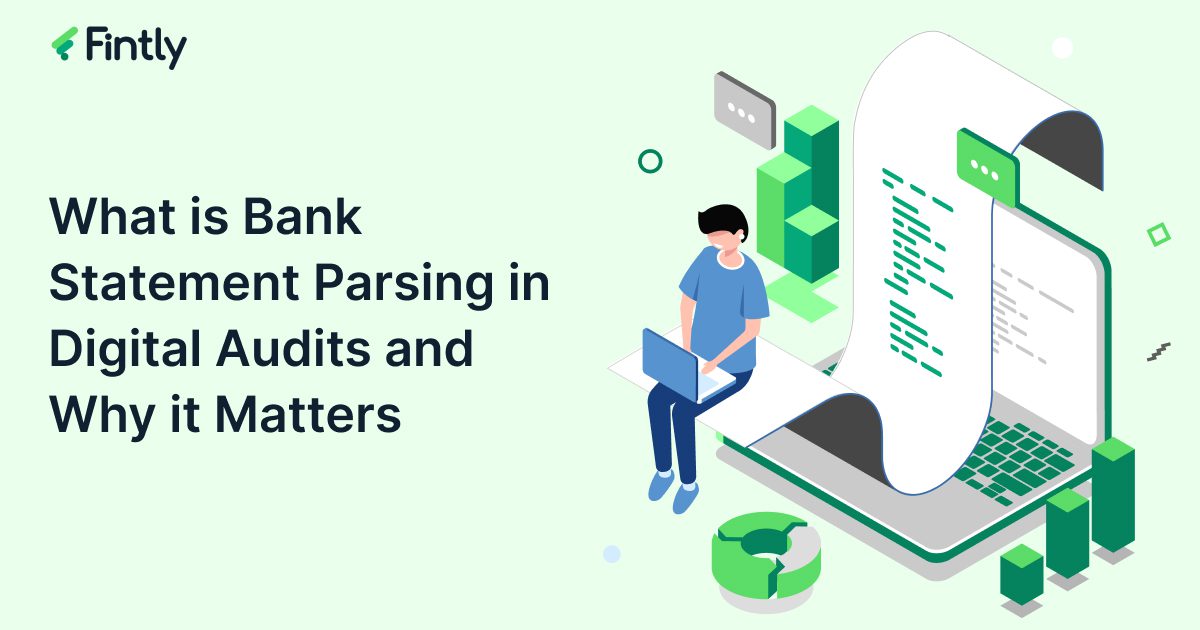
Bank statement parsing is the automated extraction of transaction data, like dates, amounts, balances, and vendor names from digital or scanned bank statements into a structured, machine-readable format like CSV or JSON.
Instead of a human reading a line item and typing it into Excel, software reads the document, understands the context of the data (dates, debits, credits, balances), and organizes it instantly. This bridges the gap between raw bank exports and the accounting software where reconciliation (the act of matching internal records with bank data) actually happens.
The Reality of a Digital Audit
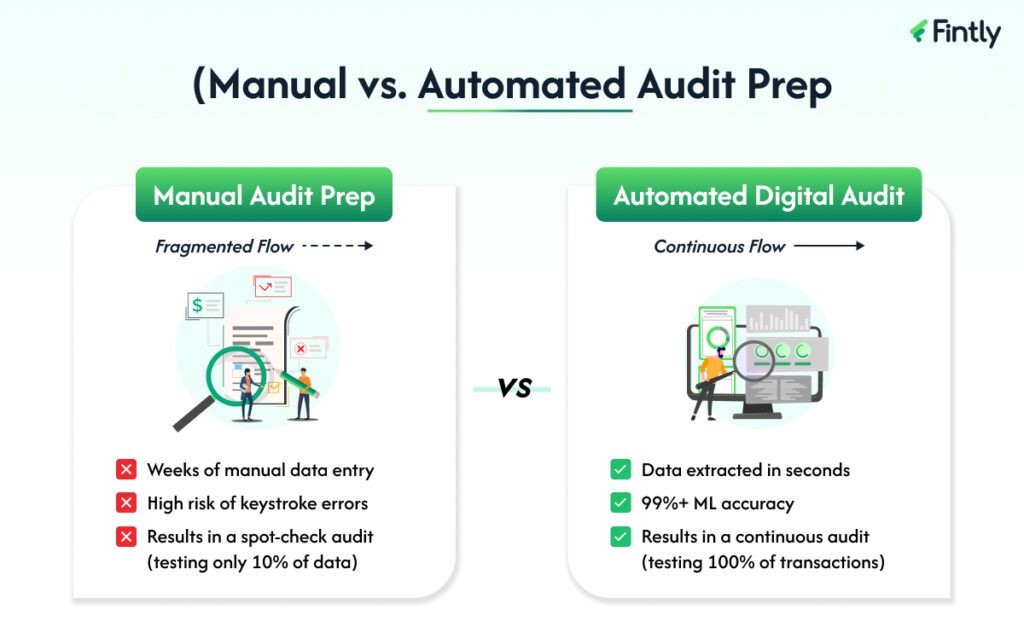
A digital audit requires verifiable data, not just digital images. When a firm relies on manual data entry to prep for an audit, the risk of failure spikes.
A tired accountant typing $1,500.00 instead of $15,000.00 creates a massive compliance gap. Furthermore, manual entry breaks the audit trail, the step-by-step record tracing a transaction back to its exact source. If a number changes between the original PDF and the final spreadsheet, an auditor cannot tell if it was a typo, a software glitch, or intentional tampering.

The Hidden Friction in Unstructured Data
Bank statements are notoriously inconsistent, which is exactly why manual audits take weeks. A statement from Chase looks entirely different from an HDFC export. Some are native PDFs with clean text layers. Others are scanned images of printed pages complete with coffee stains, skewed angles, and handwritten notes.
Even worse, tabular data rarely plays nice. A single transaction table might break across three different pages, or the bank might use DD/MM/YYYY formatting while your internal ERP requires MM/DD/YYYY.
Parsing software/ bank statement analyser normalizes this chaos. When you use a dedicated tool, every transaction ends in the exact same format, regardless of the originating bank, the file type, or the visual la
Automated Financial Data Extraction: OCR vs. Machine Learning
To understand why modern parsing is effective, you must understand how the extraction happens.
Basic automated financial data extraction relies solely on Optical Character Recognition (OCR). OCR is essentially a digital magnifying glass; it reads text on an image. However, OCR is notoriously rigid. If a bank moves the “Credit” column half an inch to the left, a standard OCR template breaks, and the data extracts incorrectly.
Modern bank statement parsing relies on Machine Learning (ML) layered over OCR. The AI does not just read the pixels; it understands financial context. It knows that a 10-digit alphanumeric string next to a date is likely a UTR (Unique Transaction Reference) number, even if the column header is missing. This context-aware extraction is what makes automated parsing reliable enough for a compliance audit.
| “The audit is shifting from a manual, sample-based approach to a continuous process that tests 100% of the data population. You cannot achieve this without automated data ingestion.” — The American Institute of CPAs (AICPA) on the Future of Auditing |
Real-World Case Study: How Top-Tier Auditors Use Parsing
When the world’s largest accounting firms conduct a digital audit, they do not rely on manual data entry. They rely on automated parsing.
Documented Example: Consider how Ernst & Young (EY) modernized their global audit processes. Auditing multinational corporations previously required EY’s teams to manually review, extract, and cross-reference millions of pages of unstructured financial documents, including complex bank statements from thousands of different global banks.
To eliminate this massive bottleneck, EY deployed AI-driven document intelligence platforms to automate their financial data extraction. The parsing technology used advanced machine learning to “read” the PDFs, instantly extract the transaction line items, and structure them directly into their internal audit software.
The business impact was undeniable:
- The firm successfully automated data extraction across millions of documents annually.
- Human transposition errors were virtually eliminated from the initial data-gathering phase.
- EY saved millions of manual hours globally.
By replacing keystrokes with automated bank statement parsing, EY didn’t just speed up the digital audit. They fundamentally shifted their team’s focus from tedious data entry to high-level financial compliance and risk assessment.
Securing Financial Compliance
Financial compliance is about proving the integrity of your numbers. When an auditor flags an anomaly, the burden of proof falls entirely on your team. You have to dig through source documents to defend the entry.
According to Gartner, human error in finance functions produces an average of 25,000 hours of avoidable rework annually. That is an expensive waste of talent, usually spent chasing down ghost transactions just to satisfy a compliance check.
Automated extraction eliminates this rework. When a parsing engine pulls data from a statement, it locks the extracted information against the original file, creating an immutable record. If an auditor questions a $10,000 outbound wire, the parsed data provides a direct, verifiable link back to the exact line on page 14 of the original bank PDF.
Audit Automation: Manual Prep vs. Parsing Software
| Feature | Manual Data Entry | Automated Bank Statement Parsing |
| Speed | Days to weeks per quarter | Minutes per statement |
| Accuracy | Prone to human fatigue and typos | 95%+ accuracy with machine learning |
| Format Handling | Requires human interpretation per bank | Normalizes all bank layouts into one format |
| Audit Trail | Weak (difficult to trace source data) | Strong (direct line from PDF to data cell) |
| Did you know? |
|---|
| According to research by the International Data Corporation (IDC), up to 90% of all global organizational data is unstructured; a category that includes PDF bank statements, scanned invoices, and email attachments. Without automated parsing, finance teams are forced to manually interpret and enter the vast majority of their daily financial data, creating a massive bottleneck long before an audit even begins. |
The Bottom Line
Bank statement parsing is the foundation of audit automation. By removing manual data entry from your workflow, you drastically reduce human error and build a bulletproof audit trail.
Early adopters of AI-driven accounting tools prove the business case quickly. Deloitte reports that 82% of organizations implementing AI in accounting see a positive return on investment within their first year. You secure your financial compliance by proving exactly where every number came from, without paying your smartest analysts to copy and paste.
Stop forcing your sharpest finance professionals to copy and paste tabular data. Let the software handle the extraction so your team can focus on growth. Implementing this technology doesn’t require a massive IT overhaul. If you are ready to see how Fintly’s extraction engine handles your specific bank formats, let’s talk.
 QUICK ANSWERS
Frequently Asked Questions (FAQs)
Your most common questions, answered with precision and insight
It is the use of software to automatically read digital or scanned bank statements and extract the transaction data into a clean, usable format like a spreadsheet or JSON file.
It creates a direct, error-free link between your raw bank documents and your accounting software. This provides external auditors with a transparent and easily verifiable data trail, which is critical for compliance frameworks.
Yes. Modern parsing tools use advanced OCR (Optical Character Recognition) combined with AI to accurately read and extract data even from skewed images, low-quality scans, or multi-page table structures.
Automation processes millions of transactions in minutes, eliminates the risk of human typographical errors, and normalizes chaotic data from different banks into one standard, audit-ready format.
Yes. Modern parsing tools are built to feed directly into major ERPs and accounting platforms like NetSuite, SAP, or QuickBooks. Instead of replacing your current system, the software simply extracts the data and delivers it via direct API integration or a ready-to-upload CSV file, eliminating manual entry without disrupting your existing workflow.

Author
Subject Matter Expert (Lending) Fintly.co
Vijay Mali is a results-driven professional with deep expertise in HFC/NBFC startups, compliance, and underwriting. He specializes in delivering end-to-end solutions for financial institutions, focusing on Business Rule Engines (BRE), workflow automation, and AI-driven credit decision-making. He is passionate about leveraging Machine Learning (ML) scorecards and AI-powered risk assessment to optimize lending processes and drive digital transformation in the financial sector.