
Digital lending has accelerated financial services. Onboarding is instant. Credit decisions are automated. Portfolio monitoring is real time.
But speed introduces exposure.
For banks, NBFCs, and fintech lenders, banking data security is no longer just an IT safeguard, it is a strategic risk mandate. A single data breach can trigger regulatory penalties, erode customer trust, and disrupt lending operations.
Traditional perimeter-based security systems were built for branch-led banking models. Today’s API-driven ecosystems demand embedded protection within workflows.
This is where digitization in banking becomes foundational.
What Is Banking Data Security?
Banking data security refers to protecting sensitive financial and customer information across digital systems.
This includes:
- Customer identity records
- Bank statements and transaction histories
- Credit underwriting data
- Risk scoring outputs
- Portfolio analytics
In modern lending environments, this information flows across onboarding systems, underwriting engines, analytics dashboards, and monitoring platforms. Every transfer point increases risk.
Security must therefore be structured, traceable, and continuous.
What Is Digitization in Banking?
Digitization in banking involves transforming manual, document-heavy processes into automated, centralized, and governed systems.
It includes:
- Automated data extraction
- AI-driven financial evaluation
- Rule-based decision engines
- Real-time dashboards
- Role-based access management
When properly implemented, digitization reduces human handling, one of the primary sources of data exposure.
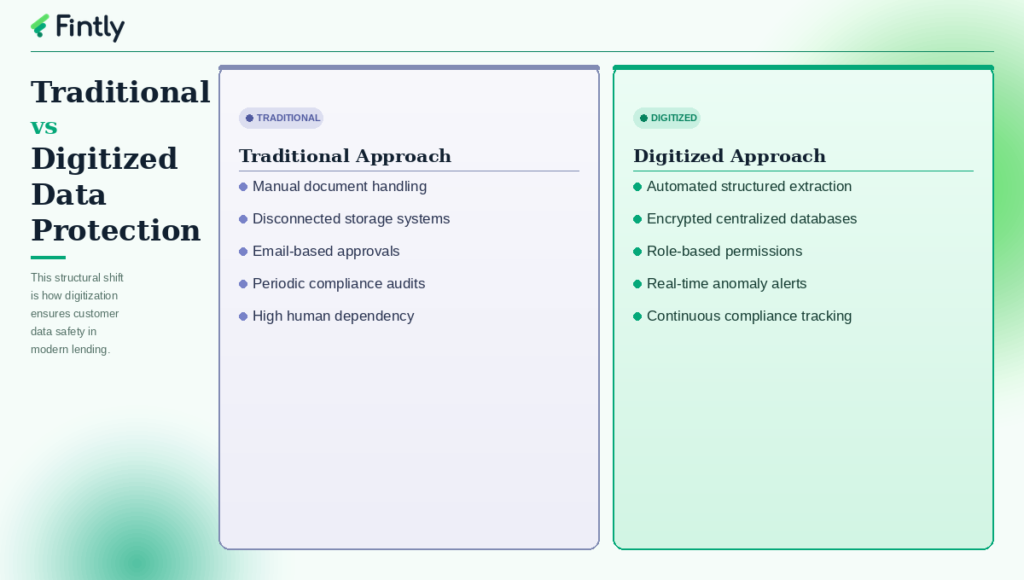
Traditional Security vs Digitized Security Framework
| Metric | Traditional Model | Digitized Model |
| Monitoring | Periodic audits | Continuous tracking |
| Data Handling | Manual files | Structured extraction |
| Access | Broad permissions | Role-based controls |
| Risk Detection | Reactive | Predictive alerts |
| Compliance | Manual documentation | Automated audit trails |
Digitized environments minimize vulnerability by design.
5 Ways Digitisation Ensures Customer Data Safety
1. Structured Data Capture Reduces Manual Exposure
Manual downloading and sharing of financial documents increases the risk of unauthorized access.
Digitized systems transform raw financial files into structured datasets using automated bank statement analysis , eliminating the need to circulate sensitive PDFs across teams.
Centralized storage ensures:
- Encrypted data retention
- Controlled access logs
- Reduced duplication
- Audit visibility
Limiting document sprawl directly strengthens data protection.
2. Role-Based Access Controls Minimize Insider Risk
Insider misuse remains one of the most overlooked cybersecurity risks.
Digitized platforms enforce:
- Segmented user roles
- Restricted visibility
- Approval hierarchies
- Logged activity trails
Strong credit management workflows ensure that underwriting teams only access what is necessary for decision-making.
This reduces accidental exposure and prevents unauthorized data manipulation.
Security becomes enforceable through system architecture.
3. Real-Time Monitoring Detects AnomaliesEarly
Traditional audit cycles create delays in identifying risk.
Digitized systems introduce continuous transaction tracking and automated alerts through embedded early warning systems.
These systems analyze:
- Transaction velocity
- Behavioral inconsistencies
- Sudden cash flow deviations
- Access pattern anomalies
By detecting irregular activity early, institutions reduce financial and reputational exposure.
Cybersecurity shifts from reactive containment to proactive prevention.
4. Encryption and Secure Integrations Protect Data in Motion
Digital lending relies heavily on third-party integrations, credit bureaus, payment processors, analytics providers, and embedded finance partners.
Digitization enables:
- End-to-end encryption
- Tokenized data transmission
- Multi-factor authentication
- API-level permissions
When aligned with AI-driven risk management, institutions protect data both at rest and in transit.
Secure integrations ensure ecosystem-level protection, not just internal safeguards.
5. Automated Audit Trails Strengthen Regulatory Compliance
Regulators demand transparency in lending decisions and data handling practices.
Digitized systems automatically record:
- User access history
- Credit decision triggers
- Workflow approvals
- Data edits and overrides
- Risk score changes
Embedded decision intelligence ensures every underwriting action is logged and traceable.
This reduces compliance friction and improves regulatory confidence.
Audit readiness becomes continuous rather than event-based.
Operational Impact of Digitized Data Security
Digitization improves security without slowing operations.
Lending Operations
Automated data capture reduces back-and-forth document exchange.
Credit Risk Teams
Structured datasets improve analysis accuracy while limiting raw file access.
Compliance Departments
Continuous logs simplify audits and regulatory reporting.
Portfolio Management
Secure dashboards enable performance monitoring without exposing customer-level data unnecessarily.
Security and efficiency move together.
Financial Impact of Strong Banking Data Security
Data breaches create layered financial consequences:
- Regulatory fines
- Legal exposure
- Customer compensation
- Reputation damage
- Increased capital scrutiny
Preventive digitization reduces these downstream risks.
Strong cybersecurity also enhances investor confidence and strengthens institutional credibility.
Data safety becomes part of financial strategy.
Traditional vs Digitized Data Protection
A 3-Point Alignment Framework for Data Protection
- Process Alignment
Embed security checks directly into onboarding and underwriting workflows. - Technology Alignment
Deploy AI-driven analytics, encryption layers, and automated monitoring. - Governance Alignment
Align risk, compliance, and operations teams under shared visibility and accountability.
When these three layers integrate, banking data security becomes scalable and resilient.
How Technology Enables Secure Lending Ecosystems
Modern digital infrastructure combines:
- AI-powered analytics
- Structured financial processing
- Configurable business rules
- Centralized monitoring dashboards
- Continuous anomaly detection
Digitization in banking ensures that automation and cybersecurity operate within the same framework.
Security is no longer an isolated function. It is embedded architecture.
Building Secure Digital Financial Infrastructure
Customer trust depends on structured data governance.
Institutions that integrate automation, encryption, AI monitoring, and centralized controls into their workflows build resilient digital ecosystems.
Security must scale with growth, not follow it.
Strengthening Financial Ecosystems with Structured Intelligence
Customer trust depends on data protection.
Fintly enables financial institutions to embed AI-driven analytics, structured data processing, and automated decision frameworks into lending workflows, enhancing visibility, control, and governance without slowing operations.
Secure infrastructure should scale with growth.
The Future of Banking Data Security
As digital ecosystems expand, cyber threats will evolve in sophistication.
Institutions relying on reactive controls will struggle with complexity and regulatory pressure.
Those embedding digitization in banking at the workflow level, integrating automation, intelligence, and governance will create sustainable, future-ready lending infrastructure.
Banking data security is not an add-on. It is foundational architecture.
Author

Subject Matter Experts (Lending) Fintly.co
Vijay Mali is a results-driven professional with deep expertise in HFC/NBFC startups, compliance, and underwriting. He specializes in delivering end-to-end solutions for financial institutions, focusing on Business Rule Engines (BRE), workflow automation, and AI-driven credit decision-making. He is passionate about leveraging Machine Learning (ML) scorecards and AI-powered risk assessment to optimize lending processes and drive digital transformation in the financial sector.
