Summary
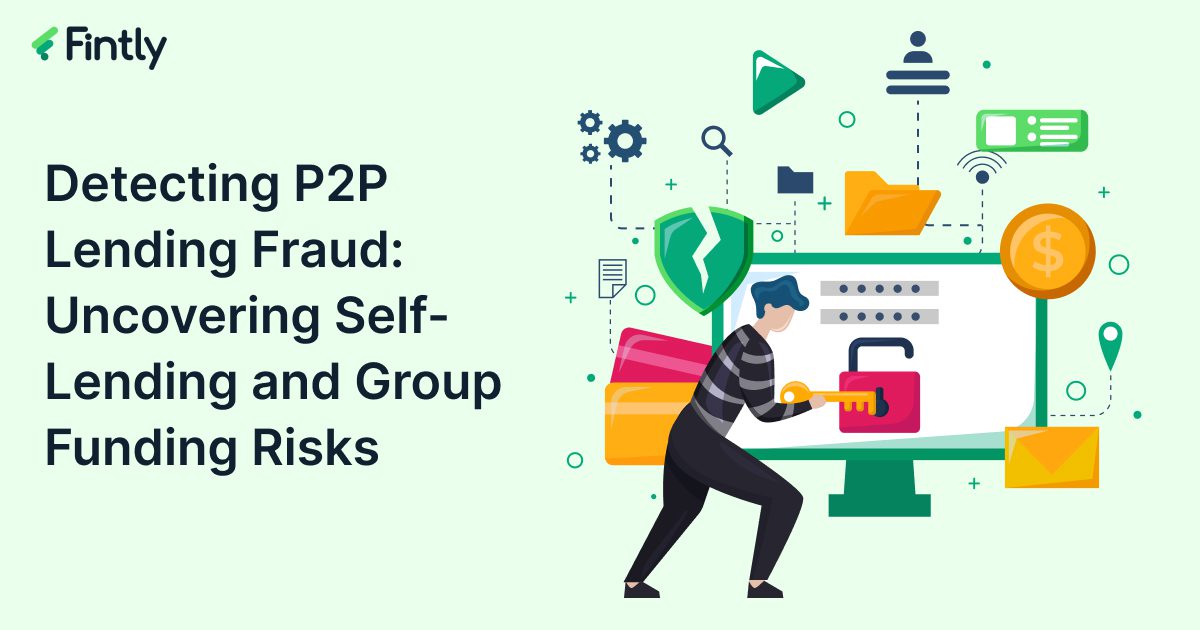
In 2023 alone, alternative lending platforms saw a sharp spike in sophisticated application manipulation, turning peer-to-peer networks into prime targets for coordinated scams. When borrowers are no longer isolated individuals but organized networks, traditional credit checks fail completely. You are not just assessing creditworthiness; you are defending against P2P lending fraud.
Identifying synthetic identities and coordinated borrowing rings requires analyzing behavioral footprints at the very point of application. Effective prevention relies on proactive, network-level detection rather than retroactive auditing. By integrating Automated Loan Application Scoring and Sophisticated Risk Scoring Algorithms, platforms can evaluate complex data patterns in real time. Ultimately, detecting self-lending in P2P platforms requires unified financial intelligence that red-flags suspicious linkages before your capital leaves the ecosystem.
This guide breaks down the hidden mechanics of two specific threats: self-lending risk and group funding schemes. You will learn exactly how bad actors orchestrate these scams, what data anomalies give them away, and how modern platforms are moving beyond static checks to catch collusion before funds are ever disbursed.

What Is Self-Lending?
Self-lending occurs when an individual or entity creates fake borrower profiles to request funds and then funds those exact loans using separate lender accounts they also control. This circular movement of money is a textbook example of P2P lending fraud.
Why go through the trouble? The goal is rarely the loan itself. Bad actors use this tactic to artificially inflate platform transaction volumes, launder money, or extract promotional cash incentives offered to new users. This specific self-lending risk easily bypasses standard KYC (Know Your Customer) checks because the synthetic identities often use stolen, but valid, credentials.
When detecting self-lending in P2P platforms, risk teams must look beyond the individual profile and analyze the relationship between the borrower and the lender. If the capital never truly changes hands outside the scammer’s control, the platform is merely facilitating a wash trade, exposing itself to severe regulatory penalties.
The Mechanics of Group Funding Risks
While self-lending is often a solitary effort, group funding introduces highly organized collusion. In a group funding scheme, a syndicate of users coordinates to manipulate platform dynamics. They cross-fund each other’s loans to build artificial credit histories, eventually culminating in a massive, coordinated default, a technique known in risk circles as “busting out.”
These networks operate like digital sleeper cells. They maintain legitimate-looking repayment behaviors for months to steadily increase their borrowing limits. Once those limits peak, they cash out simultaneously. This organized P2P lending fraud is incredibly difficult to spot because individual transactions appear entirely normal. The group funding threat only becomes visible when you map the connections between accounts. Mitigating this risk requires graph analysis rather than isolated credit scoring.
Recognizing the Red Flags in Peer-to-Peer Networks
Catching P2P lending fraud early means identifying non-financial data anomalies at the application stage. When bad actors execute organized schemes, they inevitably leave digital fingerprints.
- Velocity Anomalies: Rapid funding loops where a loan is funded almost instantly by a newly created lender account.
- Device and IP Clustering: Multiple borrower and lender profiles logging in from the same IP address, Wi-Fi network, or device fingerprint.
- Behavioral Synchronization: Accounts in a group funding ring applying for loans, transferring funds, or logging in at the exact same times of day.
Detecting self-lending in P2P platforms requires correlating these behavioral data points. A borrower with a 750 credit score might look perfect on paper, but if their loan is funded by an account using the exact same MAC address, the self-lending risk is immediate and critical.
Prevention Methods
Defending against P2P lending fraud requires shifting from manual auditing to proactive, data-driven prevention.
First, platforms must analyze the complete digital footprint. Connecting the dots between user behaviors and application metadata is crucial. For a deeper understanding of how integrated data prevents these operational blind spots, explore why the future of lending belongs to unified financial intelligence.
Second, detecting self-lending in P2P platforms demands robust cybersecurity and data integrity pipelines. Bad actors actively exploit weak spots in account recovery or data storage to fabricate synthetic profiles. Strengthening these basic infrastructures is vital; you can read more on the 5 ways digitisation can help banks and lenders ensure customer data safety.
Finally, implementing machine learning models trained on network analysis can flag early collusion attempts by identifying clusters of suspicious activity that human analysts cannot process at scale.
Real-World Impact: The Cost of Undetected Collusion
To understand the catastrophic potential of P2P lending fraud, one must look at the infamous Ezubao case. Operating as a massive peer-to-peer lender in China, Ezubao fabricated an estimated 95% of its investment projects. While an extreme scenario, it perfectly illustrates the ultimate manifestation of unchecked self-lending risk and synthetic group funding.
Platform executives created shell companies to absorb funds from retail investors, essentially orchestrating a multi-billion dollar Ponzi scheme before authorities intervened. According to a Reuters investigation into the $7.6 billion fraud, the platform lacked the fundamental oversight to separate real economic activity from synthetic money loops.
The broader alternative lending industry faces similar, scaled-down pressures daily. A recent TransUnion global digital fraud trends report noted that suspected digital fraud attempts in the financial services sector, heavily driven by synthetic identity creation and P2P lending fraud, rose by a staggering 79% globally between 2022 and 2023. This underscores why detecting self-lending in P2P platforms isn’t just about stopping small-time scammers; it is a matter of platform survival.
Assessing Risk: Isolated Borrowers vs. Network Rings
| Risk Indicator | Legitimate Borrower | Self-Lending Risk / Group Funding Ring |
| Device Identity | Single, distinct device footprint | Multiple user accounts sharing one device/IP |
| Funding Velocity | Gradual, organic lender matches | Instantaneous funding from specific, new accounts |
| Network Links | No shared financial history | Cross-funding, shared bank routing numbers |
| Behavioral Timing | Random, user-specific application times | Synchronized application and login spikes |
Conclusion
P2P lending fraud is no longer just about using stolen credit cards; it is about orchestrated networks exploiting platform trust mechanics. Mitigating self-lending risk and dismantling group funding rings requires far more than traditional credit bureau data. It demands real-time behavioral analysis and unified network intelligence. By focusing heavily on detecting self-lending in P2P platforms at the application stage, lenders can protect their liquidity, ensure regulatory compliance, and maintain a genuinely safe ecosystem for legitimate users.
Ready to fortify your lending platform against synthetic identities and organized financial fraud rings? Contact Fintly today to book a demo and see our early warning systems in action.

QUICK ANSWERS
Frequently Asked Questions (FAQs)
Your most common questions, answered with precision and insight
The most frequent types of P2P lending fraud involve synthetic identity creation and self-lending. Scammers use stolen or fabricated credentials to secure loans, often manipulating algorithms to extract platform incentives.
Self-lending risk artificially inflates a platform’s transaction volume and masks money laundering as legitimate lending. If left unchecked, it attracts severe regulatory scrutiny and destabilizes the platform’s financial health.
Group funding occurs when a syndicate of bad actors creates a network of accounts to strategically cross-fund each other. This creates fake repayment histories to boost credit limits, inevitably leading to coordinated, massive defaults.
Detecting self-lending in P2P platforms is challenging because fraudulent accounts often use real, stolen KYC data, making them look legitimate to legacy credit systems. Catching them requires analyzing non-financial red flags like shared IP addresses and synchronized login behaviors.
Yes, machine learning and AI are essential for preventing modern P2P lending fraud. Advanced risk algorithms can instantly detect the hidden network connections inherent in group funding and self-lending that manual human audits typically miss.

Author
Subject Matter Expert (Lending) Fintly.co
Vijay Mali is a results-driven professional with deep expertise in HFC/NBFC startups, compliance, and underwriting. He specializes in delivering end-to-end solutions for financial institutions, focusing on Business Rule Engines (BRE), workflow automation, and AI-driven credit decision-making. He is passionate about leveraging Machine Learning (ML) scorecards and AI-powered risk assessment to optimize lending processes and drive digital transformation in the financial sector.