

Summary:
Fintech fraud detection is critical for preventing financial crime across digital lending and payments. Modern fraud detection techniques in fintech use AI, behavioral analytics, and automated monitoring to identify suspicious activity in real time. This blog explores common fintech fraud types, detection techniques, prevention strategies, and how intelligent automation strengthens financial risk management.
Financial institutions process millions of digital transactions daily. As fintech ecosystems expand, so does exposure to financial crime. From synthetic identities to account takeovers and real-time payment fraud, attackers are becoming more sophisticated.
Traditional monitoring systems struggle to keep pace. Manual reviews are slow, fragmented, and prone to errors. Even minor detection gaps can result in portfolio losses and compliance risks.
Modern fintech fraud detection relies on AI-driven analytics, behavioral intelligence, and automated workflows. When integrated with structured bank statement analysis, institutions can detect anomalies during underwriting rather than after disbursement.
Fraud prevention is no longer just a compliance function; it is central to sustainable growth.
Understanding Fintech Fraud Detection
Fraud detection in fintech refers to intelligent systems that monitor onboarding behaviour, transactions, and financial data in real time.
Unlike traditional banking models, fintech ecosystems operate with instant onboarding, API integrations, and embedded finance partnerships. This creates speed but also increases exposure to financial crime.
By leveraging innovations in AI in finance, institutions can detect behavioural deviations, transaction anomalies, and linked fraud patterns across high-volume environments.
Common Fintech Fraud Types
Fraud in digital finance appears in multiple forms:
Synthetic Identity Fraud
Fraudsters combine legitimate and fabricated information to create identities that pass verification checks before defaulting.
Account Takeover (ATO)
Unauthorized access gained through phishing, credential stuffing, or malware.
Payment Fraud
Includes unauthorized transfers, card-not-present fraud, and real-time payment manipulation.
Loan Application Fraud
Applicants may falsify income documents or manipulate transaction histories. Strong data verification combined with intelligent monitoring significantly reduces this risk.
Merchant & Chargeback Abuse
Often seen in embedded finance ecosystems where refund systems are exploited.
Addressing these fraud types requires layered fraud detection techniques in fintech rather than isolated controls.
Fraud Detection Techniques in Fintech
Modern fraud detection techniques in fintech combine AI, automation, and adaptive risk scoring.
AI & Machine Learning
Machine learning models analyze transaction velocity, device fingerprints, behavioral shifts, and repayment patterns to detect hidden fraud signals.
Behavioral Biometrics
Monitoring typing patterns, device metadata, and geolocation inconsistencies helps detect suspicious access attempts , even when login credentials appear valid.
Real-Time Risk Monitoring
Dynamic risk scoring evaluates:
- Transaction value
- Geographic inconsistencies
- Device reputation
- Behavioral changes
When integrated with proactive early warning services , institutions can identify fraud indicators before financial damage escalates.
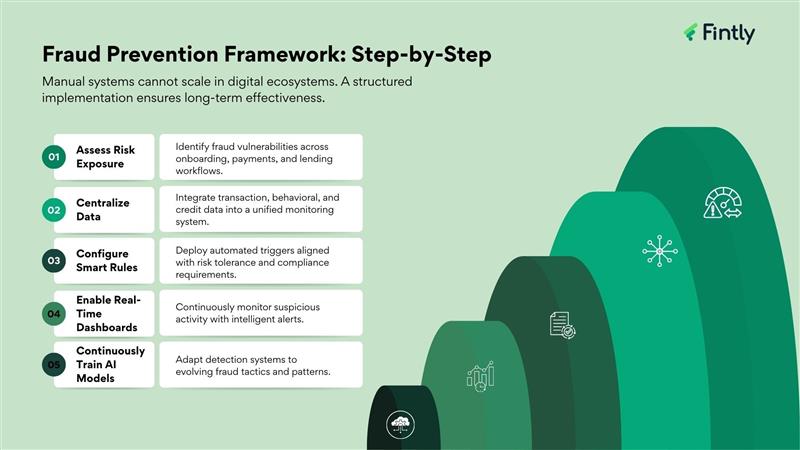
How to Implement a Fraud Prevention Framework: Step-by-Step
Manual systems cannot scale in digital ecosystems. A structured implementation approach ensures long-term effectiveness.
Step 1: Assess Risk Exposure
Identify fraud vulnerabilities across onboarding, payments, and lending workflows.
Step 2: Centralize Data
Integrate transaction, behavioral, and credit data into a unified monitoring system.
Step 3: Configure Smart Rules
Deploy automated triggers aligned with risk tolerance and compliance requirements.
Step 4: Enable Real-Time Dashboards
Monitor suspicious activity continuously with intelligent alerts.
Step 5: Continuously Train AI Models
Fraud evolves quickly. Detection systems must adapt to emerging tactics and patterns.
Institutions that embed fraud detection directly into lending workflows build stronger, more resilient fintech ecosystems.
Automated Decision Frameworks
Flexible business rule engines allow risk teams to adjust fraud thresholds instantly without engineering delays. This agility is essential as fraud tactics evolve rapidly.
Benefits of Advanced Fraud Prevention Tools
Modern fraud prevention tools deliver measurable advantages:
- Faster fraud detection cycles
- Reduced false positives
- Improved regulatory compliance
- Real-time portfolio visibility
- Lower operational costs
When embedded within broader financial risk strategies, fraud controls enhance underwriting accuracy and long-term stability.
Key Impact Table: Traditional vs AI Driven Fraud Detection
| Benefit | Traditional Monitoring | AI-Driven Detection |
| Detection Speed | Delayed | Real-Time |
| False Positives | High | Reduced |
| Pattern Recognition | Limited | Advanced ML |
| Portfolio Monitoring | Periodic | Continuous |
| Scalability | Manual | Automated |
The transition toward intelligent fraud systems reflects the broader evolution of digital lending ecosystems.
Why Fintly Leads in Fraud Intelligence
Fintly integrates fraud detection into its financial intelligence ecosystem by combining AI-driven analytics, automated decision systems, and real-time monitoring tools.
This unified approach enables financial institutions to prevent financial crime while accelerating approvals and maintaining compliance.
Strengthening Security with Intelligent Automation
Traditional fraud monitoring is reactive and fragmented. Modern fintech ecosystems require predictive intelligence embedded directly into underwriting and portfolio monitoring processes.
By combining AI, automation, and real-time monitoring, institutions can reduce fraud losses while improving customer experience and operational efficiency.
Discover how Fintly helps organizations enhance fintech fraud detection and protect digital financial ecosystems at scale.
Author

Subject Matter Experts (Lending) Fintly.co
Vijay Mali is a results-driven professional with deep expertise in HFC/NBFC startups, compliance, and underwriting. He specializes in delivering end-to-end solutions for financial institutions, focusing on Business Rule Engines (BRE), workflow automation, and AI-driven credit decision-making. He is passionate about leveraging Machine Learning (ML) scorecards and AI-powered risk assessment to optimize lending processes and drive digital transformation in the financial sector.