
Summary
Machine learning in finance is transforming how financial institutions analyze data, detect fraud, manage risk, and deliver personalized services. By analyzing large volumes of financial data in real time, machine learning models can identify patterns, predict financial outcomes, and automate complex decision-making processes. This enables banks, fintech companies, and lenders to strengthen fraud detection, improve credit risk assessment, enhance financial forecasting, and deliver more intelligent customer experiences. As financial systems become more digital and data-driven, machine learning is becoming a core technology behind modern financial services innovation.
How Machine Learning Is Transforming Financial Services
The financial services industry has always relied on data. But the volume, velocity, and complexity of financial data today have surpassed the capabilities of traditional analytics.
Transactions happen in milliseconds. Fraud patterns evolve constantly. Credit risk depends on hundreds of behavioral signals.
This is where machine learning in finance is creating a fundamental shift.
Instead of relying on static rules or manual analysis, machine learning models continuously learn from data, detect patterns, and generate predictive insights. Financial institutions can now identify risks earlier, automate financial analysis, and deliver faster decisions across lending, payments, insurance, and wealth management.
As AI in fintech adoption accelerates, machine learning is becoming the backbone of smarter financial operations.
What Is Machine Learning in Finance?
Machine learning in financial services refers to the use of algorithms that analyze financial data to identify patterns, make predictions, and automate decision-making.
Unlike traditional systems that follow predefined rules, machine learning models improve automatically as they process more data. They can analyze transaction histories, customer behavior, market data, and financial statements to generate insights that were previously difficult to detect. These capabilities are increasingly used in processes like bank statement analysis, where financial institutions extract structured insights from large volumes of transaction data to support faster financial evaluations.
This capability is particularly valuable in finance because financial datasets are:
- Large and continuously growing
- Highly dynamic and time-sensitive
- Complex with hidden correlations
By leveraging predictive analytics, financial institutions can forecast trends, detect anomalies, and optimize financial decision-making processes.
Key Use Cases of Machine Learning in Financial Services
Machine learning is being adopted across nearly every segment of financial services from retail banking and lending to payments and risk management.
Below are some of the most impactful machine learning use cases in financial services.
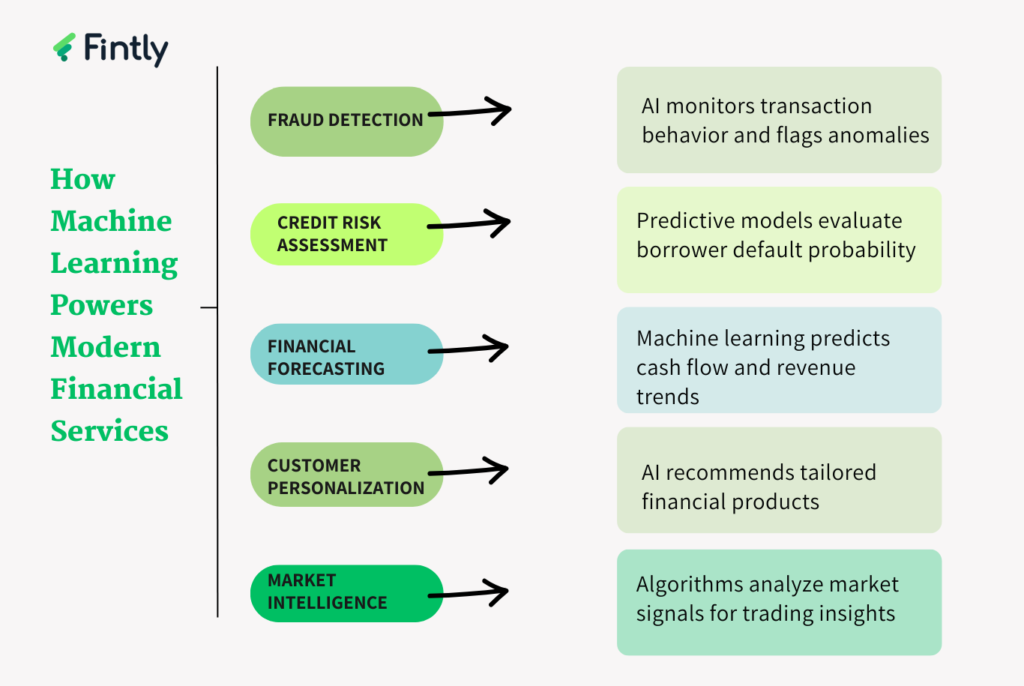
| Use Case | How Machine Learning Helps | Business Impact |
| Fraud Detection | Detects suspicious transactions using anomaly detection and behavioral patterns | Prevents financial losses and improves security |
| Credit Risk Assessment | Evaluates borrower risk using alternative data and predictive models | Enables more accurate lending decisions |
| Algorithmic Trading | Analyzes market signals to optimize trade execution strategies | Improves investment performance |
| Customer Personalization | Analyzes customer behavior to recommend financial products | Enhances customer engagement |
| Financial Forecasting | Uses predictive analytics to forecast revenue, cash flow, and risk trends | Supports strategic financial planning |
These applications show how machine learning enables data-driven financial decision making at scale.
Fraud Detection with AI
Fraud detection is one of the most critical applications of AI in fintech.
Traditional fraud detection systems rely heavily on predefined rules such as transaction thresholds or location checks. However, fraudsters continuously adapt their tactics, making rule-based systems less effective over time.
Machine learning changes this by identifying behavioral anomalies rather than fixed rule violations.
Machine learning fraud detection systems can:
- Analyze millions of transactions in real time
- Identify unusual transaction behavior
- Detect previously unseen fraud patterns
- Reduce false positives in fraud alerts
Because machine learning models continuously learn from transaction data, they can detect evolving fraud schemes faster than traditional systems.
This is particularly important for payment platforms, digital banks, and lending institutions where fraud detection must happen within milliseconds of a transaction.
Predictive Analytics Is Reshaping Financial Decision-Making
Predictive analytics powered by machine learning enables financial institutions to move from reactive decision-making to proactive strategy.
Instead of analyzing past financial reports alone, predictive models evaluate patterns in financial data to estimate future outcomes such as loan defaults, market movements, or revenue changes.
Common predictive analytics applications in finance include:
- Loan default prediction
- Customer churn prediction
- Cash flow forecasting
- Market risk modeling
- Investment portfolio optimization
This capability allows financial institutions to make faster and more accurate decisions, improving both profitability and risk management.
Benefits of Machine Learning in Financial Services
As machine learning adoption grows, financial institutions are experiencing measurable operational and strategic advantages.
- Faster Financial Analysis
Machine learning models process vast datasets instantly, eliminating manual analysis delays.
- Improved Risk Management
Predictive models help identify credit risk, market volatility, and operational threats earlier.
- Enhanced Fraud Prevention
AI-driven systems detect suspicious activities in real time.
- Better Customer Experiences
Personalized financial recommendations improve engagement and retention.
- Operational Efficiency
Automation reduces manual workflows across compliance, underwriting, and reporting.
Together, these capabilities enable financial institutions to operate with greater speed, accuracy, and resilience.
Challenges of Implementing Machine Learning in Finance
Despite its benefits, deploying machine learning in financial services comes with challenges.
Data Quality and Governance
Machine learning models rely on clean, structured data. Poor data quality can lead to inaccurate predictions.
Model Transparency
Some AI systems operate as “black boxes,” making it difficult for regulators to understand how decisions are made.
Regulatory Compliance
Financial institutions must ensure machine learning systems comply with evolving regulatory frameworks.
Integration with Legacy Systems
Many banks still operate on legacy infrastructure that may not easily integrate with AI-driven technologies.
Addressing these challenges requires strong data governance, explainable AI models, and robust compliance frameworks.
The Future of Machine Learning in Financial Services
Machine learning will continue to reshape financial services over the next decade.
We are already seeing rapid adoption of:
- AI-powered financial monitoring
- Real-time risk intelligence
- Automated compliance monitoring
- Intelligent lending platforms
- AI-driven financial forecasting
As financial ecosystems become increasingly digital, the institutions that effectively integrate machine learning and predictive analytics will gain a significant competitive advantage.
Conclusion
Machine learning is no longer a futuristic capability in financial services — it is quickly becoming a foundational technology powering modern financial decision-making.
From fraud detection with AI to predictive financial forecasting, machine learning enables financial institutions to process massive datasets, uncover hidden patterns, and make faster, more accurate decisions. As financial ecosystems become increasingly digital, the ability to transform raw financial data into structured insights will define how efficiently lenders, fintech companies, and financial institutions operate.
Platforms like Fintly are helping financial teams bring these capabilities into everyday workflows by using AI to analyze financial documents and bank statements, convert transaction data into structured insights, and support faster, more reliable credit and risk evaluations.
As machine learning adoption continues to grow across fintech, institutions that combine intelligent analytics with automated financial data processing will be better positioned to scale decision-making while maintaining accuracy and compliance.
👉 Explore how Fintly’s AI-powered financial analysis helps transform raw financial data into actionable insights for smarter financial decisions.
Author

Subject Matter Experts (Lending) Fintly.co
Vijay Mali is a results-driven professional with deep expertise in HFC/NBFC startups, compliance, and underwriting. He specializes in delivering end-to-end solutions for financial institutions, focusing on Business Rule Engines (BRE), workflow automation, and AI-driven credit decision-making. He is passionate about leveraging Machine Learning (ML) scorecards and AI-powered risk assessment to optimize lending processes and drive digital transformation in the financial sector.
