Summary
Financial statements are central to credit decisions, risk evaluation, and business performance analysis. Yet in many organizations, the process of analyzing financial data is still fragmented. Teams download statements, extract data manually, move figures between spreadsheets, and verify outputs across multiple systems.
This fragmented approach slows down decision-making and introduces operational risk.
Modern financial statement analysis tools promise faster insights and better accuracy. However, these tools only create meaningful value when they are properly integrated into existing workflows.
For lenders, banks, and credit teams, integration ensures that financial insights flow directly into underwriting systems, risk reviews, and operational decision-making processes. When implemented correctly, integrating financial analysis tools for lenders enables stronger financial automation, faster analysis cycles, and more consistent lending decisions.

Why Integration Matters
Many organizations adopt analysis software expecting instant efficiency gains. However, when these tools operate in isolation, the underlying workflow problems remain unchanged.
In lending and financial services environments, financial statement analysis connects with multiple operational systems. These include loan origination platforms, underwriting dashboards, risk assessment tools, and document management systems.
If analysis outputs remain locked within a standalone tool, analysts must still manually export, verify, and re-enter information into downstream systems.
Integration addresses this challenge by ensuring that structured financial insights can move seamlessly across business workflows.
When financial statement analysis tools integrate with lending systems, they allow organizations to:
- Standardize howfinancial data is interpreted across teams
- Reduce manual data entry and spreadsheet reconciliation
- Ensure financial insights are available during credit decisions
- Improve auditability and regulatory transparency
This approach turns financial analysis into an operational capability rather than a separate reporting activity. It is particularly important in financial statement analysis for banks, where accurate financial insights directly influence credit approvals, risk assessments, and regulatory compliance.
For lenders especially, integrated tools help ensure that borrower financial data can support both underwriting and ongoing monitoring without requiring duplicate work.
What Financial Statement Analysis Tools Need to Connect With
Before implementing any technology integration, organizations must first understand where financial analysis fits within their operational processes.
Financial analysis rarely exists as a standalone task. Instead, it supports multiple stages of the lending lifecycle.
In most lending businesses, financial analysis tools should integrate with the following areas.
Document intake systems
Borrower financial statements should flow directly from document collection channels into the analysis platform. This eliminates repeated uploads and reduces administrative overhead. Many lenders now automate bank statement analysis to ensure financial data is extracted and structured immediately after documents are submitted.
Underwriting and credit review systems
Once statements are analyzed, the resulting financial insights must be accessible to credit analysts. Structured outputs such as cash flow indicators, debt ratios, and income stability metrics should feed directly into underwriting workflows.
Risk monitoring and portfolio management
Financial analysis should not end once a loan is approved. Integrated tools allow lenders to track borrower performance over time and monitor financial risk signals across their portfolios.
Operational dashboards
Managers and compliance teams often require consolidated views of financial insights. Integration allows organizations to surface key metrics across internal dashboards without manual reporting.
These connections enable lenders to build a more cohesive financial decision infrastructure supported by lending software ecosystems rather than isolated tools.
Key Integration Steps
Successfully integrating financial statement analysis tools requires both technical and operational planning.
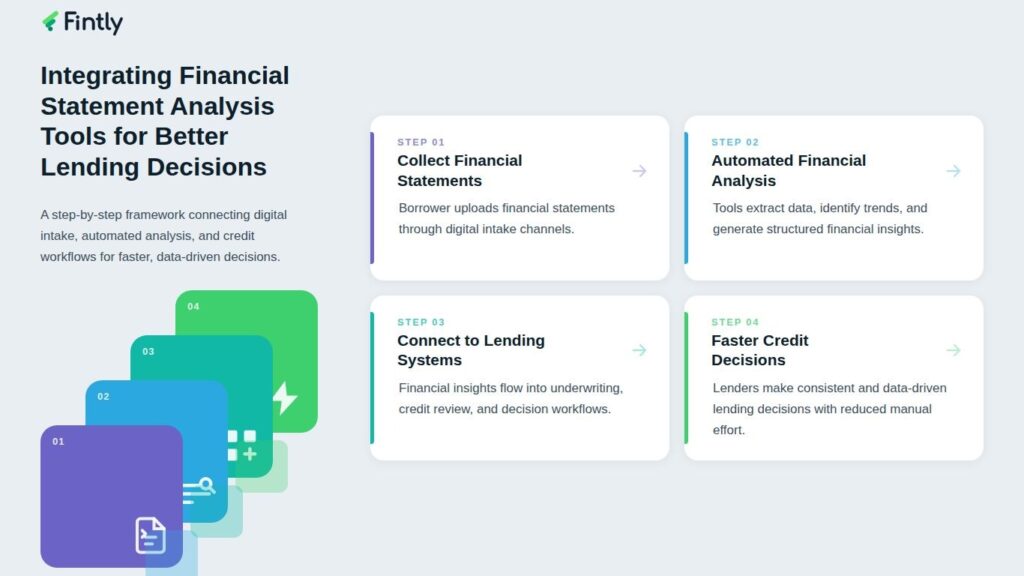
Step 1: Map the existing workflow
Organizations should begin by documenting how financial statements move through the business today. This includes document collection, financial analysis, underwriting review, and approval processes.
Understanding the current workflow helps identify where integration can reduce friction.
Step 2: Identify required outputs
Different teams require different financial insights.
Credit analysts may focus on cash flow patterns, leverage ratios, and repayment capacity. Risk teams may prioritize anomalies and financial inconsistencies.
Clearly defining these outputs ensures that integrated tools deliver information that supports real business decisions.
Step 3: Prioritize high-impact integrations
Rather than integrating every system at once, businesses should start with connections that affect lending efficiency the most.
Typically, the most valuable integrations connect financial analysis with document intake and underwriting systems.
This is where financial automation becomes practical by removing repetitive tasks that slow down credit decisions.
Step 4: Standardize decision frameworks
Integration alone does not guarantee consistency. Organizations should define standardized interpretation guidelines for financial outputs.
For example, teams should align on thresholds for income volatility, leverage ratios, or risk indicators.
This ensures that integrated tools support consistent lending decisions across analysts and teams.
Step 5: Test integration scenarios
Before full deployment, businesses should test the integrated workflow using real borrower cases.
Testing should include edge cases such as incomplete financial statements, irregular income patterns, or multiple account relationships.
These tests help identify workflow gaps and ensure the system functions effectively under real operational conditions.
Financial leaders have long emphasized the importance of interpreting financial data within operational contexts.
| “Accounting is the language of business.” — Warren Buffett, Berkshire Hathaway shareholder letters |
This principle highlights why integration matters. Financial data only becomes meaningful when it can be interpreted and applied within business decisions.
Financial statement analysis tools support this process by converting raw financial records into actionable insights.
But those insights must flow into operational systems where decisions are made.
Common Pitfalls
While integration can deliver significant operational benefits, many organizations encounter challenges during implementation.
Treating integration as purely technical
Financial statement analysis affects multiple teams including credit analysts, operations staff, and compliance managers. Successful integration requires collaboration across these groups, not only IT involvement.
Automating inefficient workflows
Some organizations implement automation without first simplifying their processes. This can result in faster but still inefficient workflows.
Ignoring exception handling
Borrower financial statements are rarely perfectly structured. Systems must be designed to manage incomplete records, anomalies, and unusual financial patterns.
Lack of process ownership
Without clear ownership, integrations can become difficult to maintain. Business rules evolve over time, and systems must adapt accordingly.
Overlooking user adoption
Even well-designed integrations fail if analysts continue using manual workarounds. Training and clear workflow documentation are critical for adoption.
Understanding these pitfalls allows organizations to implement financial analysis integrations more effectively.
| Did you know? |
|---|
| Financial institutions that adopt automated financial analysis workflows can reduce financial statement review times by up to 60–70%, allowing credit teams to focus more on decision-making and risk evaluation. |
How Fintly Supports Integrated Financial Analysis
For lenders, the goal of financial analysis is not simply generating reports. It is enabling faster and more reliable credit decisions.
Fintly addresses this challenge by connecting financial analysis capabilities with broader lending workflows.
Instead of operating as an isolated analysis tool, platforms like Fintly help integrate financial insights with underwriting processes, operational dashboards, and credit monitoring systems.
By supporting financial automation and lending workflow integration, lenders can ensure that financial insights move directly into decision-making environments.
This approach allows financial institutions to build scalable credit operations without relying on fragmented manual processes.
👉 Explore how Fintly enables intelligent financial workflows for modern lending teams.
 QUICK ANSWERS
Frequently Asked Questions (FAQs)
Your most common questions, answered with precision and insight
Financial statement analysis tools are software solutions that analyze financial records to generate insights about cash flow, profitability, leverage, and financial risk.
Integration allows financial insights to move directly into operational systems such as underwriting platforms, improving efficiency and decision accuracy.
They should typically integrate with document intake systems, underwriting platforms, risk monitoring tools, and operational dashboards.
They reduce manual data entry, improve consistency across analysts, and accelerate credit decision timelines.
No. These tools are also valuable for financial analysts, accounting teams, and business leaders who need structured insights from financial data.

Author
Subject Matter Expert (Lending) Fintly.co
Vijay Mali is a results-driven professional with deep expertise in HFC/NBFC startups, compliance, and underwriting. He specializes in delivering end-to-end solutions for financial institutions, focusing on Business Rule Engines (BRE), workflow automation, and AI-driven credit decision-making. He is passionate about leveraging Machine Learning (ML) scorecards and AI-powered risk assessment to optimize lending processes and drive digital transformation in the financial sector.