Summary:
Traditional fraud systems are failing, resulting in billions in losses and high false positives. You need a smarter approach. Anomaly detection machine learning is the critical solution, shifting defense from reactive blocking to proactive identification. By understanding baseline “normal” behavior, AI fraud detection flags subtle deviations in real-time. This guide details how advanced ML models operate within modern fraud analytics, showcasing real-world examples of businesses protecting revenue and customers with scalable, intelligent defense.
Global payment fraud losses are projected to exceed $40 billion by 2027. If you are relying solely on traditional, manual rule sets to catch bad actors, you are already behind.
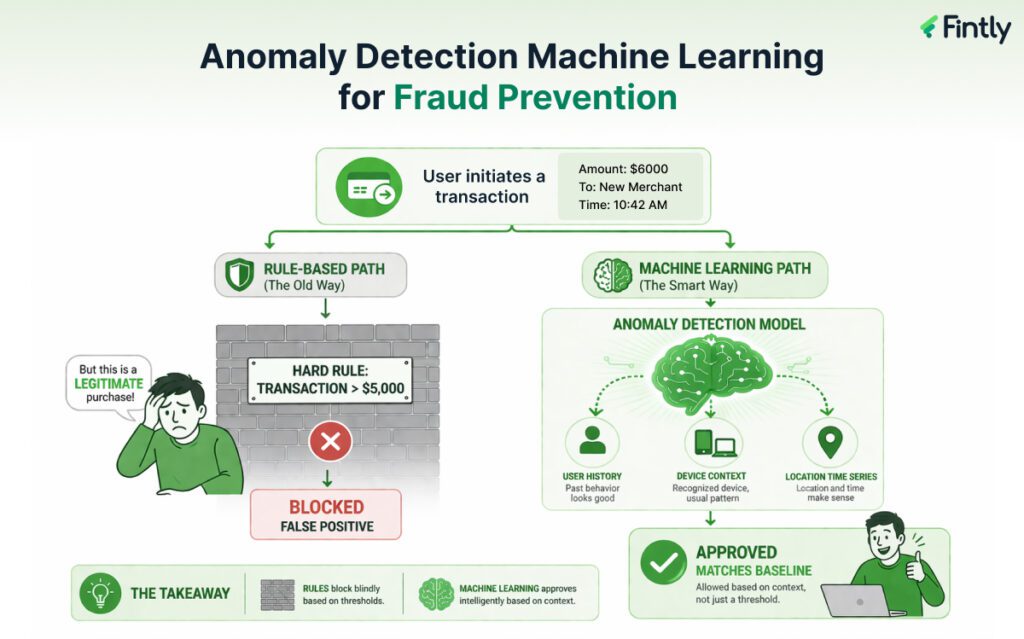
Traditional rule-based systems are currently drowning in false positives. They block legitimate customers making unusual purchases while sophisticated criminals, who know exactly how to bypass static rules, slip through unnoticed. To catch modern fraud, you need systems that learn what “normal” looks like and react instantly when something deviates.
In this guide, you will learn exactly how anomaly detection machine learning works, the specific algorithms used in modern fraud analytics, and how leading companies deploy these AI models to protect their revenue and their customers.

What Is Anomaly Detection?
Anomaly detection in machine learning is the process of automatically identifying data points, events, or observations that deviate significantly from a dataset’s normal behavior.
Instead of trying to write a specific rule for every possible type of fraud (which is impossible, as fraud tactics change daily), you train an AI model on historical data. The model learns the baseline of legitimate, everyday activity. Anything that falls outside that baseline is flagged as an anomaly or an outlier.
Think of it like a bank teller who knows their regular customers perfectly. If a stranger walks in wearing a disguise and asks to withdraw a massive sum from a regular’s account, the teller immediately spots the anomaly. Machine learning does this, but across millions of transactions a second.
The Financial Reality of Fraud
Why are financial institutions and fintechs rushing toward AI fraud detection? The numbers tell the story.
- The Multiplier Effect: According to LexisNexis Risk Solutions, every $1 of fraud costs U.S. financial services firms $4.23.
What this means for you: Fraud isn’t just the lost transaction amount. This multiplier accounts for chargeback fees, legal expenses, investigation labor, and the ultimate cost of customer churn.
- The Revenue Drain: A global study by the Association of Certified Fraud Examiners (ACFE) estimates that organizations lose 5% of their revenue to fraud each year.
What this means for you: For a mid-sized company generating $50 million, that is $2.5 million wiped out annually. Implementing smarter anomaly detection directly recovers that lost margin.
Anomaly Detection Machine Learning Algorithms
When data science teams build these defenses, they rely on a mix of approaches. For baseline implementations, engineers often start with robust libraries like scikit learn outlier detection.
One of the most popular algorithms here is the Isolation Forest. Instead of profiling normal behavior, an Isolation Forest works by actively trying to isolate anomalies. Because anomalies are few and different, it takes fewer steps for the algorithm to separate them from the rest of the data.
Integrating these predictive models into your daily operations doesn’t have to mean building infrastructure from scratch. Deploying Fintly’s machine learning scoring engine allows businesses to ingest data, run these complex algorithms in real-time, and generate immediate risk scores on live transactions.
Handling Complexity: Time Series and Deep Learning
Fraudsters rarely attack with a single, massive transaction. They test the waters. To catch them, you need advanced techniques.
Multivariate time series anomaly detection involves tracking multiple different variables as they change over time. For example, the model simultaneously watches a user’s login location, typing speed, transaction frequency, and device ID. If a user logs in from a new IP address, changes their password, and immediately initiates three rapid transfers, the model flags the temporal anomaly. It’s the combination of events over time, not just one bad data point, that triggers the alarm.
When datasets become incredibly massive and complex, teams use anomaly detection with deep learning. This involves neural networks, specifically architectures called Autoencoders. An Autoencoder takes a transaction, compresses it into a tiny summary, and then tries to reconstruct the original transaction from that summary. If the system fails to reconstruct it accurately, it means the transaction contained strange, unfamiliar patterns. It’s an anomaly.
This deep, multi-layered approach highlights exactly how AI decision-making software is revolutionizing business risk management, moving organizations from reactive blocking to proactive defense.
Real-World Examples: Catching the Invisible
Case Study: Mastercard’s Decision Intelligence
To understand the impact of ML models in use, look at Mastercard. A few years ago, they implemented an AI-driven framework called Decision Intelligence. Rather than relying on rigid rules, their machine learning models evaluate thousands of data points per transaction in real-time, including customer value, location, time, and merchant data.
Apart from fraud prevention, the primary goal was to reduce “false declines.” A false decline happens when a legitimate customer’s card is wrongly blocked, which often causes them to abandon the card entirely. By using anomaly detection to understand the highly specific “normal” behavior of individual cardholders, Mastercard drastically reduced false declines while maintaining high fraud-catch rates. They shifted from asking “Does this look like fraud?” to “Does this look like the actual customer?”
Machine Learning vs. Traditional Rules
While machine learning is powerful, it rarely exists in a vacuum. Often, no-code business rules management system acts as the first line of defense to enforce strict compliance laws, while the machine learning models handle the nuanced behavioral analysis.
Here is how the two approaches compare:
| Feature | Rule-Based Systems | ML Anomaly Detection |
| Setup & Maintenance | Manual, requires constant updating by human analysts. | Automated learning; adapts to new data over time. |
| Detecting Unknown Fraud | Fails. Only catches what you explicitly tell it to look for. | Succeeds. Flags anything outside of established normal behavior. |
| False Positive Rate | High. Rigid thresholds often block legitimate users. | Low. Context-aware scoring accurately identifies real customers. |
| Scalability | Poor. Too many rules create system latency and conflicts. | Excellent. Easily processes millions of varied data points instantly. |
Conclusion
Anomaly detection machine learning has shifted fraud prevention from a guessing game to an exact science. By establishing a baseline of normal behavior, these algorithms catch sophisticated financial crimes that static rules miss, while ensuring your actual customers aren’t punished with false declines.
Upgrading your risk architecture doesn’t require a massive internal engineering overhaul. If you are ready to reduce your false positives and automate your complex risk decisions, Fintly can help.
Contact us and explore how we can integrate our ML scoring engine into your current workflows.
 QUICK ANSWERS
Frequently Asked Questions (FAQs)
Your most common questions, answered with precision and insight
It is a technique used by AI models to identify data points that deviate significantly from a dataset’s normal, expected behavior. In finance, these “outliers” are usually indicators of fraudulent activity.
Deep learning uses neural networks, like Autoencoders, to process massive datasets. The network learns the incredibly complex, hidden patterns of legitimate transactions, allowing it to instantly flag highly sophisticated fraud that simpler algorithms might miss.
Common models include Isolation Forests, One-Class Support Vector Machines (SVMs), and Autoencoders. Teams often use libraries like scikit-learn to deploy these outlier detection algorithms efficiently.
This is a method that looks at multiple different variables changing simultaneously over a period of time. Instead of just looking at the size of a single transaction, it analyzes the sequence of events, like login time, location, and click speed to spot temporal fraud patterns.
Fraudsters constantly change their tactics to bypass known rules. Machine learning adapts automatically by learning what normal customer behavior looks like, meaning it can catch entirely new types of fraud without needing a human to write a new rule first.

Author
Subject Matter Expert (Lending) Fintly.co
Vijay Mali is a results-driven professional with deep expertise in HFC/NBFC startups, compliance, and underwriting. He specializes in delivering end-to-end solutions for financial institutions, focusing on Business Rule Engines (BRE), workflow automation, and AI-driven credit decision-making. He is passionate about leveraging Machine Learning (ML) scorecards and AI-powered risk assessment to optimize lending processes and drive digital transformation in the financial sector.