According to McKinsey, AI-driven decisioning can help banks improve efficiency, automate routine decisions, and strengthen risk management capabilities when deployed at scale.
While the benefits are clear, many financial institutions find it difficult to put them into practice because business policies are often embedded directly within application code. As a result, even minor changes, whether it’s updating a lending policy, adjusting a fraud detection threshold, or responding to new regulatory requirements can trigger a lengthy development cycle. Teams must modify the code, conduct extensive testing, and redeploy applications, slowing down the organization’s ability to adapt to changing business and compliance needs.
This is where a business rule engine becomes valuable.
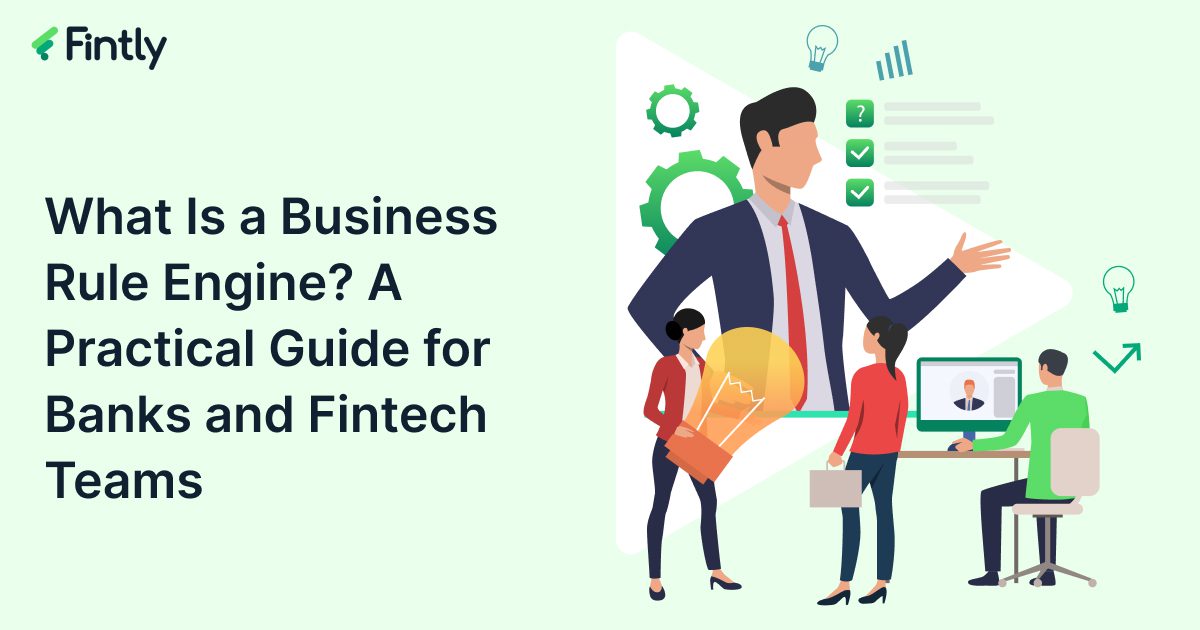
A business rule engine (BRE) is software that separates decision logic from application code, allowing organizations to create, manage, and update business rules without rebuilding entire systems.
For banks and fintech companies, a business rule engine helps automate approvals, risk assessments, fraud checks, and compliance workflows while maintaining consistency and auditability.
Why Does a Business Rule Engine Matter in Banking?
A bank processes thousands of decisions every day. For example, should a loan application be approved? Is a transaction potentially fraudulent? Does a customer meet eligibility criteria? Which compliance checks must be completed? Or, should an application be routed for manual review?
Without a business rule engine, these decisions are often embedded directly inside application code. That directly results in:
- Slow policy updates
- High IT dependency
- Inconsistent decisions
- Greater compliance risk
- Longer product release cycles
A modern BRE platform enables business teams and technical teams to manage rules centrally while ensuring every decision follows approved policy.
On the contrary, banks operating with hardcoded rules often face delayed response to regulatory changes, increased operational risk, manual review bottlenecks, higher maintenance costs, and reduced customer experience.
When lending policies change weekly or compliance requirements change unexpectedly, agility becomes a competitive advantage.

What Is a Business Rule Engine in Banking?
Let’s learn the basics first. A business rule engine is a software component that evaluates predefined rules and produces a decision automatically. It is like a digital decision-maker that follows business policies consistently.
For example, if credit score > 750 and debt-to-income ratio < 35%, the rule is to approve application. Hence, the system automatically approves qualifying applications without human intervention.
Instead of developers rewriting software whenever policies change, teams simply update the rules inside the BRE platform.
What Are the Key Components of a BRE Platform?
Refer to the table below for a clear picture.
Workflow IntegrationConnects rules to applications
| Component | Purpose |
| Rule Repository | Stores business rules |
| Decision Engine | Executes rules |
| Audit Trails | Tracks decisions and changes |
| Rule Authoring Tools | Allows updates without code |
This structure makes rule-based automation significantly easier to manage at scale.
Did You Know?IBM describes business rules management systems as platforms that allow organizations to define, deploy, manage, and automate business decisions consistently across the enterprise, which is why banks heavily invest in a business rule engine. |
BRE Examples in Lending, Fraud Detection, and Compliance
1. Loan Approval Automation
One of the most common BRE examples is lending. Rules might include:
- Minimum credit score
- Employment history requirements
- Loan-to-income thresholds
- Product eligibility rules
The business rule engine for lending automatically evaluates these conditions in seconds.
So, the business rule engine benefits include faster approvals, reduced manual reviews, and consistent underwriting.
To give you a live example, a bank decides to increase its minimum credit score requirement from 700 to 720. Instead of modifying application code, the risk team updates a single rule in the BRE, and the revised policy is immediately applied across all new loan applications.
2. Fraud Detection
A business rule engine for fraud detection can monitor transactions in real time.
Example rules:
- Transaction exceeds threshold
- Unusual geographic location
- Multiple failed login attempts
When triggered, the system can block activity, request verification, and escalate for investigation.
3. Compliance Management
Regulatory requirements change frequently. A business rule engine compliance management framework helps institutions update rules without large-scale development projects.
Examples include:
- KYC checks
- AML screening
- Risk classification
- Documentation requirements
4. Customer Onboarding
Banks use decision automation to determine:
- Identity verification status
- Product eligibility
- Risk categories
This reduces onboarding delays while improving customer experience.
Why Decision Automation Is Becoming Critical?
McKinsey estimates AI technologies could generate up to $1 trillion in additional value annually for the global banking industry, largely through smarter decision-making and automation capabilities.
The key lesson isn’t simply to use AI. It’s that intelligent decisions must be operationalized.
A business rule engine provides the governance layer that helps organizations apply policies consistently while supporting scalable decision automation.
How to Choose the Right BRE Platform?
Not every BRE platform is built for modern banking requirements. Let’s see how you can choose the right platform for your organization.
Look for Rule Transparency
Business users should understand the reason for the decision, the rules applied, and the changes between versions before choosing a BRE platform.
Prioritize Auditability
Financial institutions need more than just automated decisions. They need complete visibility and control over how those decisions are made. This requires rule version control to track policy changes, approval workflows to govern updates before they go live, and historical records that provide a clear audit history for regulatory reviews and internal oversight.
Evaluate Performance
Decision latency matters. In banking and fintech, even a small delay can impact customer experience, slow approvals, and create operational bottlenecks. The best business rule engine solutions evaluate rules and deliver decisions in real time, ensuring applications, transactions, and workflows move forward without unnecessary friction.
Look for AI & ML Integration
Choose a BRE that integrates with ML scoring models, fraud detection systems, and alternative data sources so predictive insights and business rules work together within a unified decisioning process.
Ensure Integration Flexibility
A modern platform should connect with:
- Core banking systems
- Lending platforms
- Fraud systems
- Data warehouses
- AI models
Consider Scalability
Today’s fintech might process thousands of decisions. Tomorrow it may process millions. The platform must scale accordingly.
Can’t Enterprises Just Hardcode the Rules?
Technically, yes. Many institutions begin by embedding rules directly into applications. However, this approach creates problems over time. When compliance policies change or lending criteria evolve, developers must:
- Find the relevant logic
- Modify code
- Test applications
- Deploy updates
This slows innovation. A dedicated business rule engine separates decision logic from the application itself, making changes faster, safer, and more transparent. That doesn’t mean a BRE is perfect.
Remember, implementation may require:
- Initial rule discovery
- Governance processes
- Team training
- Integration planning
But for organizations managing hundreds or thousands of business rules, the long-term benefits typically outweigh the upfront effort.
To give you a live example, Renny Thomas of McKinsey notes that banks increasingly need AI-powered decisioning capabilities that help automate decisions, lower operating costs, reduce risk, and improve customer engagement at scale. This reflects a broader shift happening across financial services:
- Decision-making is no longer just a business process.
- It is a competitive capability.
As lending, fraud prevention, and compliance become more complex, financial institutions need systems capable of making fast, consistent, and explainable decisions.
How Fintly Supports Intelligent Decision Automation
Fintly’s business rule engine empowers financial institutions to design and manage decision rules through an intuitive no-code interface.
It integrates smoothly with databases, REST APIs, queues, and webhooks via idempotent endpoints that ensure data consistency across systems, provide comprehensive audit trails, and enable rapid policy updates without requiring changes to application code.
Instead of forcing teams to deal with fragmented systems, Fintly helps combine automation, intelligence, and security into a unified experience designed for modern financial organizations.
Conclusion
A business rule engine is no longer just a technical tool. It’s a strategic capability for banks and fintech companies that need faster decisions, stronger compliance, and scalable operations.
Whether you are automating lending approvals, strengthening fraud controls, or improving compliance workflows, the right business rule engine creates a foundation for smarter decision-making.
As financial organizations continue modernizing their operations, solutions like Fintly make it easier to turn complex business rules into secure, intelligent, and scalable outcomes.

QUICK ANSWERS
Frequently Asked Questions (FAQs)
Your most common questions, answered with precision and insight
A business rule engine in banking is software that automatically evaluates predefined business rules and generates decisions such as loan approvals, fraud alerts, compliance checks, and customer eligibility assessments. It helps ensure consistency, speed, and auditability.
A BRE works by receiving input data, evaluating business rules, executing the appropriate action, and recording the decision. This process enables automated decision-making across banking and fintech workflows.
Common BRE examples include loan approval automation, fraud detection, AML screening, KYC verification, customer onboarding, credit risk assessment, and compliance monitoring.
A business rule engine for lending helps banks apply underwriting policies consistently, speed up approvals, reduce manual reviews, and quickly adapt to policy changes without extensive software development.
Yes. A business rule engine compliance management framework helps organizations automate regulatory checks, enforce policy updates, maintain audit trails, and reduce the risk of inconsistent decisions.
Key capabilities include auditability, scalability, rule transparency, integration flexibility, governance controls, real-time decision processing, and ease of updating business rules.

Author
Subject Matter Expert (Lending) Fintly.co
Vijay Mali is a results-driven professional with deep expertise in HFC/NBFC startups, compliance, and underwriting. He specializes in delivering end-to-end solutions for financial institutions, focusing on Business Rule Engines (BRE), workflow automation, and AI-driven credit decision-making. He is passionate about leveraging Machine Learning (ML) scorecards and AI-powered risk assessment to optimize lending processes and drive digital transformation in the financial sector.