
Summary
Early Warning Services transforms risk management from delayed reporting to real-time intelligence. They monitor transactions and behaviors continuously to detect risks as they form. Unlike traditional systems, they rely on predictive analytics instead of fixed rules and thresholds. This enables finance, procurement, and compliance teams to act faster and prevent issues before they escalate.
Imagine detecting financial and operational risks the moment they start forming.
This concept is transforming the way risks are managed in organizations today. Early Warning system brings this about by emphasizing monitoring in real time rather than in slow reviews. Teams can easily identify issues as they emerge in systems and transactions.
Conventional risk management systems involve reviews and outdated reports. These systems are based on old information and late notifications, which are not effective in today’s fast-paced digital environment. Managing risks using Early Warning Services bring a new approach by enabling continuous monitoring of transactions and systems. This moves risk handling from reporting to decision-making.
In this blog, we will examine how new technology for monitoring is eliminating reactive risk controls in favor of new insights. We will also explore why organizations are opting for improved systems that prevent risks from worsening.
| “The Early Warning Exercise brings together diverse analytical tools not only to identify vulnerabilities but also to understand how risks can translate into wider systemic impacts, enabling decision-makers to act before issues cascade.”
— Takatoshi Kato, Deputy Managing Director, International Monetary Fund |
Why Traditional Risk Systems Struggle in Modern Environments
The traditional method has fixed rules and only alerts teams after issues have happened. This might cause late discoveries. Teams such as finance, procurement, and compliance usually operate independently, making it difficult to identify risks that cross several teams.
With increasing connectivity in businesses, independent systems fail to display the whole picture. Teams require data from all areas to understand how risks are increasing in other areas. This highlights the need for predictive risk analytics tools rather than tools that only offer late alerts.
Understanding the Core of Early Warning Services
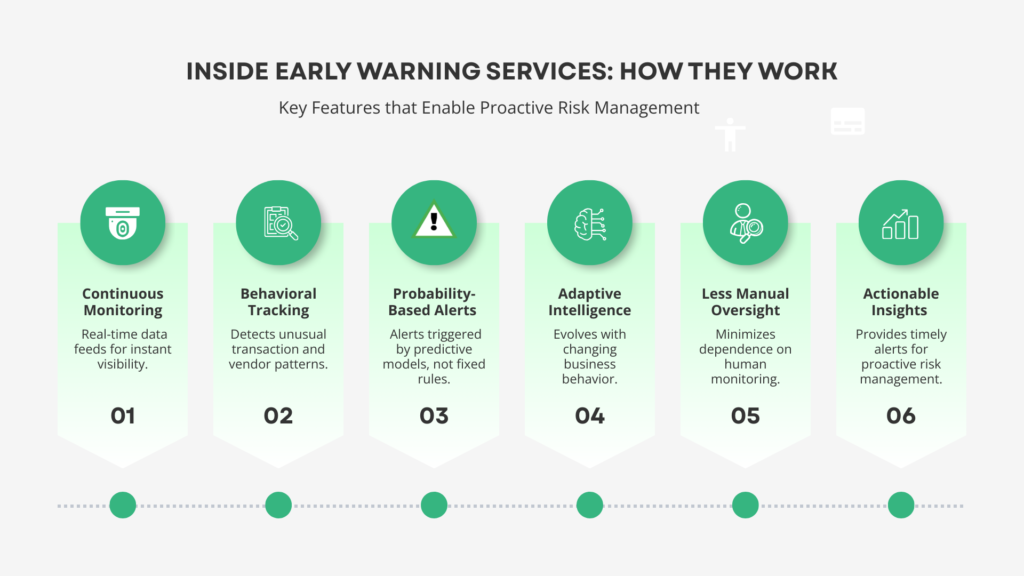
Early Warning System relies on continuous data feeds and not batch processing. They track behavioral trends and transactions in real-time. Notifications are triggered based on probability models, not just thresholds. This ensures that monitoring is adaptive and intelligent.
The intelligent monitoring system ensures that risk detection is dynamic and keeps changing with business behavior. There is less reliance on human monitoring and rule-based thresholds. Businesses get value from notifications provided by Early Warning Services.
How Predictive Risk Analytics Changes Decision Making
Predictive risk analytics assist organizations in identifying potential risks before they turn into major problems. By analyzing historical trends and real-time information, predictive risk analytics can identify potential risks that could go unnoticed. For instance, unexpected changes in payments to suppliers or unusual transactions in accounts can trigger alerts, allowing teams to investigate immediately.
Real-time Risk Monitoring enables finance, compliance, and operations teams to make more informed decisions. Rather than waiting to address risks after they occur, organizations can prepare for and manage risks in advance. Over time, risk analytics also assist in prioritizing high-risk areas, optimizing resource utilization, and reducing manual reviews, which enhances risk management.
| Did you know? |
|---|
| Did you know that companies using predictive analytics see fraud detection accuracy improve by up to 60% compared with traditional rule‑based systems? This is because advanced analytics models recognize complex patterns that static systems often miss. |
Comparing Early Warning Services vs Traditional Risk Systems
Knowing the difference between old methods and new monitoring systems is important for organizations that want to improve their financial risk management. Traditional tools look at past data and use set rules for alerts, while Early Warning Services use smart monitoring to spot problems as they happen.
| Aspect | Traditional Risk Systems | Early Warning Services |
| Data Processing | Periodic and batch-based | Continuous and real-time |
| Alerts | Threshold-based | Pattern and behavior-based |
| Risk View | Historical | Predictive and dynamic |
| Integration | Siloed systems | Connected ecosystem |
| Response Time | Delayed | Immediate |
| Intelligence | Rule-driven | Analytics-driven |
This comparison shows why Early Warning Services vs traditional risk systems represent a strategic shift in risk intelligence.
The Role of Monitoring in Fraud and Compliance
Fraud patterns are constantly evolving, and traditional systems are often not equipped to handle the pace. Organizations can monitor transactions, vendor activity, and other key events in real-time through Early Warning Services. This allows organizations to identify unusual payment speeds, unusual account behavior, or unusual vendor activity early on, before issues escalate.
This approach enhances controls without increasing workload. Everyone is no longer required to conduct manual reviews or checks. Teams can rapidly respond to notifications from Early Warning System, making better decisions and acting faster to manage risks in finance, procurement, and compliance teams.
| Did you know? |
|---|
| Did you know the global risk management and fraud detection market generated over USD 3.28 billion in revenue in 2024 and is expected to grow at a 27.1% CAGR by 2030, driven by demand for smarter, real-time systems?. |
Research Insights Driving Adoption of Early Warning Services
Research shows strong gains when organizations adopt Early Warning Services supported by modern analytics.
- Faster detection reduces losses: Continuous monitoring identifies fraud and anomalies early.
- Predictive alerts reduce false positives: Behavior models outperform static thresholds.
- Integrated data improves response time: Connected systems enable quicker action across teams.
- Lower compliance burden: Instant alerts keep teams audit ready.
- Higher operational efficiency: Automation reduces time spent on repetitive reviews.
This evidence indicates a growing preference for intelligent risk frameworks.
Use Cases Where Early Warning Services Deliver Immediate Value
Organizations apply Early Warning Services across finance and procurement to prevent risks in motion.
- Vendor monitoring: Flags unusual payment or invoice behavior early.
- Financial activity analysis: Detects inconsistencies without waiting for audits.
- Procurement oversight: Identifies abnormal spending and duplicate payments instantly.
- Fraud detection: Tracks transaction patterns before losses occur.
- Compliance alerts: Identifies gaps early.
- Cross-team visibility: Unified dashboards support faster coordinated action.
These use cases show how proactive detection improves everyday operations and enables multiple departments to respond in real time.
The Business Impact of Moving Beyond Traditional Risk Systems
Early Warning Systems assist teams in making quicker decisions and acting faster. Keeping a pulse on things helps address issues as they arise, rather than waiting for the review cycle.
Companies receive faster assistance and better mitigation of financial and supplier risks. This proactive approach reduces losses and improves company policies. Over time, teams shift from reactive incident handling to real-time risk monitoring.
How Fintly Enables Intelligent Risk Visibility
Fintly Integrates financial data and resources for Early Warning Services. Fintly’s Early Warning Services system enables teams to view transactions and vendor activity easily, which helps them identify potential issues early.
Fintly enables the connection of various data, making it easier for different departments to collaborate better. Departments no longer need to perform manual verification and can quickly analyze data to identify unusual patterns early, which enables organizations to manage things better and make informed decisions.
Transforming Risk Management for the Digital Age
Risk is always changing with new information. New systems that report late cannot adapt to the changes. Systems based on delayed reporting cannot be kept up. Early Warning Services vs traditional risk systems show why predictive intelligence is essential. Companies that apply this approach are more prepared for new risks because they monitor risks constantly.
To understand how active monitoring can help you with risk management, book a demo with fintly and look at how it assists Early Warning Services with smart data analysis.
Author

Subject Matter Experts (Lending) Fintly.co
Vijay Mali is a results-driven professional with deep expertise in HFC/NBFC startups, compliance, and underwriting. He specializes in delivering end-to-end solutions for financial institutions, focusing on Business Rule Engines (BRE), workflow automation, and AI-driven credit decision-making. He is passionate about leveraging Machine Learning (ML) scorecards and AI-powered risk assessment to optimize lending processes and drive digital transformation in the financial sector.
