
Summary
A bank statement analysis solution helps lenders gain clear visibility into a borrower’s financial behavior, validate income, and detect risks early. Modern BSA tools automate transaction review, reduce errors, and provide actionable insights. This enables financial institutions to make faster, more accurate lending decisions, minimize defaults, and enhance credit risk assessment.
Imagine approving a loan for a borrower who appears financially perfect on paper only to later find repayments slipping and cash flows inconsistent. Credit score, income proof, and static statement only show half the picture. They do not show what happens on a daily basis that truly determines repayment potential.
This is where bank statement analysis really becomes a game-changer for lenders because they get to see a real-time view of how a borrower’s income, spending habits, and financial discipline are shaping up. It reveals hidden risks and verifies all the information, thereby improving the creditworthiness of these borrowers.
In this blog, we’ll explore why bank statement analysis is important for credit management Furthermore, we will learn how lenders are using bank statement analysis to lower the rates of defaults through a step-by-step workflow to better understand how we can derive valuable insights from the bank statements.
| “At a time when financial transparency, anti-fraud or accounting justification obligations are being strengthened, it is crucial that data from bank statements be reliable, traceable and exploitable quickly.”
— Tristan Thommen, Co‑founder, Koncile |
What Is Bank Statement Analysis
Bank statement analysis is defined as an evaluation of the borrower’s past transactions to understand their past earnings, their spending habits, and their financial discipline over time. Unlike other financial instruments, bank statements give a dynamic and real-time view of the borrower’s financial life, which can reveal hidden expenditures and financial discipline better than other tools would.
This analysis improves credit risk assessment because it offers actual insights into how well a borrower can pay. This is because lenders are not relying on how the borrower says they are rather than how they are. This improves accuracy in credit analysis because it is not based on fake sources.
Role of Bank Statement Analysis in Credit Risk Evaluation
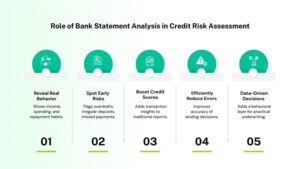
When lenders only use credit reports or scores, they might approve people who can’t pay back loans later. Looking at bank statements analysis helps show how people really manage their money. By seeing regular deposits, loan payments, spending habits, and overdrafts, lenders can spot signs of money problems early. This adds useful information that regular documents don’t show.
Mixing these insights from bank transactions with credit scores and other documents strengthens credit risk assessment. This way, they can reduce mistakes in approvals and better guess if someone will pay back their loan. This method makes sure that decisions are based on real data and are practical.
| Did you know? |
|---|
| AI‑driven bank statement analysis improved prediction accuracy for defaults by up to 25% compared to manual methods, helping lenders better identify risk and enhance credit outcomes. |
How Lenders Use It to Reduce Defaults
Bank statement analysis is used by lenders to identify the early signs of defaults in advance of lending. Indications of poor average balances, volatile income deposits, and huge withdrawals are indications of difficulties in repaying the loans. These red flags enable the lenders to sift through risky profiles prior to lending. Lenders initiate preventive actions before lending the credit.
Such a proactive approach to screening would result in better lending decisions as financially sound applicants are targeted. The transaction-based approach lowers the possibilities of defaults and non-performing assets. The system is able to offer more confidence approval. The strategy of preventing default is to understand how finance truly conducts itself.
Key Financial Indicators Extracted from Bank Statements
Bank statement analysis reveals measurable indicators like income consistency, EMI obligations, average balances, and spending behavior. These factors help create structured borrower profiles based on real financial habits rather than declarations.
| Indicator | What It Reveals | Credit Impact |
| Average Monthly Balance | Liquidity stability | High |
| Income Consistency | Repayment ability | High |
| EMI / Loan Deductions | Existing obligations | High |
| Bounced Transactions | Financial stress | Medium |
| Expense Categories | Spending discipline | Medium |
Using these indicators strengthens credit risk assessment, allowing lenders to assign risk scores, standardize underwriting, and make data-driven credit decisions consistently.
Behavioral Insights That Traditional Documents Cannot Show
Automating bank statement analysis with AI provides an accurate view of a borrower’s actual financial performance, showing how income, expenditure, savings, and commitments are managed. These patterns, often invisible in credit scores or income proofs, give lenders a clearer understanding of long-term financial discipline and repayment reliability
Key insights include:
- Balance maintenance.
- Regular savings habits
- Timely EMI and bill payments
- Discretionary spending that is controlled.
- Indications of financial strain such as overdrafts
These understandings enhance credit risk assessment by offering an enhanced insight into the reliability of repayment and financial maturity, enhancing the accuracy of underwriting and lowering the possibility of giving credit to unsound borrowers.
Step-by-Step Guide: How to Use Bank Statement Analysis in the Credit Workflow
A clear process makes bank statements analysis a regular part of lending, not just a one-time task. By adding this to the credit process, lenders can look at real spending habits along with traditional documents.
- Step 1: Collect Digital Bank Statement Securely: Get statements from applicants using safe digital methods to make sure they are real.
- Step 2: Upload Statements into an Automated Analysis Tool: Use finance technology to organize the raw data from these statements for easier review.
- Step 3: Identify Key Financial Indicators: Look for important financial details like steady income, average account balance, loan payments, and spending habits.
- Step 4: Detect Red Flags and Financial Stress: Signals Spot issues like overdrafts, failed payments, or unusual deposits that need more attention.
- Step 5: Integrate Insights into Internal Evaluation Models: Use the gathered data in scoring systems to improve lending decisions with real transaction evidence.
- Step 6: Combine with Bureau and Document Verification: Check the transaction data alongside credit reports and submitted documents for a complete view of the borrower.
Following these steps makes lending decisions based on data and more trustworthy. This process ensures that understanding real transactions is a regular part of modern credit checks and helps credit risk assessment better.
Fraud Detection and Income Verification Through Transactions
One major benefit of bank statement analysis is verifying declared income against actual deposits. It reveals undisclosed liabilities, suspicious transfers, and inconsistent credits. This protects lenders from applicants who misrepresent financial information. Transaction history acts as proof of financial authenticity.
This verification process improves credit risk assessment and reduces exposure to fraudulent applications. Lenders can confidently validate borrower claims. Authentic data leads to safer credit approvals. Fraud prevention becomes an integral part of underwriting.
| Did you know? |
|---|
| Up to 33% of borrowers materially overstate their income on loan applications, making bank statement analysis essential for verifying true financial capacity. |
How Fintly Supports Intelligent Credit Evaluation
Fintly is a tool that allows lenders to conduct complex bank statements analysis using automatic data extraction and interpretation tools. The platform transforms the complex data of transactions into structured insights to be used by the underwriting teams. This assists lenders without problems in manual assessment as they pursue data-driven assessment.
Fintly enables better underwriting through enhanced credit risk assessment. Verified transaction intelligence can be used to make reliable credit approvals by institutions. This makes it a powerful facilitator of new credit evaluation practices.
Turning Transaction Data into Confident Credit Decisions
Proper underwriting needs actual financial transparency. Bank statement analysis allows lenders to gauge the behavior of the borrowers with accuracy and confidence. It fills the gap between stated information and real financial practices. This results in higher credit approval and healthy portfolios. Explore how Fintly can enhance your credit assessment process with intelligent transactions.
| Key Takeaways |
|---|
|
Author

Subject Matter Experts (Lending) Fintly.co
Vijay Mali is a results-driven professional with deep expertise in HFC/NBFC startups, compliance, and underwriting. He specializes in delivering end-to-end solutions for financial institutions, focusing on Business Rule Engines (BRE), workflow automation, and AI-driven credit decision-making. He is passionate about leveraging Machine Learning (ML) scorecards and AI-powered risk assessment to optimize lending processes and drive digital transformation in the financial sector.
