
Summary:
AI bank statement analysis helps in automating the process of reviewing transactions, thus saving time and reducing the chances of errors. Organizations can obtain real-time analysis and identify anomalies with the help of automated financial analysis. This blog post will discuss how AI helps analyze bank statements, implementation procedures, trends, and challenges.
Financial institutions process millions of transactions daily, making manual bank statement review slow, error-prone, and expensive. Even minor mistakes can result in poor credit decisions, delayed approvals, or missed fraud.
Analysts have historically spent hours analyzing transactions, classifying income and expenses, and matching statements in different formats. This has led to delayed decision-making and increased risks. AI bank statement analysis can automate mundane tasks, enhance speed and accuracy, and automated financial analysis enables finance teams to concentrate on high-level decisions rather than manual data analysis.
In this blog, we will learn how AI helps in bank statement analysis, explore the benefits of automated financial analysis, follow a step-by-step implementation guide, and understand industry trends and overcome challenges.
| “AI is changing the work of finance professionals by automating repetitive operations, improving fraud detection, offering real‑time insights and modernizing audit processes.”
— Forbes Finance Council, on the evolving role of AI in finance |
Understanding AI Bank Statement Analysis
Bank statement analysis is an important process in credit risk evaluation, cash flow analysis, and reporting. AI bank statement analysis employs OCR and machine learning to read and standardize data from PDFs, images, and online streams. When combined with automated financial analysis, finance professionals can analyze trends, anomalies, and income and expenditure patterns in an instant. AI helps to convert unstructured data into structured data, minimizing errors, ensuring compliance, and facilitating informed decision-making.
Challenges of Manual Analysis
AI bank statement analysis solves the problems of manual processing and provides strategic benefits. The most important applications are:
- Automated Data Extraction: It extracts data from PDFs, images, and web statements.
- Transaction Categorization & Anomaly Detection: It identifies unusual transactions and patterns.
- Credit Decisioning & Risk Scoring: It enables fast and accurate credit decisions.
- Portfolio Monitoring: It gives real-time cash flow and risk analysis for multiple accounts.
Finance teams can benefit from these applications of AI to make their operations faster, smarter, and more accurate.
AI Use Cases in Finance
AI solves the problems of manual processing and provides strategic insights. The most important applications are:
- Automated Data Extraction: Extracts data from PDFs, images, and web statements and translates it into structured data for AI analysis of bank statements.
- Transaction Categorization & Anomaly Detection: Automatically identify unusual transactions and recurring patterns for precise automated financial analysis.
- Credit Decisioning & Risk Scoring: Enables fast and accurate credit decisions.
- Portfolio Monitoring: Offers real-time cash flow and risk analysis for multiple accounts.
Finance teams can optimize processes, minimize inaccuracies, and concentrate on high-level decision-making by harnessing these AI capabilities.
Benefits of Automated Financial Analysis
The benefits of financial analysis go beyond the time-saving aspect. When integrated with AI bank statement analysis, businesses can efficiently handle a high number of statements, identify and classify transactions correctly, and identify anomalies in a short time. This helps to gain a clear understanding of cash flow, income, and spending trends, thus improving portfolio visibility and risk management.
Automated financial statement analysis also helps to eliminate errors, ensure compliance, and improve reporting. By providing a consolidated view of data from multiple accounts in a single interface, finance professionals can make informed decisions quickly and focus on higher-level tasks rather than spending time on manual data entry. This makes AI bank statement analysis and automated financial analysis critical components of modern banking.
| Did you know? |
|---|
| AI adoption in finance has surged rapidly an estimated 85% of financial firms report increased operational efficiency after implementing AI tools, with many planning to expand AI usage further in the next few years. |
Key Impact Table: Traditional vs AI-Driven Processing
| Benefit | Traditional Process | AI-Driven Process |
| Time per Statement Review | 30–45 min | 2–5 min |
| Error Rate | 10–15% | 1–2% |
| Fraud Detection Efficiency | Medium | High |
| Portfolio Risk Insights | Delayed | Real-Time |
| Data Integration | Limited | Multi-bank |
This table highlights the clear advantages of integrating AI bank statement analysis and automated financial analysis, showing faster turnaround, improved accuracy, and better risk insights.
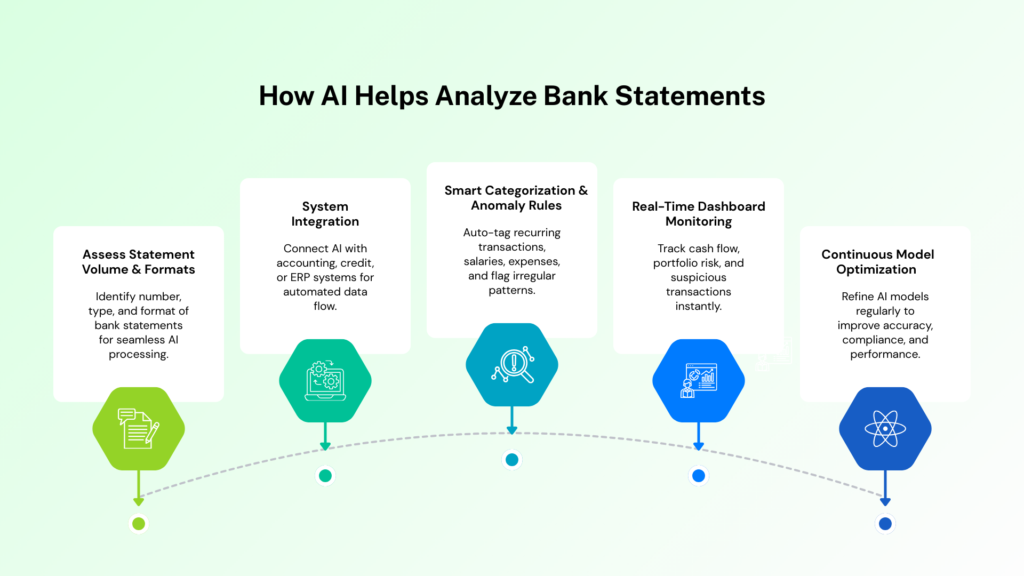
How AI Helps Analyze Bank Statements: Step-by-Step
Manual processing is time-consuming and prone to errors. AI bank statement analysis is efficient and automated. The process involves:
-
Step 1: Evaluate Statement Volumes & Types
Evaluate the volume and types of statements to ensure the AI system processes them efficiently.
-
Step 2: Integration with Systems
Integrate the AI system with accounting, credit, or ERP systems for smooth functioning.
-
Step 3: Establish Rules for Categorization & Anomalies
Automate the tagging process for recurring payments, salaries, and anomalies.
-
Step 4: Monitor Dashboards
Monitor cash flow, portfolio risk, and anomalies in real-time.
-
Step 5: Refine AI Models
Refine the models periodically to ensure accuracy and compliance.
Organizations can benefit from AI-driven bank statement analysis and automated financial analysis together.
Trends Driving AI Bank Statement Analysis Adoption
The finance industry is increasingly adopting automated financial analysis for improved efficiency, risk management, and compliance. The key trends are:
- Operational Efficiency: Automates manual and repetitive tasks to focus on strategic tasks.
- Fraud and Risk Management: Enables early detection of anomalies to safeguard portfolios.
- Cost Reduction: Minimizes operational costs and errors.
- Audit-Ready Compliance: Achieves financial transparency with ease.
- Digital Transformation: Enables real-time decision-making in a digital banking ecosystem.
The above trends clearly establish that AI bank statement analysis is a strategic imperative for the finance industry.
| Did you know? |
|---|
| AI tools can process transactions up to 90% faster than traditional methods, greatly improving operational efficiency and accelerating financial workflows. |
Future Outlook: AI in Finance
The future of finance will see AI bank statement analysis and automated financial analysis further enhancing credit decisioning, predictive risk scoring, and automated workflows. Early adopters will benefit from faster approvals, fewer defaults, and higher client satisfaction. Firms that invest in AI today gain a competitive advantage while mitigating financial and operational risk.
As AI continues to evolve, finance teams can expect more advanced predictive analytics, dynamic portfolio management, and fully automated decision-making processes. Organizations that leverage these capabilities will not only reduce operational costs but also enhance strategic planning and client trust.
Why Fintly Leads in AI Bank Statement Analysis
Fintly’s Bank Statement Analyzer uses OCR, AI, and machine learning to provide structured and real-time financial information. The tool combines multiple bank accounts seamlessly to continuously monitor cash flow and anomalies. Fraud detection is also improved by proactive alerts, and audit-ready reporting ensures compliance.
Major banks and fintech companies partner with Fintly to make faster, smarter, and fairer lending decisions. Fintly uses AI bank statement analysis and automated financial analysis to help finance teams decrease errors, increase efficiency, and optimize overall portfolio management.
Transforming Finance with AI and Automation
The current financial processing system has some drawbacks, including slow processing, errors, and a lack of transparency in cash flow and risk. Fintly’s AI bank statement analysis solution provides a remedy to the above problems by automating the processing, classification, and analysis of financial statements. With the help of automated financial analysis, finance professionals can now have real-time access to information about anomalies, cash flow, and portfolio performance.
Find out how Fintly’s bank statement analysis solution can revolutionize your financial operations. Automate data processing and identify anomalies quickly. Schedule a demo with Fintly to experience the benefits.
Author

Subject Matter Experts (Lending) Fintly.co
Vijay Mali is a results-driven professional with deep expertise in HFC/NBFC startups, compliance, and underwriting. He specializes in delivering end-to-end solutions for financial institutions, focusing on Business Rule Engines (BRE), workflow automation, and AI-driven credit decision-making. He is passionate about leveraging Machine Learning (ML) scorecards and AI-powered risk assessment to optimize lending processes and drive digital transformation in the financial sector.
