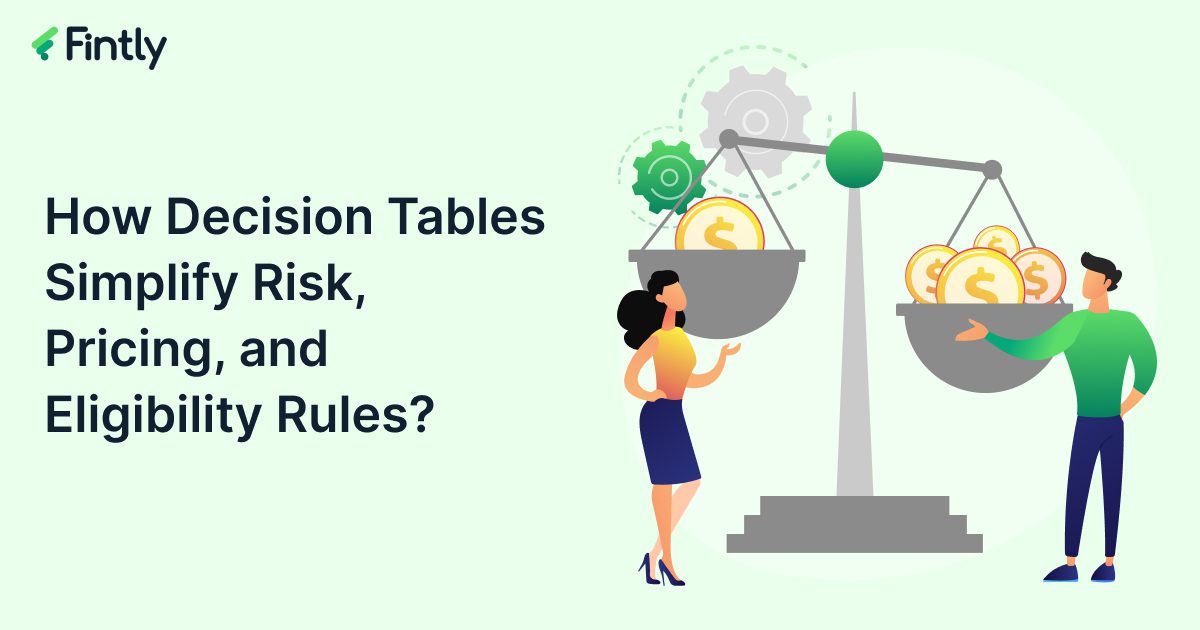
Managing business rules sounds simple at first. Then the exceptions start piling up. A lender adds new eligibility criteria. An insurer updates pricing logic. A bank introduces new risk thresholds. Before long, teams are buried under hundreds of nested if/else statements that are difficult to understand, test, and maintain.
This is where a decision table becomes the go-to solution.
Instead of hiding business logic inside complex code, decision tables organize rules in a clear and structured format. Teams can see every possible condition, outcome, and exception in one place. For industries that rely on risk assessments, pricing decisions, and eligibility checks, decision tables create consistency, reduce errors, and make rule management far easier.
In this guide, we’ll explore how decision tables work, when they outperform traditional if/else logic, and why more organizations are adopting them as part of modern decision automation strategies.
What Is a Decision Table and Why Is It Better Than Nested If/Else Logic?
A decision table is a structured matrix that maps business conditions to specific outcomes. It makes complex decision-making easy to understand, manage, and audit. Unlike nested if/else statements, decision tables display all possible rule combinations in a single view. This improves transparency and reduces maintenance challenges.
How Does a Decision Table Work?
A decision table contains conditions, actions, and outcomes arranged in rows and columns.
Each row represents a business rule. Each column represents a condition or resulting action. Teams can quickly identify decision paths without digging through code.
Imagine a lender evaluating applicants based on credit score and monthly income.
| Rule | Credit Score > 700 | Monthly Income > ₹50,000 | Outcome |
| 1 | Yes | Yes | Approve Loan |
| 2 | Yes | No | Manual Review |
| 3 | No | Yes | Manual Review |
| 4 | No | No | Reject Loan |
Instead of writing multiple nested if/else statements, the business logic is displayed in a single view. Anyone, from developers to risk analysts, can quickly understand how the decision is made.
Why Do If/Else Rules Become Difficult Over Time?
As business requirements grow, new exceptions must be added.
This creates lengthy chains of logic. Developers spend more time testing and troubleshooting than delivering improvements. Eventually, the logic becomes difficult for both technical and business teams to follow.

What Are the Benefits of Decision Tables Over Traditional Logic?
- Better Visibility: All rules appear in one structured format, making reviews easier.
- Faster Rule Updates: Business teams can update logic without rebuilding large parts of the application.
- Reduced Errors: Missing scenarios and conflicting rules become easier to detect.
- Easier Testing: Every rule combination can be validated systematically.
When rules become too complex for humans to follow quickly, they’re usually too complex for code-only management.
How Do Decision Tables Simplify Risk Assessment Rules?
Risk decisions often involve dozens of variables. A decision table organizes those variables into clear and predictable outcomes. This helps ensure every customer or application is evaluated consistently.
What Makes Risk Rules So Complex?
Risk models often consider income, credit history, debt ratios, employment status, geographic data, and behavioral indicators.
Each factor can influence the final outcome. Managing these combinations through nested code quickly becomes overwhelming.
How Do Decision Tables Improve Risk Evaluation?
Decision tables create a structured framework for risk classification.
Instead of reviewing complicated logic trees, analysts can view every condition and outcome in one place. This supports quicker validation and regulatory reviews.
Let’s see some examples of risk decision automation:
- Loan Approval Decisions: Automatically classify applicants based on predefined risk criteria.
- Fraud Detection Rules: Trigger risk alerts when specific risk combinations occur.
- Credit Scoring Adjustments: Apply policy changes consistently across all applications.
- Compliance Controls: Ensure regulatory policies are enforced through transparent rules.
Strong risk management depends on clear rules, and decision tables make those rules visible.
How Can Decision Tables Improve Pricing and Eligibility Decisions?
Pricing and eligibility decisions often have multiple dependencies. A decision table helps organizations manage these relationships without creating operational complexity.
The result is faster, fairer, and more consistent decisions.
Why Are Pricing Rules Difficult to Maintain?
Pricing models evolve constantly.
Organizations introduce promotional offers, risk-based pricing, customer tiers, and market adjustments. Over time, managing these combinations in code becomes expensive and error-prone.
So, organizations that already use financial statement analysis tools can further improve decision quality by connecting insights directly to automated decision tables.
How Do Rule Engine Decision Tables Improve Pricing?
Rule engine decision tables separate business logic from application code.
This allows pricing teams to adjust rules without lengthy development cycles. Updates can be implemented faster while maintaining consistency.
Where Are Decision Tables Commonly Used?
Below listed are the common use cases of decision tables:
- Insurance Premium Calculations: Match risk characteristics to pricing outcomes.
- Lending Rate Decisions: Assign interest rates based on predefined risk conditions.
- Customer Eligibility Checks: Validate applicants against business requirements.
- Product Recommendations: Deliver tailored offerings based on qualification criteria.
- Healthcare Eligibility Verification: Automatically determine patient eligibility, insurance coverage, or claim approval based on predefined policy rules.
Pricing becomes more agile when business rules are structured rather than hard-coded.

Why Are Decision Tables the Future of Scalable Decision Automation?
A decision table helps businesses scale decision-making without creating operational complexity.
As organizations grow, they introduce more products, regulations, customer segments, and business rules. Without a structured framework, managing these decisions becomes difficult, expensive, and error-prone.
Growing Complexity
Business rules rarely stay the same.
New pricing models, changing regulations, evolving risk policies, and customer-specific exceptions can quickly turn simple workflows into a tangled web of logic. A decision table keeps every rule visible and organized, making growth easier to manage.
A decision table:
- Adds new conditions without rewriting entire workflows
- Reduces dependency on development teams for rule updates
- Identifies conflicting rules before they impact customers
- Maintains clarity even as rules expand
As a result, complexity grows, but the operational conundrum doesn’t.
Financial Transparency
In industries like banking, lending, and insurance, every decision must be explainable.
This is where decision tables in banking deliver significant value. Instead of burying logic deep within application code, organizations can clearly document how decisions are made and why certain outcomes occur.
The business benefits include:
- Easier regulatory compliance
- Better audit readiness
- Consistent policy enforcement
- Improved stakeholder confidence
Hence, every decision has a clear and traceable path.
Intelligent Automation
Modern organizations need more than automation. They need automation they can trust.
Fintly combines AI-powered intelligence with transparent rule management, helping businesses automate risk assessments, pricing decisions, and eligibility evaluations without sacrificing visibility or control.
Fintly enables:
- AI-driven decision automation
- Centralized rule management
- Enterprise-grade security and audit trails
- Faster policy and workflow updates
Thus businesses can take smarter decisions with less operational effort.
Business Impact
Decision automation should create measurable business value.
A well-designed decision table reduces maintenance overhead while improving decision consistency across teams, systems, and channels. This allows organizations to focus more on growth and less on managing complex logic.
Organizations typically gain:
- Faster decision-making
- Greater consistency across operations
- Stronger governance and compliance
- Lower maintenance costs
- Future-ready scalability
Thus, teams spend less time managing rules and more time driving business outcomes.
As decision volumes increase and business rules become more complex, a decision table provides the structure needed to scale confidently. It transforms business decision automation from a technical challenge into a strategic advantage.
Decision Tables vs Nested If/Else Logic
| Factor | Decision Tables | Nested If/Else Logic |
| Readability | High | Low |
| Rule Visibility | Complete | Limited |
| Maintenance Effort | Low | High |
| Scalability | Excellent | Poor |
| Testing | Structured | Complex |
| Compliance Audits | Easy | Difficult |
| Business User Involvement | High | Low |
| Change Management | Fast | Slow |
Key Takeaways
- A decision table organizes complex business rules into a structured format.
- Decision tables are easier to manage than deeply nested if/else statements.
- They improve accuracy, transparency, and compliance.
- Rule engine decision tables enable faster updates without major code changes.
- Industries such as banking, lending, insurance, and healthcare benefit significantly from decision-driven automation.
- Decision tables support scalable and auditable business processes.
According to Gartner, organizations that modernize business decision management improve operational consistency, reduce manual intervention, and accelerate policy changes across business functions. Decision management platforms provide greater transparency and governance compared to hard-coded logic approaches.
Conclusion
A decision table transforms complex business logic into a simple, structured framework.
Whether you’re managing risk assessments, pricing models, or eligibility checks, decision tables provide clarity, consistency, and control. They outperform nested if/else logic because they are easier to understand, maintain, test, and scale.
For organizations looking to modernize financial operations, decision automation is no longer optional. It is becoming a competitive necessity.
Fintly helps businesses make that transition smoothly with AI-powered solutions that combine intelligent automation, enterprise-grade security, and human-centered experiences.
The result is smarter decisions, faster operations, and greater confidence at every stage of the process.

QUICK ANSWERS
Frequently Asked Questions (FAQs)
Your most common questions, answered with precision and insight
A decision table is a structured format that maps business conditions to outcomes. It helps organizations manage complex rules in a clear and transparent way.
Decision tables are typically configured within a business rules engine, where business conditions and outcomes are defined in a structured format. This enables authorized users to update rules without modifying application code, ensuring faster deployments and easier governance.
Use a decision table when multiple conditions and outcomes create complex rule combinations. It improves readability, maintenance, and scalability.
Rule engine decision tables are decision tables managed within a business rules engine, allowing organizations to update rules without changing application code.
Decision tables create transparent and auditable rule structures. This makes it easier to demonstrate how decisions were made during audits.
Yes. Decision tables in banking help manage lending policies, risk scoring, fraud detection, compliance controls, and customer eligibility decisions.
Yes. Modern platforms such as Fintly combine AI-driven analytics with decision tables to create intelligent and explainable decision automation.

Author
Subject Matter Expert (Lending) Fintly.co
Vijay Mali is a results-driven professional with deep expertise in HFC/NBFC startups, compliance, and underwriting. He specializes in delivering end-to-end solutions for financial institutions, focusing on Business Rule Engines (BRE), workflow automation, and AI-driven credit decision-making. He is passionate about leveraging Machine Learning (ML) scorecards and AI-powered risk assessment to optimize lending processes and drive digital transformation in the financial sector.