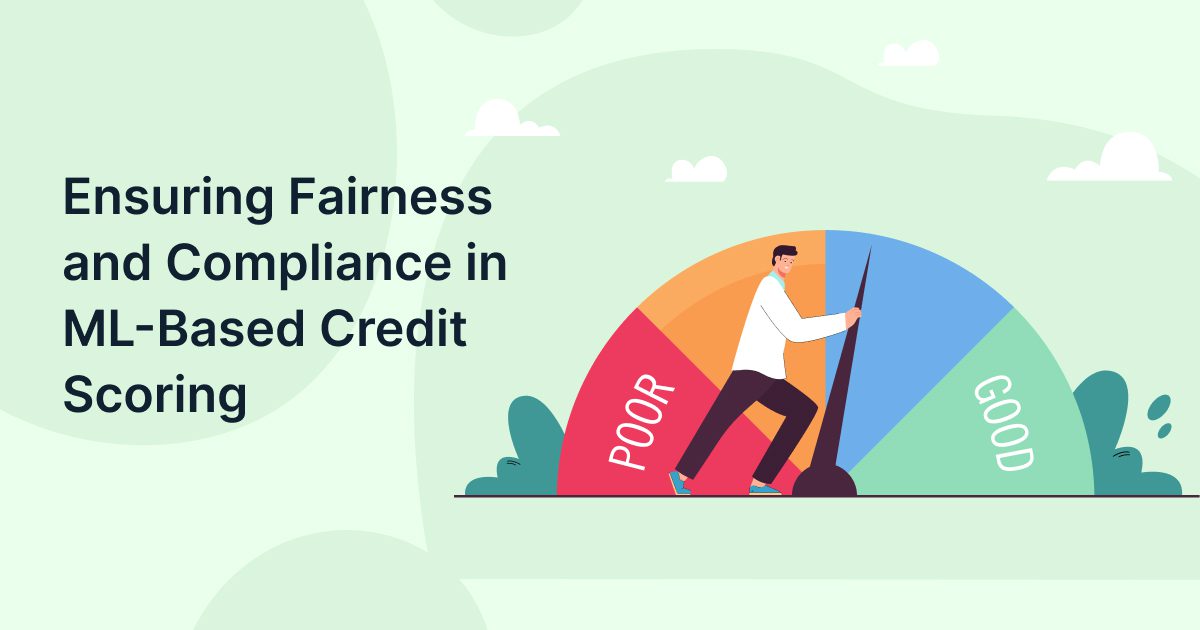
ML scoring must be transparent, bias-tested, and explainable to meet RBI and Indian regulatory expectations. Lenders need clear frameworks for fairness, documentation & human oversight to keep credit decisions both smart and compliant.
Credit is moving faster. More decisions are being made by models that learn from data instead of just following fixed rules. That brings real gains in speed and accuracy. It also raises tough questions for risk teams: Are these models fair? Can we explain why a loan was approved or rejected? Will regulators be comfortable with how we use them?
This post walks through what fair and compliant ML scoring looks like in India. You’ll see how explainable AI works in practice, which fairness checks matter, and how to align your models with RBI’s expectations without slowing down lending.
Key Takeaways
- ML scoring must be explainable – Regulators and customers expect clear, plain-language reasons for credit decisions, not black-box outputs.
- Fairness is a design choice – Use representative data, avoid biased features, and test models across segments before and after deployment.
- Compliance is operational, not optional – Document models, monitor drift and bias, and keep human oversight where it matters.
- The cost of inaction is high – Biased or opaque models can trigger regulatory scrutiny, reputational damage, and lost growth in underserved segments.
Why ML scoring needs fairness and compliance guardrails?
ML scoring models can spot patterns humans miss. They can use bank statements, GST data, cashflow signals & more to judge creditworthiness. But if those patterns reflect past biases, the model can repeat them at scale.
A model that quietly disadvantages certain regions, genders, or business types creates three problems –
- Regulatory risk: RBI and other regulators expect fair treatment of borrowers and clear reasons for adverse decisions.
- Reputational risk: Borrowers and partners lose trust when decisions feel arbitrary or discriminatory.
- Business risk: You may miss good customers in underserved segments, limiting growth.
The cost of inaction is real. Regulators can ask you to pause or rework models. Complaints can pile up. And growth stalls when you cannot confidently scale credit to new segments.

What is ML scoring, and where does it fit in Indian lending?
ML scoring uses machine learning algorithms to estimate the likelihood that a borrower will repay. Instead of a fixed scorecard with static weights, the model learns from historical data to predict default risk, delinquency, or loss.
In Indian lending, ML scoring typically sits inside the broader credit decisioning flow –
- Pre-screening and eligibility checks
- Credit bureau and alternative data pulls
- ML scoring to estimate risk and suggest pricing or limits
- Policy rules and human review for edge cases
- Final approval/rejection and documentation
For many banks and NBFCs, this is where platforms like Fintly come in. Fintly’s machine learning scoring capability plugs into existing loan origination systems to add risk scores, reason codes, and segmentation without ripping out legacy infrastructure.
That means your ML scoring engine cannot be a black box. You must be able to explain, in plain language, why a particular decision was made.
For a deeper look at how Indian fintechs are already using these models, see how fintechs leverage predictive credit intelligence for smarter lending.
How do regulators in India view AI and ML in credit decisions?
Indian regulators are not against AI. They are against uncontrolled risk.
RBI’s recent guidance makes this clear. The draft Model Risk Management Framework and the FREE-AI principles (Fairness, Resilience, Explainability, Ethics) ask banks and NBFCs to –
- Maintain an inventory of AI/ML models used in critical processes
- Ensure board-level oversight and clear ownership for model risk
- Build in human oversight and the ability to switch off models quickly if needed
- Document data sources, assumptions, and limitations
- Test for bias and fairness across customer segments
|
Key Insight RBI’s FREE-AI framework explicitly calls out “fairness” and “explainability” as core pillars, requiring lenders to demonstrate how models avoid discriminatory outcomes and provide understandable reasons for decisions. |
SEBI and IRDAI are moving in similar directions for their domains, pushing for algorithmic accountability and clear audit trails. For credit, this translates into two expectations –
- You can show how your model works at a high level.
- You can justify that it does not systematically disadvantage protected or vulnerable groups.
What is explainable AI in credit scoring?
Explainable AI (XAI) in banking means you can answer the question: “Why did the model take this action?” in a way a human can understand.
In credit scoring, that usually means –
- Global explanations: Which factors generally drive risk in the model (e.g., cashflow volatility, bureau delinquencies, GST filing consistency)?
- Local explanations: For a specific borrower, which factors pushed the score up or down?
- Adverse action reasons: Simple, borrower-friendly statements like “recent missed payments” or “high debt-to-income ratio” that map back to model drivers.
Explainability is not about revealing proprietary code. It is about giving risk officers, auditors, and customers enough clarity to trust the decision.
Techniques like SHAP values or LIME help quantify how much each feature contributed to a particular score. But the output must be translated into business language, not math.
How to make ML credit models fair?
Fairness starts before you train the first model. It is a design choice, not an afterthought.
Practical steps include –
- Clean, representative data: Ensure your training data covers different regions, genders, business types, and income levels. Gaps here create blind spots.
- Feature shielding: Avoid using variables that directly encode protected attributes (like gender) or obvious proxies (like certain pin codes) unless you can justify them on pure risk grounds.
- Fairness metrics: Track approval rates, average scores, and default rates across segments. Large, unexplained gaps are a red flag.
- Bias testing: Run pre-deployment and periodic tests to check if the model behaves differently for similar profiles in different groups.
- Human-in-the-loop: Keep underwriters in the loop for borderline cases, new segments, or when the model’s confidence is low.
The goal is not identical approval rates for everyone. It is ensuring that differences are driven by risk, not by unfair or irrelevant factors.
Which fairness and explainability techniques work in practice?
|
Industry Insight RBI’s Fintech Supervision Report highlighted concerns around gender-based disparities in digital lending outcomes, pushing lenders to examine how data and models may reinforce existing biases. |
Not all techniques fit all use cases. The table below outlines common approaches and where they tend to work best.
| Technique | What it does | Pros | Cons | Best use cases |
| SHAP values | Shows how each feature contributed to a specific score | Detailed, model-agnostic, widely accepted | Can be complex to explain to non-technical stakeholders | High-value loans, regulatory scrutiny, adverse action reasons |
| LIME | Approximates model behaviour locally for a single decision | Easier to compute than full SHAP in some setups | Less stable across runs, can vary by sample | Quick explanations for front-line staff and customer support |
| Rule-based overlays | Adds simple policy rules on top of ML scores (e.g., caps, floors) | Transparent, easy to audit, aligns with policy | Can reduce model’s predictive edge if overused | Regulated products, new segments, pilot phases |
| Challenger models | Runs a second model (simpler or different algorithm) in parallel | Helps detect drift, bias, or overfitting | Extra cost and complexity | Mature portfolios, high-volume unsecured lending |
| Human-in-the-loop underwriting | Routes borderline or high-impact cases to human review | Adds judgment, handles edge cases, builds trust | Slower, depends on underwriter quality | SME loans, first-time borrowers, high-ticket exposures |
In practice, most lenders use a combination: ML scores for speed and accuracy, plus rule overlays and human review for control.
How does AI credit scoring meet regulations in India?
Meeting regulatory expectations is less about a single tool and more about a disciplined process.
Key elements include –
- Model documentation: Clear records of data sources, features, training periods, performance metrics, and known limitations.
- Governance: Defined roles for model owners, validators, and approvers, with board-level visibility for critical models.
- Monitoring: Ongoing tracking of performance, drift, and fairness metrics, with triggers for review or retraining.
- Kill switches: Ability to pause or override a model if it behaves unexpectedly or breaches risk limits.
- Customer communication: Ability to generate plain-language adverse action reasons tied to model outputs.
When done well, AI credit scoring does not fight regulation; it supports it. You get faster decisions with a clearer audit trail.
For teams already using predictive models, the next step is often tightening governance and explainability without losing speed. That is exactly where many fintechs are focusing now, as described in this piece on how fintechs leverage predictive credit intelligence for smarter lending.
Illustrative Case study: A mid-sized NBFC fixes bias in its ML scoring model
Consider a mid-sized NBFC focused on small business loans. Their initial ML scoring model improved approval speed but showed worrying patterns –
- Lower approval rates for women-led businesses in certain states
- Higher average scores for similar cashflow profiles in metro vs. tier-3 locations
- Rising complaints about “unclear” rejection reasons
A fairness audit revealed two issues –
- Some location-based features were acting as proxies for socio-economic status.
- The training data underrepresented women-led firms that had repaid well.
The NBFC took three steps –
- Removed or reweighted location features that lacked clear risk justification.
- Augmented training data with additional cohorts of women-led businesses.
- Added SHAP-based reason codes to rejection letters, reviewed by legal and regulatory compliance.
Within two quarters –
- Approval rates for women-led businesses in targeted segments rose by 18%, with no increase in early delinquency.
- Customer complaints on “unclear reasons” dropped by over 40%.
- Internal audit and regulators were satisfied with the documentation and monitoring framework.
This is not a one-off project. The NBFC now runs quarterly fairness reviews as part of its model risk calendar.
When might simpler or manual approaches still make sense?
ML scoring is powerful, but not always the right first choice. Simpler or more manual approaches can make sense when –
- Data is thin: New products or segments with limited historical performance data.
- Regulatory scrutiny is high: During investigations or when launching in a tightly regulated niche.
- Business logic is complex: Where policy exceptions and relationship factors dominate pure risk signals.
In these cases, a rule-based scorecard or manual underwriting, possibly augmented by basic analytics, may be safer. You can layer in ML later once you have enough clean data and a stable process.
The risk is not using ML at all. It is using it without controls. A well-governed simple model beats a black-box complex one every time.
How to operationalize fair and compliant ML scoring
Turning principles into day-to-day practice requires a checklist mindset.
A practical roadmap –
1. Define governance first
- Appoint model owners and validators.
- Set approval workflows and escalation paths.
2. Audit your data
- Check coverage across segments.
- Document sources, transformations, and known gaps.
3. Design for explainability
- Choose models and techniques that can generate reason codes.
- Map model drivers to policy and adverse action language.
4. Test for fairness before go-live
- Run bias tests across key segments.
- Set thresholds for acceptable differences and escalation triggers.
5. Monitor continuously
- Track performance, drift, and fairness metrics monthly or quarterly.
- Retrain or recalibrate when thresholds are breached.
6. Document everything
- Keep versioned records of models, data, and decisions.
- Ensure audit trails are accessible for internal and external reviews.
Many teams find that platforms which combine ML scoring with built-in governance features reduce the operational burden. For example, Fintly’s approach to accelerating loan sanctions with its ML ScoreEngine includes reason codes, segment-level monitoring, and integration with existing policy rules.
What happens if you ignore fairness and compliance in machine learning finance?
Ignoring fairness and compliance does not save time. It borrows time at high interest.
Possible consequences include –
- Regulatory actions: Queries, directives, or even temporary halts on certain products.
- Model shutdowns: Being forced to switch off models’ mid-cycle and revert to slower processes.
- Customer backlash: Complaints, social media scrutiny, and loss of trust.
- Missed growth: Inability to confidently expand into underserved but creditworthy segments.
In a regime where regulators expect board-level accountability for AI use, “we did not know” is not a defensible position.
Conclusion
Fairness and compliance are not obstacles to ML scoring. They are the foundation that lets you scale it with confidence.
For Indian lenders, the path is clear: build explainable models, test for bias, document decisions, and keep humans in the loop where it matters. That is how you satisfy regulators, protect your brand, and unlock credit for customers who deserve it.
If you want to review your current ML scoring approach or explore how to embed fairness and explainability into your credit workflows, reach out Fintly’s team to start the conversation.
 QUICK ANSWERS
Frequently Asked Questions
Your most common questions, answered with precision and insight
Explainable AI in credit scoring means the model can show why it gave a particular score or decision in simple terms. Instead of a black box, you get clear reasons like “recent missed payments” or “low cashflow stability.” This helps lenders give meaningful adverse action reasons and satisfy regulators who want transparent decisions.
Make ML credit models fair by using clean, representative data and avoiding features that unfairly disadvantage certain groups. Track approval and default rates across segments with fairness metrics & run regular bias tests. Combine model outputs with rule overlays and human review & monitor continuously for drift or emerging disparities.
AI credit scoring meets regulations in India by aligning with RBI’s expectations on fairness, explainability, and model risk management. Lenders must document data and model logic, test for bias, maintain human oversight, and explain adverse decisions.
RBI and other regulators care about ML scoring fairness because unfair models can systematically disadvantage certain groups and increase systemic risk. They want credit access based on risk, not irrelevant or discriminatory factors. Clear explainability and fairness controls also make it easier to investigate complaints and hold institutions accountable.
Biased ML credit models can lead to regulatory penalties, reputational damage, and loss of customer trust. They may also cause lenders to miss good customers in underserved segments, limiting growth. In extreme cases, regulators can ask institutions to pause or rework models, disrupting operations and increasing costs.
Yes, ML scoring can be both accurate and fair if it is designed and monitored with fairness in mind. This means using representative data, testing for bias, and adjusting features or thresholds that create unjustified disparities. The goal is to ensure differences in decisions are driven by genuine risk factors.
Audit ML credit models for bias before deployment and then on a regular schedule, typically quarterly or semi-annually. Run additional audits after major data or product changes, or if regulatory concerns arise. Continuous monitoring dashboards can flag issues between formal audits and trigger timely reviews.
Tell the borrower clear, specific reasons for rejection in plain language, such as “recent missed payments” or “insufficient cashflow.” These reasons should map back to the model’s key drivers without revealing proprietary details. This helps customers understand the decision and take steps to improve their credit profile.

Author
Subject Matter Expert (Lending) Fintly.co
Vijay Mali is a results-driven professional with deep expertise in HFC/NBFC startups, compliance, and underwriting. He specializes in delivering end-to-end solutions for financial institutions, focusing on Business Rule Engines (BRE), workflow automation, and AI-driven credit decision-making. He is passionate about leveraging Machine Learning (ML) scorecards and AI-powered risk assessment to optimize lending processes and drive digital transformation in the financial sector.