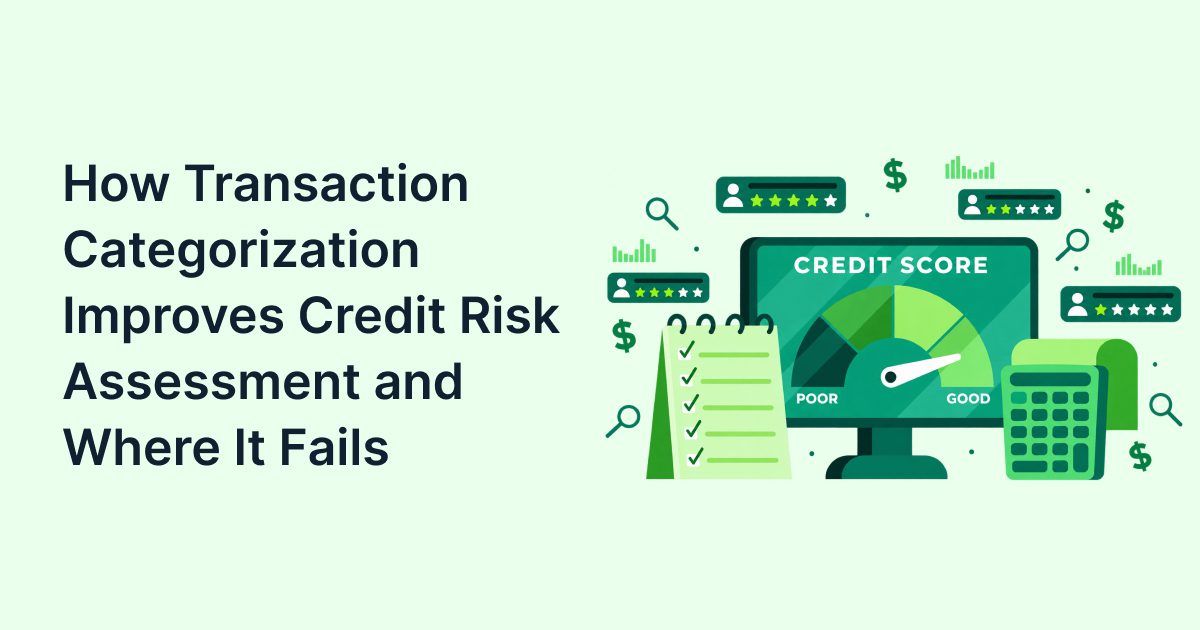
Transaction categorization improves credit risk assessment by converting raw bank activity into structured information about income, expenses, debt obligations & cash-flow stability. However, it only adds value when lenders validate the categories, distinguish genuine income from transfers or borrowing, and explain how the resulting signals affect the decision.
Lenders in India now see more data than ever; bank statements, bureau reports, GST filings, and account-aggregator feeds. The problem is that most of this data arrives as messy transaction descriptions: cryptic merchant names, payment references, and codes that mean little on their own.
This post explains how transaction categorization turns that noise into usable credit signals. You will learn what categories actually matter for underwriting, how AI-powered bank statement analysis fits into the process, and where categorization can be misled if used without controls. For context on how this works in practice, you can explore Fintly’s Bank Statement Analyzer, which performs AI-powered bank transaction categorization and cash-flow analysis for lenders.
Summary
- Explain what transaction categorization is and why raw data is insufficient.
- Understand how categorized transactions improve income verification, affordability, and risk monitoring.
- Identify the biggest failure modes and how to control them.
- Use a simple framework to move from categories to credit decisions.
What is transaction categorization?
Transaction categorization is the process of assigning labels to each bank’s entry so that it becomes meaningful for analysis. Instead of seeing “NEFT-ABC12345-PAYRL”, a lender sees “salary credit”. Instead of “UPI-XYZMART-500”, they see “grocery expense”.
In practice, this means –
- Mapping raw transaction text to standard categories such as income, expense, transfer, loan repayment, or tax.
- Using a hierarchy that moves from broad groups (income, expense) to granular tags (salary, freelance income, rent, utilities).
- Creating a consistent view across different banks, formats, and description styles.
The output is not a credit score. It is structured financial behaviour data that underwriters and models can use.

Why raw bank transactions are not enough for credit decisions
Raw transaction data is noisy by design. Bank descriptions are built for reconciliation, not underwriting. Common issues include –
- Cryptic codes and abbreviations that vary by bank.
- Merchant names that change frequently or are unclear.
- Mixed personal and business transactions in the same account.
- Inflows that could be salary, loan proceeds, transfers, or refunds.
- Reversals, refunds, and failed transactions that distort the picture if not identified.
A credit analyst reading a PDF statement can spend hours cleaning and interpreting this data. Even then, important patterns, such as recurring obligations or stress signals, can be missed. Systematic bank transaction categorization addresses this by applying consistent rules and models at scale.
How does transaction categorization improve credit risk assessment?
The core value of transaction categorization lies in turning unstructured entries into signals that map directly to risk questions.
How does it create a clearer cash-flow picture?
Categorized data lets lenders see –
- When money comes in and goes out.
- Which inflows are regular and which are one-off.
- How balances behave before and after key payments.
This cash-flow view is more current than bureau data, which often reflects past credit behaviour rather than present liquidity.
The account-aggregator ecosystem in India has scaled rapidly, with millions of accounts linked per month at its peak in 2025, according to public adoption dashboards tracked by industry observers. This growth means more lenders can access standardized bank data, but only if they can interpret it correctly.
How does it improve income verification?
Income is not just “all credits”. Transaction categorization helps separate –
- Salary and wages.
- Business receipts and merchant settlements.
- Government benefits or subsidies.
- Rental income.
- Transfer from your own accounts or family.
- Loan disbursements and cash advances.
Treating all credits as income can overstate repayment capacity. Categorization, combined with rules and human review, reduces this risk.
How does it help identify recurring obligations?
Lenders need to know what payments a borrower cannot easily cut. Categorization highlights –
- Existing loan EMIs and credit card payments.
- Rent or mortgage payments.
- Insurance premiums.
- Subscriptions and other fixed commitments.
These recurring outflows are central to estimating how much of a borrower’s income is truly available for new debt.
How does it support affordability assessment?
Affordability is about whether a customer can make repayments without falling into financial difficulty. RBI’s Digital Lending Directions, 2025 require regulated entities to obtain information on the borrower’s economic profile, including age, occupation and income details, to assess creditworthiness before extending any loan.
Categorized transactions allow lenders to –
- Estimate non-discretionary expenses (rent, utilities, food, existing debt).
- Compare them against stable income.
- Identify whether adding a new EMI would push the borrower into stress.
This is more nuanced than looking only at credit bureau utilisation or past delinquencies.
Which transaction categories matter most to lenders?
Not all categories carry the same risk weight. The table below shows typical categories and why they matter in underwriting.
| Category | Example | Risk relevance |
| Verified recurring income | Monthly salary credit | Indicates stable repayment capacity |
| Business revenue | Customer receipts, settlements | Shows revenue consistency and volatility |
| Existing debt repayments | Loan EMI, credit-card payment | Determines current debt-service burden |
| Essential expenditure | Rent, utilities, food, fuel | Defines non-discretionary spend baseline |
| Discretionary spending | Dining, travel, entertainment | Indicates flexibility to absorb new EMI |
| Transfers | Own-account, family transfers | Helps avoid counting transfers as income |
| Borrowed funds | Loan disbursement, cash advance | Prevents false income signals |
| Financial stress events | NSF, overdraft, returned payment | Signals liquidity pressure and potential default risk |
A strong income expense categorization framework focuses on these high-impact categories rather than chasing hundreds of low-value tags.
How does AI transaction categorization actually work?
AI transaction categorization uses pattern recognition to assign labels at a scale. In simple terms –
- The system learns from historical transactions and their known categories.
- It analyses merchant names, transaction types, amounts, and counterparty patterns.
- It applies rules and models to new transactions, producing a category and a confidence score.
This is not a black box that makes lending decisions on its own. It is a classification layer that humans and models can interrogate.
At Fintly, AI transaction categorization is used to standardize data across banks, flag low-confidence entries for review, and generate cash-flow features that feed into underwriting policies.
Where can transaction categorization go wrong?
Better categorization does not automatically mean better decisions. Several failure modes are common in live lending programs.
Misclassifying transfers and borrowed funds as income
A borrower may receive –
- Transfers between their own accounts.
- Funds from family members.
- Loan disbursements or credit-card cash advances.
If these are labelled as income, the lender may overestimate repayment capacity and extend credit that the borrower cannot sustainably service.
Treating one-off deposits as stable earnings
A large, irregular credit, such as a bonus, asset sale, or one-time business receipt, may look like income in a single month. Without multi-month context, it can distort income calculations.
Overlooking cash-based or seasonal income
In India, many MSMEs and gig workers still operate with significant cash flows or seasonal patterns. Relying only on categorized bank data without understanding business cycles can understate true income for some segments.
While digital payments have grown sharply, cash remains important for many households and small businesses.
Shared accounts and business-personal mixing
For small businesses and sole proprietors, personal and business transactions often sit in the same account. Without careful rules, business revenue can be misread as personal income, or personal expenses can be misread as business costs.
Over-reliance on granular categories
More categories do not always mean better risk prediction. A model that focuses on hundreds of micro-categories may overfit to noise. A simpler, policy-aligned taxonomy often performs better in production.
The key is to treat categorization as an input, not a decision. Confidence scores, human review for material cases, and periodic model checks are essential.
From categories to credit-risk features: a practical framework
A useful way to think about this is a five-step flow –
Classify → Validate → Aggregate → Interpret → Decide.
- Classify each transaction into categories such as income, expense, transfer, debt, and tax.
- Validate high-impact categories, especially income and debt, using rules and spot checks.
- Aggregate transactions into monthly and behavioural metrics.
- Interpret those metrics in the context of the product and policy.
- Decide using a governed process that combines bank data with other signals.
The table below shows how categories translate into features and underwriting questions.
| Categorized data | Derived feature | Underwriting question |
| Salary credits | Median monthly salary over 6–12 months | Is income stable enough to support a new EMI? |
| Loan repayments | Total monthly debt-service amount | What is the existing debt burden? |
| Rent and utilities | Average monthly essential expense | How much income is already committed? |
| NSF / overdraft events | Count of stress events in last 6 months | Is the borrower experiencing liquidity pressure? |
| Business revenue | Month-on-month revenue volatility | Can the business absorb fixed repayments? |
| Own-account transfers | Ratio of transfers to total credits | Is reported income overstated? |
| Closing balances | Balance trend over time | Is financial resilience improving or deteriorating? |
This framework keeps the focus on decisions, not just labels.

How should Indian lenders implement transaction categorization?
Implementation is as much about governance as technology. A practical checklist –
- Define a category taxonomy aligned to your credit policy and product types.
- Set minimum history requirements, such as 6–12 months of bank data for income assessment.
- Establish rules for ambiguous transactions, for example, treating large, infrequent credits as non-recurring until proven otherwise.
- Validate high-impact categories like income, rent, and existing debt through sampling or secondary data.
- Calculate features over multiple periods to capture seasonality and trends.
- Track confidence and overrides, so you know where the model is uncertain and how often humans intervene.
- Monitor performance across segments, including thin-file, new-to-credit, and MSME borrowers.
- Maintain audit logs for regulatory reviews and internal risk audits.
RBI’s 2025 Digital Lending Directions make it clear that digital lending arrangements cannot substitute for robust credit underwriting standards. Lenders must still obtain and record borrower information, assess creditworthiness & maintain audit trails.
Combining bank-level cash-flow insights with bureau data gives a fuller picture of both past credit behaviour and current financial capacity. Our post on how credit bureau report parsing transforms risk assessment explains how these layers fit together.
Illustrative example: MSME lender in India
Consider an NBFC that lends to small traders and service providers. Previously, it relied on:
- Application form data.
- Credit bureau score and report.
- Manually review bank statements for select cases.
Challenges included –
- Inconsistent income assessment across underwriters.
- Missed existing debt when borrowers had loans from smaller lenders.
- High manual effort for bank statement review.
After introducing automated bank statement analysis with transaction categorization –
- Income was assessed using median monthly salary or business receipts over 6–12 months, excluding clear transfers and loan proceeds.
- Existing debt was identified from recurring EMI-like outflows, even when not fully visible on the bureau.
- Stress signals such as frequent overdrafts and returned payments were systematically captured.
Result (illustrative, based on typical patterns seen in the market) –
- Faster time-to-decision for standard cases.
- More consistent income and debt calculations across underwriters.
- Better identification of borderline cases for senior review.
The key was not just faster processing, but a clearer, policy-aligned view of cash flow.
What is the cost of ignoring transaction categorization?
Choosing not to use structured transaction analysis has real costs –
- Higher reliance on incomplete data, such as application forms and bureau history alone.
- More manual review time, as analysts clean and interpret PDF statements.
- Greater risk of mispricing or misclassification, especially for thin-file or new-to-credit customers.
- Missed opportunities in segments where cash-flow data could safely expand access.
For SME lending, ignoring bank-level cash-flow signals means leaning heavily on financial statements, which may be outdated, unaudited, or prepared for tax purposes rather than true economic performance. That is where combining bank data with financial statement analysis becomes critical.
In a competitive lending market, the institutions that can reliably interpret cash flow will have an edge in both risk control and growth.
Conclusion
Transaction categorization is valuable because it structures financial behaviour into something underwriters and models can use. It improves visibility into income, expenses, debt obligations, and stress signals. But it is not a substitute for sound credit policy, validation, and governance.
Used well, transaction categorization strengthens credit risk assessment without creating false confidence. Used poorly, it can amplify errors and bias.
If you want to discuss how your team can use bank statement analysis and transaction categorization in live lending programs, you can contact Fintly to speak with our team.
 QUICK ANSWERS
Frequently Asked Questions
Your most common questions, answered with precision and insight
Lenders analyze bank statements by extracting transactions, categorizing them into income, expenses, transfers and debt, and then calculating cash-flow metrics. They look at recurring inflows to verify income, recurring outflows to identify obligations, and patterns such as overdrafts or returned payments to gauge stress. Many now use automated bank statement analysis tools to do this at scale instead of manual PDF review.
Bank transaction categorization is the process of assigning meaningful labels to each entry in a bank statement, such as “salary”, “rent”, “loan repayment”, or “transfer”. This turns raw, cryptic transaction descriptions into structured data that can be used for income verification, affordability checks & credit risk assessment.
AI categorizes bank transactions by learning patterns from historical data, such as merchant names, transaction types, amounts & counterparty information. It applies these patterns to new transactions and assigns a category along with a confidence score. Humans and rules then validate high-impact categories, especially income and debt.
No. Transaction categorization complements credit bureau data but does not replace it. Bureau data shows past credit behaviour across lenders, while categorized bank transactions show current cash flow and spending patterns. Strong underwriting uses both, along with application data and, for SMEs, financial statements.
Transaction categorization helps verify income by separating genuine earnings, such as salary or business receipts, from transfers, loan proceeds, and one-off deposits. It allows lenders to calculate stable income metrics over multiple months and to adjust for seasonality or irregular cash flows.
The biggest risks include misclassifying transfers or loan proceeds as income, treating one-off deposits as stable earnings, and overlooking cash-based or seasonal income. Shared accounts and mixed business-personal transactions can also distort the picture. Categorization should be validated and used alongside other data sources.
Lenders can distinguish genuine income by analysing transaction patterns over time, checking counterparty details, and applying rules that flag large or infrequent credits. They can also compare categorized inflows with known salary dates, business cycles, and bureau-reported debt to identify inconsistencies.
A lender should look for a solution that offers a clear category taxonomy, confidence scores, and the ability to validate and override categories. It should support multi-month analysis, integrate with existing underwriting workflows, and provide audit logs. Security, compliance with Indian data norms, and proven performance in live lending programs are also important.

Author
Subject Matter Expert (Lending) Fintly.co
Vijay Mali is a results-driven professional with deep expertise in HFC/NBFC startups, compliance, and underwriting. He specializes in delivering end-to-end solutions for financial institutions, focusing on Business Rule Engines (BRE), workflow automation, and AI-driven credit decision-making. He is passionate about leveraging Machine Learning (ML) scorecards and AI-powered risk assessment to optimize lending processes and drive digital transformation in the financial sector.