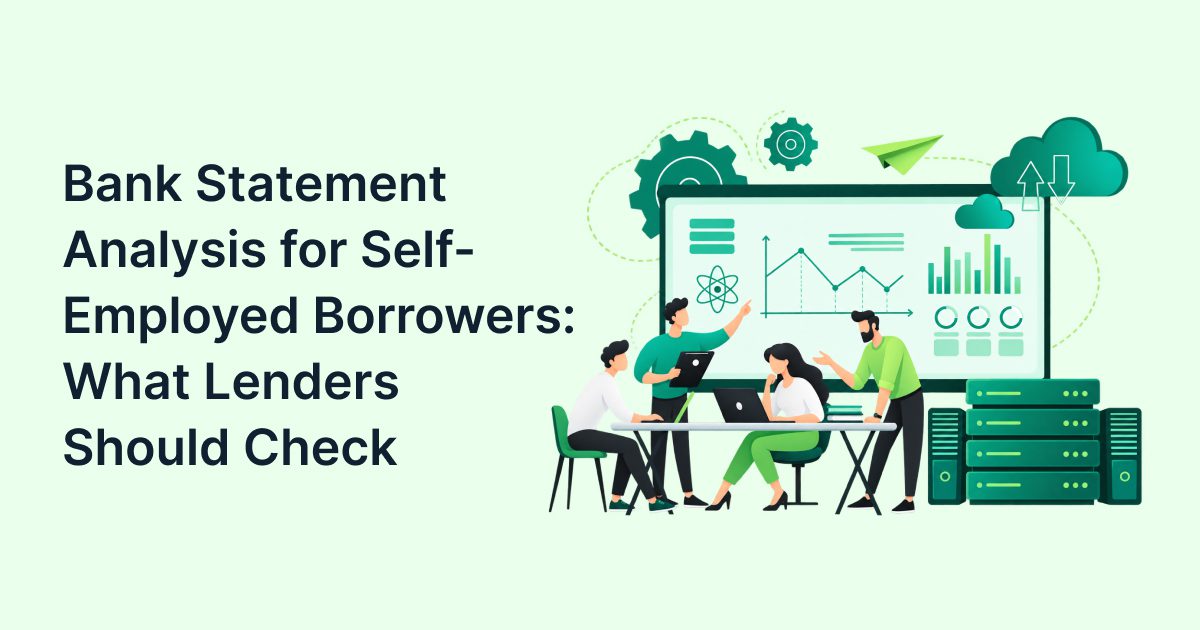
Bank statement analysis for self-employed borrowers helps lenders determine whether business inflows are repeatable, usable & sufficient for loan repayment. A reliable review looks beyond total credits to examine net cash flow, income trends, existing debt, balance behaviour & unusual transactions.
A self-employed borrower can show substantial monthly bank credits and still have limited capacity to repay a loan. A contractor may receive a large project payment but spend most of it on materials and labour. A distributor may have high turnover, but thin margins and several existing EMIs.
That is why lenders cannot treat a bank statement like a salary slip. This guide explains what to check during self-employed income verification, how to assess business cash flow analysis, and where technology can make self-employed borrower underwriting faster and more consistent. A purpose-built bank statement analyser for lenders helps turn unstructured transaction records into information that credit teams can review against policy. Fintly supports uploads from PDFs, Excel, CSV, JSON, and aggregator feeds, then categorises transactions and surfaces patterns for review.
What is bank statement analysis?
Bank statement analysis is the process of reviewing transaction history to understand a borrower’s income, expenses, balances, existing obligations, and financial behaviour. For lenders, it converts raw credits and debits into evidence that supports a credit decision.
The analysis should answer practical questions –
- Where does the borrower’s money come from?
- How often does that income arrive?
- How much of it remains after business costs?
- Are loan repayments already consuming the available surplus?
- Do transactions show possible stress or manipulation?
The Reserve Bank of India requires regulated entities conducting digital lending to obtain information about a borrower’s economic profile, including occupation and income, when assessing creditworthiness.
RBI’s Digital Lending Directions, 2025 require data collected through digital lending applications to be need-based, supported by prior and explicit borrower consent, and backed by an audit trail. The information must also be retained for audit purposes.

Why is bank statement analysis for self-employed borrowers different?
Salaried borrowers generally have predictable pay cycles, payslips, and employer records. Self-employed borrowers often do not. Their income may be seasonal, invoice-based, cash-heavy, or spread across business and personal accounts.
A strong underwriting review separates three things that are often confused –
- Revenue: Total money received by the business.
- Usable income: Money available after removing transfers, refunds, borrowings, and non-business credits.
- Repayment capacity: For this analysis, repayment capacity refers to the cash surplus available after relevant business costs, personal obligations and existing debt payments, subject to the lender’s underwriting policy.
This distinction matters because gross deposits can create false confidence. A borrower who receives Rs 12 lakh in monthly credits is not necessarily earning Rs 12 lakh. Part of that amount could be supplier reimbursements, internal transfers, loan disbursals, or customer collections that must be used to pay vendors.
India’s workforce also makes this a mainstream lending issue. Lenders therefore need a reliable way to evaluate income that does not follow a monthly salary pattern.
Which seven checks should lenders make?
1. Are business inflows recurring and traceable?
Start with the source and frequency of credits. Regular payments from known customers, marketplaces, payment gateways, or contracts usually provide stronger evidence than irregular large deposits.
Check for –
- Repeat credits from the same counterparties.
- Stable payment intervals.
- Clear transaction descriptions.
- Dependence on one customer.
- A sudden drop in recent inflows.
High customer concentration may increase sensitivity to the loss or delay of a major customer, so lenders should consider concentration alongside contract stability, payment history and business context.
2. What part of the credits is actual income?
Not every credit is income. Internal transfers between accounts, loan proceeds, refunds, and reversals can materially inflate the apparent earning level.
Lenders should identify and remove –
- Transfers from the borrower’s own accounts.
- Loan disbursals or overdraft draws.
- Reversed transactions.
- Refunds.
- Owner capital introduced into the business.
- One-time asset-sale receipts.
This is one of the most common weaknesses in manual self-employed borrower underwriting. Analysts may see a high credit total but fail to distinguish operating income from money that merely passed through the account.
3. Is cash flow improving, stable, or weakening?
A twelve-month average is helpful, but it can hide a recent decline. A business that earned well last year may now be losing customers or facing delayed payments.
Compare –
- Recent three-month inflows.
- Recent six-month inflows.
- Twelve-month averages.
- Month-on-month variation.
- Inflow levels during the same period last year, where available.
A fall in inflows does not automatically justify a decline. It does mean the lender should ask why it happened and test whether the borrower’s explanation matches the transaction record.
4. How much is left after business expenses?
Business cash flow analysis should focus on surplus, not turnover. Net operating cash flow means the money left after routine costs such as supplier payments, rent, payroll, utilities, taxes, and operating purchases.
A business can have high revenue but weak repayment capacity if the cost of earning that revenue is also high. For example, a wholesaler may collect Rs 8 lakh a month but spend Rs 7.3 lakh on inventory, wages & logistics before accounting for existing EMIs.
For a closer view of the capabilities that help credit teams review such patterns, read why Fintly’s Bank Statement Analyser software is built for credit teams.
5. What debt commitments already exist?
A lender should identify all recurring debt obligations before offering more credit. These may include business loans, personal loans, vehicle finance, overdraft interest, credit-card payments, and informal repayment patterns.
Look for –
- Regular EMI debits.
- Repeated auto-debit failures.
- Overdraft use.
- Loan credits followed by rapid withdrawals.
- Collections activity.
- Multiple recent loan-related credits.
Debt is not always a negative signal. A borrower may use working-capital finance productively. The issue is whether existing obligations leave enough monthly surplus for the proposed repayment.
6. Do account balances support the borrower’s story?
Balances show how a business manages uneven cash flow. A borrower who reports healthy earnings but regularly reaches near-zero balances before month-end may have limited financial cushion.
Review –
- Average monthly balance.
- Month-end balance.
- Frequency of low-balance days.
- Overdraft events.
- Cheque or auto-debit returns.
- Sudden balance spikes before the loan application.
This does not mean lenders should reject every borrower with volatile balances. Seasonal businesses, for example, may have legitimate periods of strain. The balance pattern should be assessed alongside sales cycles, industry context, and declared purpose of the loan.
7. Are there anomalies that need investigation?
Anomaly detection is not about treating every unusual transaction as fraud. It is about identifying activity that does not match the borrower’s stated business profile and requires explanation.
Possible review triggers include –
- Repeated round-number deposits.
- Money transferred in and out within a short period.
- Multiple reversals.
- Sudden inflows immediately before an application.
- Duplicate-looking transactions.
- Credits with no clear source.
- Significant mismatches across accounts or documents.
Fintly’s Bank Statement Analyzer is designed to categorise transactions, flag anomalies, and create structured outputs that support faster review of income patterns, expenses, and repayment behaviour.
What should count as income?
| Transaction type | Typical treatment | Why it matters |
| Regular customer payments | Count after validation | They can indicate recurring business income |
| Internal account transfers | Exclude from income | They do not create new earning capacity |
| Loan disbursals | Exclude from income | Borrowed money can overstate affordability |
| Refunds and reversals | Review separately | They can distort monthly credit totals |
| Owner capital introduced | Do not treat as operating income | It is usually a one-time contribution |
| Supplier and operating payments | Include in cash-flow review | They reveal the cost of generating revenue |
The key principle is simple: lenders should not approve credit on total credits alone. They should approve based on income that is recurring, validated, and sufficient after necessary outflows.
Illustrative example: Rs 10 lakh in credits is not Rs 10 lakh in income
Consider a small electronics distributor applying for a business loan.
The account shows Rs 10 lakh in credits during an average month. A quick review could classify the borrower as financially strong. A better analysis tells a different story –
- Rs 6.5 lakh comes from repeat customer payments.
- Rs 1.5 lakh is an internal transfer from another account.
- Rs 1 lakh is a short-term loan disbursal.
- Rs 1 lakh is a one-time refund from a supplier.
The borrower’s operating costs, including inventory purchases, transport, staff payments, and rent, total Rs 5.4 lakh. Existing EMIs are Rs 35,000 a month.
The usable operating surplus is therefore far lower than the headline Rs 10 lakh credit figure suggests. The lender should base the proposed EMI on verified cash surplus and volatility, not the largest number on the statement.
This is where lenders protect both portfolio quality and good borrowers. A weak process can lead to over-lending. An overly rigid process can reject a viable business because it cannot interpret its cash flow properly.

When should lenders still use manual review?
Automation should reduce repetitive work, not remove judgement from complex cases. Manual review remains important when the facts need context.
Examples include –
- A business with less than one year of operating history.
- Seasonal revenue patterns.
- Multiple legitimate business accounts.
- A large but explainable one-time transaction.
- Conflicts between bank statements, GST returns, ITRs, bureau data, or declared income.
The contrary view is important: automation is not automatically better if the lender has weak policy rules or ignores exceptions. A clear credit policy and skilled underwriters remain essential. Fintly can help teams standardise extraction, classification, and risk signals so underwriters spend their time investigating exceptions rather than reading statements line by line.
How can lenders make self-employed income verification consistent?
A consistent workflow reduces analyst-to-analyst variation and makes credit decisions easier to explain later.
1. Obtain clear consent
Collect statement data only with the borrower’s explicit permission and explain why it is required.
2. Collect statement data securely
Use approved sources, secure uploads, or consented data-sharing methods.
3. Standardise transaction data
Convert different bank formats into a consistent structure so transactions can be reviewed using the same rules.
4. Classify transactions
Separate income, operating expenses, transfers, loan proceeds, EMI payments, cash activity, and anomalies.
5. Calculate key indicators
Measure income consistency, average balances, surplus, debt burden, and volatility.
6. Route exceptions for review
Send complex cases to an underwriter with the evidence and reason for the exception clearly recorded.
RBI’s Digital Lending Directions, 2025 require data collected through digital lending applications to be need-based, supported by prior and explicit borrower consent, and backed by an audit trail. Borrowers must also have options to deny or revoke consent for particular data uses.
Teams looking to implement this kind of controlled process can see how to automate bank statement analysis with Fintly’s AI. Fintly describes a workflow that normalises transaction data across formats, applies categorisation, flags anomalies, and generates explainable outputs for underwriting and monitoring.fintly
What is the cost of a quick document check?
Treating bank statements as documents to scan rather than financial evidence creates both risk and cost.
It can lead to –
- Credit approvals based on inflated gross deposits.
- Viable applicants being rejected because genuine income was missed.
- Longer turnaround times.
- Higher review costs as volumes grow.
- Different outcomes from different analysts.
- Missed warning signs such as reversals, short-term funding, or stressed repayment behaviour.
- Poor auditability when decision reasons are not recorded.
The RBI has also made clear that a regulated entity remains responsible for its digital lending activity and the conduct of its lending service providers. Outsourcing a process does not outsource accountability.
How Fintly supports self-employed borrower underwriting
Fintly helps banks, NBFCs, and fintechs convert bank-statement data into structured information that supports policy-led lending decisions. Its platform accepts multiple statement formats and aggregator feeds, categorises transactions into income, expenses, and investments, identifies patterns and anomalies, and provides downloadable reports for review.
For underwriting teams, the value is practical –
- Less time spent extracting data from statements.
- More consistent transaction categorisation.
- Clearer views of income, expenses, balance trends, and repayment signals.
- Faster exception review with supporting transaction evidence.
- Better documentation for internal review and audit needs.
Conclusion
Bank statement analysis for self-employed borrowers should never stop at total monthly credits. Lenders need to establish whether inflows are repeatable, distinguish revenue from usable income, measure the cash left after operating costs, and test whether existing debt leaves enough room for another EMI.
The goal is not to automate every judgement. It is to give underwriters cleaner information, clearer exceptions, and a defensible basis for decisions. If your team needs a more consistent way to assess self-employed applicants, contact Fintly to discuss a bank-statement analysis workflow aligned with your lending policy.
 QUICK ANSWERS
Frequently Asked Questions
Your most common questions, answered with precision and insight
Bank statement analysis is the review of banking transactions to understand income, expenses, balances, debt obligations, and financial behaviour. Lenders use it to assess whether a borrower’s income is consistent and whether enough cash remains to make loan repayments. It is especially useful for self-employed borrowers who do not have regular salary slips.
Lenders verify self-employed income by identifying recurring business credits, removing internal transfers and loan proceeds, reviewing expenses, and calculating the surplus available after obligations. They also compare recent cash flow with longer-term patterns to check whether income is stable or declining.
There is no single review period that applies to every lender or borrower. Six to twelve months is a common analytical range in some lending workflows, but the appropriate period depends on lender policy, product, seasonality, business vintage and the stability of the borrower’s cash flows.
Underwriters look for regular income, source of funds, operating expenses, average balances, existing EMIs, overdraft use, payment returns, and unusual transactions. They also check whether the account activity supports the borrower’s stated business type, earnings, and loan purpose.
Bank statements can support income verification, but they do not always replace ITRs or other financial documents. Statements show transaction behaviour and recent cash movement, while ITRs provide reported tax information. Lenders commonly use both sources where their policy requires a fuller view of the borrower’s financial position.
Major red flags include unexplained large deposits, repeated reversals, heavy overdraft reliance, failed auto-debits, sudden activity before an application, and transaction patterns inconsistent with the declared business. A red flag is not proof of fraud, but it should trigger a documented review.
Start by identifying recurring business credits, then remove transfers, borrowings, refunds, and other non-income credits. Next, review essential operating expenses and existing debt payments. The resulting surplus gives a more useful estimate of the borrower’s repayment capacity than gross deposits alone.
Automated bank statement analysis cannot fully replace a human underwriter. It can extract, standardise, categorise, and flag transactions much faster, but complex cases still require judgement. Underwriters need to assess business context, seasonality, document conflicts, and exceptions that cannot be resolved by rules alone.

Author
Subject Matter Expert (Lending) Fintly.co
Vijay Mali is a results-driven professional with deep expertise in HFC/NBFC startups, compliance, and underwriting. He specializes in delivering end-to-end solutions for financial institutions, focusing on Business Rule Engines (BRE), workflow automation, and AI-driven credit decision-making. He is passionate about leveraging Machine Learning (ML) scorecards and AI-powered risk assessment to optimize lending processes and drive digital transformation in the financial sector.