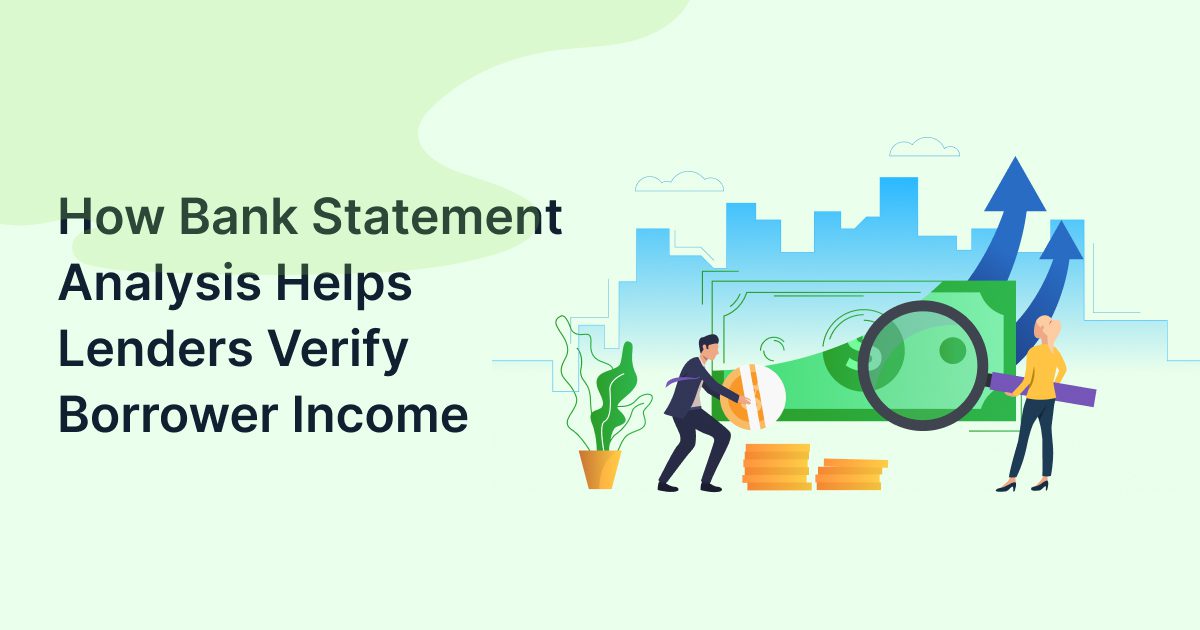
Income verification from bank statements helps lenders confirm whether a borrower’s declared income is real, recurring, and sufficient to support repayment. By analysing salary credits, business inflows, spending patterns, and account balances, lenders get a clearer view of repayment capacity than application forms alone can provide.
A borrower may declare a healthy monthly income. But the bank statement shows what enters the account, how often it enters, and whether it is likely to continue.
For lenders, that difference matters. Income verification from bank statements turns a self-declared figure into evidence-based borrower income verification. It helps credit teams assess affordability, identify inconsistencies, and make more reliable lending decisions.
This article explains how bank statement income verification works, how lenders verify salary and self-employed income, where automation helps, and what lenders should check before relying on a statement.
What Is Income Verification from Bank Statements?
Income verification from bank statements is the process of checking whether the income a borrower declares matches the deposits and cash-flow patterns visible in their bank account.
It goes beyond simply adding credits. A bank account may receive salary, business payments, refunds, loan transfers, family support, and one-time windfalls. Only some of these represent dependable income.
A useful bank statement income verification process identifies:
- Recurring salary credits from an employer or payroll source.
- Business receipts that repeat across months.
- Platform payouts for gig or delivery workers.
- Rental, dividend, pension, or other alternate income.
- Transfers, refunds, and one-time credits should not be treated as income.
The goal is not to find the highest possible income number. It is to find a defensible income figure that reflects the borrower’s actual ability to repay.
This is where Fintly’s Bank Statement Analyzer helps lenders convert unstructured statements into structured income, cashflow, and risk signals. Instead of reviewing hundreds of transactions manually, credit teams can review standardised outputs and focus on exceptions.

Why Do Lenders Use Bank Statements for Borrower Income Verification?
Lenders use bank statements because they show financial behaviour, not just financial claims.
Payslips confirm employment and salary. Tax returns show annual income. But bank statements show whether money actually arrives, how consistently it arrives, and whether the borrower can manage regular obligations.
Bank statements are especially useful when:
- A borrower is self-employed and does not receive a fixed salary.
- Income comes from multiple sources.
- A gig worker receives weekly or irregular platform payouts.
- Salary includes variable components such as incentives or reimbursements.
- A borrower has limited credit history but regular cash inflows.
- Documents such as salary slips or employer letters are unavailable or inconsistent.
Bank statement analysis also supports wider credit management. It helps lenders see whether income is stable, whether balances are under pressure, and whether spending patterns suggest financial stress. For a broader view of this use case, read why bank statement analysis is important in credit management.
The need for reliable verification is growing. According to RBI data reported by Economic Times BFSI, advances-segment fraud cases numbered 7,950 in FY25 and accounted for over 92% of the total fraud amount involved in reported banking fraud cases. When income documents are weak or manipulated, the cost is not just a delayed loan; it can be a poor-quality credit exposure.
How Does Bank Statement Income Verification Work?
Bank statement income verification works by collecting account data, identifying genuine income deposits, removing non-income transactions, and calculating a monthly income figure that can support underwriting.
A practical workflow looks like this:
- Collect statements or account data. The borrower shares statements for a defined period, typically three, six, or twelve months, depending on the loan type and lender policy.
- Extract and standardise transactions. Dates, descriptions, amounts, balances, and account details are converted into structured data.
- Classify deposits. The system separates salary credits, business receipts, transfers, refunds, and other inflows.
- Identify recurring income. Lenders look for repeated deposits with similar amounts, dates, and sources.
- Remove non-income credits. Internal transfers, loan disbursements, refunds, gifts, and one-time deposits are excluded.
- Calculate income. The lender calculates an average or qualifying monthly income based on verified recurring deposits.
- Run risk checks. The lender reviews income stability, source concentration, balance behaviour, and potential fraud indicators.
- Create an audit-ready output. The final report shows how income was calculated and which transactions were included or excluded.
The last step is important. An income figure without a clear calculation trail is difficult for an underwriter, credit committee, auditor, or regulator to trust.
How Do Lenders Verify Salary from Bank Statements?
Lenders verify salary by looking for recurring credits that match the borrower’s stated employer, pay cycle, and declared salary amount.
For a salaried borrower, strong salary verification signals include:
- A recurring monthly or periodic salary credit.
- Similar credit amounts across multiple months.
- A consistent pay date or pay cycle.
- An employer name, payroll descriptor, or recognisable salary narration.
- Salary credits that align with the income declared in the application.
- Continued salary credits over the review period.
A single large deposit is not enough. Lenders need a pattern.
For example, three consecutive monthly salary credits of ₹82,000 from the same employer are stronger evidence than one ₹2,50,000 deposit with an unclear description.
Declared Income vs. Bank-Statement Evidence
| What the borrower declares | What the bank statement can show | Why it matters |
| Monthly salary | Recurring employer credits and pay frequency | Confirms whether salary is received |
| Employment status | Employer or payroll descriptors in transaction narrations | Helps validate the stated employer |
| Income amount | Actual net salary credited to the account | Shows the income available for repayment |
| Financial stability | Balance trends, salary continuity, and spending pressure | Indicates whether income supports ongoing obligations |
| Additional income | Rental, dividend, pension, or business credits | Helps assess total repayment capacity |
Bank statements usually show net salary—the amount credited after deductions. Lenders should therefore avoid treating the bank-statement figure as gross salary without checking the borrower’s salary structure.
How Is Borrower Income Calculated from Bank Statements?
Borrower income is calculated by identifying qualifying income deposits over a review period and converting them into a monthly figure.
The right method depends on the borrower type.
| Borrower type | What lenders analyse | Common income approach |
| Salaried employee | Salary credits, employer pattern, pay cycle | Average monthly net salary credit |
| Self-employed borrower | Business inflows, seasonality, owner transfers | Adjusted average monthly business income |
| Gig or platform worker | Platform payouts, frequency, volatility | Rolling average of verified payouts |
| Rental or dividend income | Recurring credits and source consistency | Average of verified recurring non-salary income |
| Multiple-income borrower | All dependable income sources | Combined qualifying income after exclusions |
A simple average can be misleading. If a business receives a large annual payment, a 12-month average may overstate its regular monthly income. Similarly, a borrower with seasonal sales may show high income in some months and low income in others.
Lenders should therefore review:
- Whether income is recurring or one-time.
- Whether the source is identifiable.
- Whether income is rising, falling, or volatile.
- Whether the borrower has enough income after existing obligations.
- Whether the income is likely to continue during the loan tenure.
For self-employed applicants, this becomes even more important. Business accounts often include owner transfers, GST-related movements, loan proceeds, and customer receipts that require different treatment. Fintly covers these checks in more detail in its guide to bank statement analysis for self-employed borrowers.
Illustrative Example: Salaried Borrower with Extra Credits
Consider a salaried applicant who declares a monthly income of ₹1,00,000.
The bank statement shows:
- ₹85,000 credited every month from “ABC Pvt Ltd Salary.”
- ₹15,000 credited occasionally as a travel reimbursement.
- Two one-time transfers of ₹40,000 each from a family member.
- Regular UPI spending, rent payments, and EMI debits.
In this case, the dependable salary signal is ₹85,000 per month. The reimbursement may be legitimate, but it should not automatically be treated as recurring qualifying income. Its treatment depends on the nature of the payment and the lender’s policy.
Also ensure that reimbursements are not categorically excluded in every case if the lender policy treats certain recurring payments differently.
A lender that uses total credits would overstate income. A lender that uses recurring salary credits gets a more realistic view of repayment capacity.

What Income Signals Matter Beyond the Average Deposit?
The average deposit is only one input. Strong borrower income verification looks at income quality.
Lenders should assess four signals:
- Source: Is the deposit genuinely income, or is it a transfer, refund, or loan credit?
- Stability: Does the income repeat at a predictable frequency?
- Sufficiency: Is the income enough after existing EMIs, household expenses, and business obligations?
- Sustainability: Is the income likely to continue through the loan tenure?
This creates a simple framework: Source, Stability, Sufficiency, and Sustainability.
For example, a borrower may show high average deposits, but if 80% of inflows come from one client and the pattern is irregular, the income may be less dependable than the average suggests. Conversely, a lower but consistent salary credit from a stable employer may support a stronger lending decision.
Lenders should also review balance behaviour. Frequent overdrafts, low closing balances, or a pattern of spending soon after salary credits can indicate cash-flow stress even when headline income appears adequate.
How Does Bank Statement Analysis Detect Income Fraud?
Bank statement analysis detects income fraud by checking whether the document and its transactions are internally consistent, plausible, and aligned with the borrower’s declared profile.
Common checks include:
- Balance reconciliation: Opening balance plus all transactions should equal the closing balance.
- Document integrity: Altered PDFs, inconsistent fonts, missing pages, or edited metadata can indicate manipulation.
- Transaction logic: Salary credits should follow a realistic pay cycle and match employer details.
- Deposit patterns: Sudden large deposits shortly before a loan application need scrutiny.
- Income alignment: Declared income should broadly match recurring credits and spending behaviour.
- Source consistency: Employer names, transaction descriptions, and account ownership should not conflict.
Automation can flag these issues quickly, but it should not replace judgement entirely. Mixed personal-business accounts, informal business receipts, regional banking formats, and unclear transaction narrations often require an underwriter’s review.
The right model is an exception-based review: automate the standard checks, then route unusual cases to a trained underwriter.
When Does Lending Automation Make Income Verification Better?
Lending automation makes income verification better when it reduces repetitive manual work, applies the same rules to every application, and gives underwriters clear exceptions to review.
Manual statement review is slow and inconsistent. Two analysts can interpret the same statement differently, especially when income comes from multiple sources or transaction descriptions are unclear.
Automation helps lenders:
- Extract transactions from statements quickly.
- Standardise income classification rules.
- Identify recurring salary and business credits.
- Flag unusual deposits and possible document manipulation.
- Generate consistent income summaries.
- Maintain an audit trail of included and excluded transactions.
- Send only high-risk or unclear cases for manual review.
This does not mean the lender should auto-approve every loan. It means the lender can automate the repetitive parts of verification while keeping humans responsible for judgement, exceptions, and final lending decisions.
For banks, NBFCs, and fintechs handling high application volumes, this balance is essential. Lending automation should improve speed and consistency without weakening credit discipline.
What Is the Cost of Not Fixing Income Verification?
Weak income verification creates risk across the lending lifecycle.
If a lender relies on unverified declared income, it may approve borrowers who cannot afford the loan. If it relies only on manual review, it may slow down approvals and lose good applicants to faster competitors. If it accepts manipulated statements, it increases fraud exposure.
The operational costs include:
- Higher default risk from overstated income.
- More manual underwriting effort per application.
- Inconsistent credit decisions across teams and branches.
- Slower turnaround times and application drop-offs.
- Higher fraud losses from altered or fabricated documents.
- Weak audit evidence during internal reviews or regulatory scrutiny.
Income verification is therefore not a back-office formality. It directly affects portfolio quality, customer experience, and the reliability of lending decisions.
How Should Lenders Choose a Bank Statement Analysis Approach?
Lenders should choose an approach that produces accurate, explainable, and audit-ready income insights; not just fast PDF extraction.
Key capabilities to evaluate include:
- Accurate extraction of transactions, balances, and account details.
- Reliable classification of salary, business, transfer, and non-income credits.
- Support for salaried, self-employed, gig, and MSME borrower profiles.
- Fraud and document-tampering checks.
- Clear income calculation logic.
- Configurable rules aligned with the lender’s credit policy.
- Exception queues for underwriter review.
- Integration with loan origination and decisioning systems.
- Audit trails and evidence of retention.
A good bank statement analysis solution should help lenders answer one question clearly: Can this borrower reliably repay this loan?
Conclusion: Turn Bank Statements into Better Lending Decisions
Bank statements are most valuable when lenders assess income quality, not just deposit totals. Income verification from bank statements should confirm the source, stability, sufficiency, and sustainability of a borrower’s income before it influences a credit decision.
Automation makes this process faster and more consistent, but human review remains essential for exceptions, complex income structures, and high-value lending decisions.
To see how Fintly can support your income verification and lending automation workflow, contact Fintly for a discussion with our team.
 QUICK ANSWERS
Frequently Asked Questions
Your most common questions, answered with precision and insight
Yes. Lenders can verify income from bank statements by identifying recurring salary credits, business receipts, or other dependable inflows. They then compare these deposits with the borrower’s declared income and assess whether the income pattern is stable enough to support repayment.
Most lenders review three to twelve months of statements, depending on the loan product and borrower profile. Salaried borrowers may need fewer months, while self-employed applicants often require a longer period, so lenders can assess seasonality and income stability.
Lenders identify qualifying income deposits, exclude transfers and one-time credits, and calculate an average monthly figure. For salaried borrowers, this is often the average recurring salary credit. For self-employed borrowers, lenders may adjust for seasonality, owner transfers, and irregular business receipts.
Bank statements can support or sometimes substitute salary slips, especially when payslips are unavailable. However, they usually show net salary rather than gross salary. Lenders may still ask for salary slips, employment proof, or tax documents to complete the borrower’s income verification process.
Lenders look for recurring credits with a similar amount, date, and employer or payroll description. A strong salary pattern usually appears across multiple months. They also check whether the credited amount matches the income declared in the loan application.
Lenders review business inflows over several months, separate genuine customer receipts from owner transfers and loan credits and assess seasonality. They may calculate an adjusted average monthly income rather than using total deposits, which can overstate regular earnings.
Transfers between the borrower’s own accounts, loan disbursements, refunds, gifts, reimbursements, and one-time windfalls generally do not count as income. These credits may increase the account balance, but they do not necessarily represent repeatable repayment capacity.
Lenders check whether the opening balance, transactions, and closing balance reconcile. They also review document formatting, metadata, transaction descriptions, salary patterns, and whether declared income matches actual account activity. Automated checks can flag anomalies for underwriter review.
Automated verification is accurate when the extraction, classification, and fraud checks are reliable, and the lender configures rules to match its credit policy. Automation works best when it handles routine cases and sends unclear or high-risk applications to an underwriter.
Lenders should look for recurring income, stable balances, manageable spending, consistent salary or business credits, and no major unexplained deposits. They should also check for overdrafts, income concentration, irregular cash flows, and signs of document manipulation.

Author
Subject Matter Expert (Lending) Fintly.co
Vijay Mali is a results-driven professional with deep expertise in HFC/NBFC startups, compliance, and underwriting. He specializes in delivering end-to-end solutions for financial institutions, focusing on Business Rule Engines (BRE), workflow automation, and AI-driven credit decision-making. He is passionate about leveraging Machine Learning (ML) scorecards and AI-powered risk assessment to optimize lending processes and drive digital transformation in the financial sector.