Digital lending has made loan approvals faster and more accessible than ever. But it has also created new opportunities for fraud.
Today, lenders face a growing range of threats from synthetic identities and manipulated financial documents to coordinated application fraud, making fraud detection in fintech a critical priority for modern financial institutions.
The challenge for lenders is clear:
How can institutions detect fraud early without slowing down the lending experience for genuine borrowers?
The answer lies in combining advanced fraud detection techniques, automated fraud detection tools, and strong risk management frameworks that monitor borrower data across the lending lifecycle.
In this article, we explore the fraud detection techniques every lender should know, the tools used for modern fraud prevention, and practical implementation tips to strengthen lending risk management.

What Are Fraud Detection Techniques?
Fraud detection techniques are the methods lenders use to identify suspicious activity, detect fraudulent loan applications, and prevent financial losses before credit is approved.
These techniques analyze various signals such as:
- Identity verification data
- Financial statements
- Transaction histories
- Borrower behavior
- Device and location data
By analyzing these data points together, lenders can identify unusual patterns that may indicate fraud.
Modern financial institutions increasingly rely on automated fraud detection tools and AI-driven analytics to process large volumes of loan applications quickly and accurately.
| Did you know? |
|---|
| Synthetic identity fraud has become one of the fastest-growing fraud threats in digital lending. According to research from TransUnion, U.S. lenders faced more than $3.3 billion in exposure from synthetic identity fraud linked to newly opened accounts in 2024.
Source: TransUnion Newsroom |
Key Fraud Detection Techniques Used by Lenders
Modern lenders use a combination of analytical and operational fraud detection methods.
Identity Verification
Identity verification ensures that the borrower is who they claim to be.
Common techniques include:
- KYC verification
- Document authentication
- Biometric validation
- Government database cross-checks
These measures help prevent identity theft and impersonation-based loan fraud.
Behavioral Monitoring
Behavioral monitoring analyzes how borrowers interact with lending platforms.
Fraud detection systems can identify unusual behavior patterns such as:
- Multiple applications submitted in a short time
- Unusual typing or navigation behavior
- Suspicious login activity
Behavioral analytics helps detect account takeover attempts and automated fraud activity.
Transaction Pattern Analysis
Fraud detection tools can analyze borrower financial transactions to identify anomalies using structured financial insights from financial statement analysis tools.For example:
- Sudden spikes in income
- Unusual fund transfers
- Irregular transaction patterns
These insights help lenders detect manipulated financial data and suspicious financial behavior.
Device and Network Intelligence
Fraud prevention systems often analyze device and network data to identify suspicious activity.
This includes:
- Device fingerprinting
- IP address monitoring
- Detection of proxy or VPN usage
These signals help lenders identify coordinated fraud attempts or repeat fraud applications.
Manual vs Automated Fraud Detection
Traditional lending processes relied heavily on manual fraud checks. However, digital lending requires faster and more scalable solutions.
| Fraud Detection Method | How It Works | Limitations | Benefits |
| Manual Review | Analysts examine loan applications and documents | Slow and difficult to scale | Useful for complex cases |
| Rule-Based Systems | Predefined rules flag suspicious activity | Limited adaptability | Faster than manual checks |
| AI-Based Detection | Machine learning identifies anomalies | Requires training data | Highly scalable and accurate |
| Hybrid Approach | Combines automation with human oversight | Requires integration | Balanced accuracy and efficiency |
Most modern lenders adopt a hybrid fraud detection strategy, where automated systems flag risks and analysts review high-risk applications.
Fraud Detection Tools Used by Modern Lenders
To implement fraud detection techniques effectively, lenders rely on specialized fraud detection tools.
These tools help automate risk analysis and improve decision accuracy.
Identity Verification Tools
These platforms verify borrower identities through digital document checks and biometric authentication.
They help prevent identity fraud and impersonation.
Transaction Monitoring Systems
Transaction monitoring tools analyze borrower financial activity and identify suspicious financial patterns.
They are commonly used during:
- Loan underwriting
- Financial statement analysis
- Risk scoring
AI-Powered Fraud Detection Platforms
Machine learning systems analyze large datasets to identify patterns and anomalies that traditional systems may miss. Many modern fraud detection platforms leverage machine learning in finance to detect hidden fraud patterns and improve risk prediction.These platforms help lenders:
- Predict fraud risks
- Detect unusual borrower behavior
- Reduce false positives
Device Intelligence Tools
Device intelligence platforms analyze device fingerprints and network activity.
These tools help detect:
- Repeated loan applications from the same device
- Suspicious IP addresses
- Bot-driven loan applications
| Thought Leadership Insight |
|---|
| “Financial institutions that invest in advanced analytics and machine learning are better positioned to detect fraud patterns and respond faster to evolving threats.”
|
Implementation Tips for Building a Strong Fraud Detection Framework
Implementing fraud detection tools alone is not enough. Lenders must adopt a comprehensive fraud prevention strategy.
Integrate Multiple Data Sources
Fraud detection improves significantly when lenders analyze multiple datasets together.
This includes:
- Identity verification data
- Financial statements
- Transaction histories
- Device intelligence signals
Combining these data points provides a more accurate fraud risk profile.
Automate Early Risk Screening
Automated fraud detection tools allow lenders to evaluate applications within seconds.
This helps institutions:
- Detect suspicious applications earlier
- Reduce manual review workload
- Accelerate loan approvals
Continuously Update Fraud Detection Models
Fraud patterns evolve quickly. Lenders must regularly update fraud detection rules and machine learning models to stay ahead of new fraud techniques.
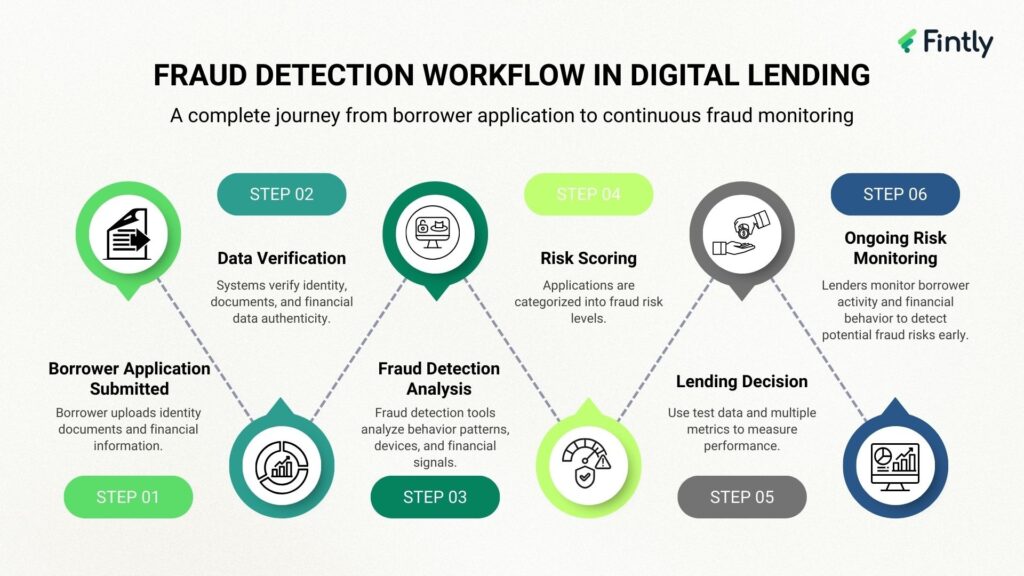
Implement Risk Scoring Models
Risk scoring models categorize applications based on fraud risk.
For example:
- Low risk → fast approval
- Medium risk → additional verification
- High risk → manual investigation
This improves operational efficiency while maintaining strong fraud protection.
How Fintly Supports Fraud Detection in Lending Workflows
Effective fraud detection works best when it is integrated directly into lending workflows rather than treated as a separate tool. Fintly helps financial institutions strengthen fraud prevention by combining financial data analysis, AI-driven risk scoring, automated decision rules, and portfolio monitoring within a unified lending intelligence platform.
With solutions such as Bank Statement Analyzer, ML ScoreEngine, Business Rule Engine, and Early Warning System, lenders can detect financial anomalies, automate risk checks, and monitor borrower behavior more effectively. This integrated approach helps institutions identify potential fraud earlier while enabling faster and more confident lending decisions.
 QUICK ANSWERS
Frequently Asked Questions (FAQs)
Your most common questions, answered with precision and insight
Fraud detection techniques are methods lenders use to identify suspicious activities, verify borrower information, and detect fraudulent loan applications before approving credit.
Common fraud detection tools include identity verification platforms, transaction monitoring systems, machine learning fraud detection platforms, and device intelligence tools.
Automated fraud detection allows lenders to analyze large volumes of applications quickly, identify fraud signals early, and reduce manual review workload.
Synthetic identity fraud occurs when criminals combine real and fake personal information to create new identities that can be used to apply for loans or financial products.
Lenders can improve fraud prevention by combining identity verification, behavioral monitoring, transaction analysis, AI-driven risk scoring, and automated decision systems.

Author
Subject Matter Expert (Lending) Fintly.co
Vijay Mali is a results-driven professional with deep expertise in HFC/NBFC startups, compliance, and underwriting. He specializes in delivering end-to-end solutions for financial institutions, focusing on Business Rule Engines (BRE), workflow automation, and AI-driven credit decision-making. He is passionate about leveraging Machine Learning (ML) scorecards and AI-powered risk assessment to optimize lending processes and drive digital transformation in the financial sector.