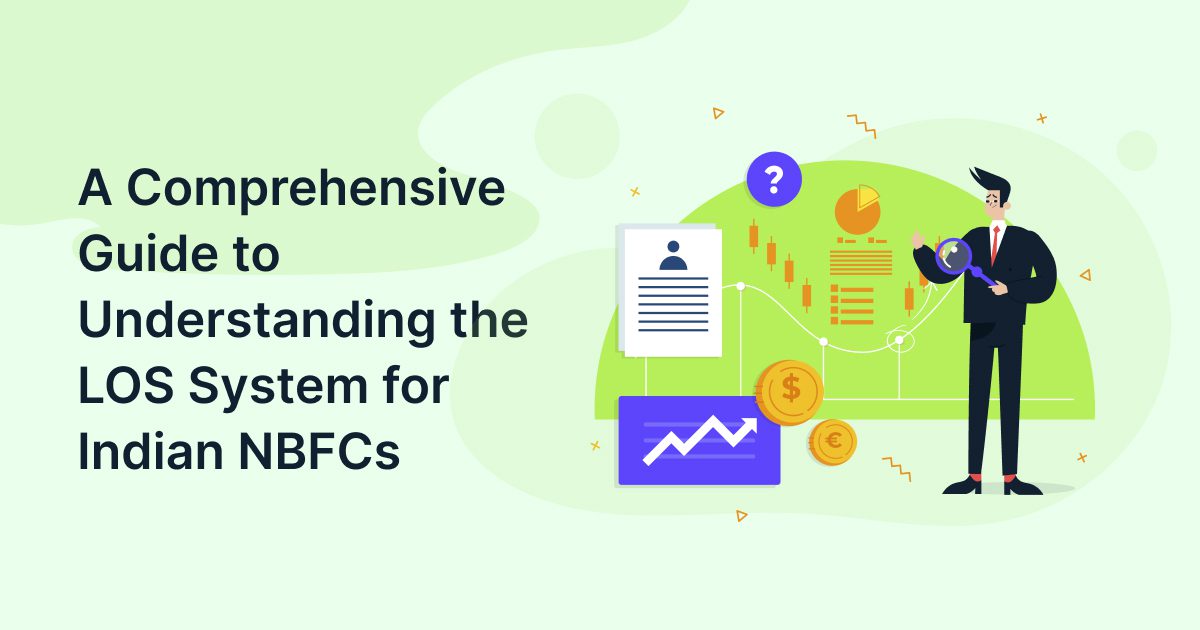
A loan origination system (LOS) is the software an NBFC uses to manage a loan from first enquiry to disbursal. It captures applicant data, verifies identity and income, runs credit checks, applies policy, records approvals, and triggers payout and triggers payoutand triggers payoutnd triggers payoutd triggers payout triggers payouttriggers payoutriggers payoutiggers payoutggers payoutgers payouters payoutrs payouts payout payoutpayoutayoutyoutoututt, while creating the audit trail regulators and risk teams need.
For many Indian NBFCs, the problem is not a shortage of loan demand. It is the operational drag between “application received” and “money disbursed.” Applications arrive through branches, direct-selling agents, partner apps, and digital channels. Each channel brings different documents, data quality, exceptions, and approval paths. A loan origination system brings those paths into one governed workflow.
This guide explains how an LOS works, where it differs from a loan management system, what Indian NBFCs should evaluate, and how to implement it without turning every credit decision into an engineering project. It also shows where automated bank statement analysis fits—particularly for lenders assessing self-employed borrowers, cash-intensive businesses, or applicants with multiple bank accounts. Fintly’s Bank Statement Analyzer is designed for this stage, converting statements into structured cash-flow, income, and risk insights for underwriting.

What Is a Loan Origination System?
A loan origination system is a loan processing system that manages everything before a loan becomes a servicing account. It handles lead capture, application intake, KYC, document collection, credit assessment, underwriting, sanction, agreement execution, and disbursal.
Think of it as the control room for new lending. The LOS does not merely store an application form. It decides what data to collect, when to call external services, which rules to apply, who must review an exception, and what happens after approval.
For an NBFC, this matters because lending is not one standard journey. A ₹50,000 consumer loan may be eligible for straight-through processing, while a ₹50 lakh secured business loan may need field verification, financial analysis, collateral checks, and committee approval. A capable LOS supports both without forcing teams to maintain separate processes.
How Does a Loan Origination System Work?
A modern LOS follows a sequence of connected stages. The exact order varies by product, but the control points remain similar.
- Lead and application capture: The system accepts applications from web forms, mobile apps, branch staff, DSAs, or partner APIs, then creates a single applicant record.
- KYC and identity checks: It validates PAN, Aadhaar-based or video KYC, and other identity requirements before credit assessment proceeds.
- Document and data collection: The LOS requests income proof, bank statements, GST data, bureau consent, or Account Aggregator data based on the loan product.
- Credit data retrieval: It pulls bureau reports and other permitted data sources, then normalises the information for decisioning.
- Eligibility and credit decisioning: Business rules, scorecards, and policy thresholds determine approval, decline, referral, pricing, or additional documentation.
- Underwriting and sanction: Automated cases proceed directly; exceptions go to a credit officer with the relevant evidence and decision history.
- Agreement and disbursal: The system generates the sanction letter and loan agreement, captures acceptance, and triggers payment to the borrower’s verified account.
The value is not simply automation. It is traceability. If an auditor asks why a loan was approved, declined, or escalated, the LOS should show the data used, rules applied, user actions, and time stamps.
LOS vs Loan Management System: Where Does One End?
An LOS manages the creation of a loan. A loan management system (LMS) manages the loan after disbursal. The distinction is practical, not academic: confusing the two often leads NBFCs to buy servicing tools when their real bottleneck is origination.
| Area | Loan origination system | Loan management system |
| Main purpose | Create, assess, approve, and disburse a loan | Service, collect, restructure, and close a loan |
| Core records | Applicant, application, documents, decision, sanction | Loan account, repayment schedule, dues, collections |
| Typical users | Sales, credit, risk, operations, compliance | Collections, servicing, finance, customer support |
| Key outputs | Sanctioned and disbursed loan | Repayment history, delinquency data, closure status |
| Common failure point | Slow document checks and unclear exception handling | Poor collections workflow and inaccurate schedules |
The handoff is where many lending stacks break. At disbursal, the LOS should pass a complete, validated loan record to the LMS: sanctioned amount, tenor, rate, fee structure, repayment schedule, borrower identifiers, documents, and approval evidence. If that handoff requires manual re-entry, the lender inherits data errors and reconciliation work.
What Should an Indian NBFC Look For?
Indian NBFCs should evaluate a loan origination system against operational reality, not a feature checklist. The best test is whether business teams can change a product journey without waiting weeks for custom development.
Fintly LOS Readiness Scorecard
| Evaluation area | What to test | Strong signal |
| Workflow configurability | Can credit and operations teams change stages, fields, and routing? | Product changes do not require a code release |
| India-specific integrations | Does it support bureau, KYC, Account Aggregator, payment, and e-sign flows? | APIs and prebuilt connectors reduce integration effort |
| Decisioning control | Can risk teams update eligibility, pricing, and referral rules? | Rules are versioned and governed outside hard-coded logic |
| Data quality | Does it validate inputs and prevent incomplete files from advancing? | Exceptions are routed with a clear reason and owner |
| Auditability | Can the lender reconstruct every decision? | Immutable logs cover data, rules, overrides, and approvals |
| Scalability | Can it handle peak application volumes and multiple products? | Performance remains stable across channels and geographies |
| Compliance readiness | Does it support disclosures, consent capture, and document delivery? | KFS, agreements, and borrower communications are traceable |
A business rule engine is central to this scorecard. It lets lenders encode policies such as minimum income, debt-to-income limits, bureau thresholds, cash-flow conditions, and referral rules. For a closer look at decision automation, see Fintly’s guide to business rule engine use cases in banking, NBFCs, and fintech.
What RBI’s 2025 Digital Lending Directions Mean
The Directions require a regulated entity using a Lending Service Provider to have a contractual agreement that defines each party’s roles, rights, and obligations. They also require lenders to obtain information relevant to assessing creditworthiness, including at minimum age, occupation, and income details, and retain it for audit.
For borrower disclosures, RBI requires a Key Fact Statement under its Non-Banking Financial Companies: Responsible Business Conduct Directions, 2025. It also requires digitally signed documents—including the KFS, loan product summary, sanction letter, terms and conditions, account statements, and privacy policies, to flow automatically to the borrower’s registered and verified email or SMS after execution of the loan contract or transaction.
An LOS should therefore support:
- Consent capture and evidence storage for data pulled from borrowers or partners.
- Role-based access so only authorised users can view applicant financial data.
- Version-controlled credit policies and decision logs.
- Automated delivery of prescribed borrower documents.
- Complete audit trails from application intake through disbursal.

Where Does Bank Statement Analysis Fit?
Bank statement analysis belongs between document collection and final credit decisioning. It is especially important for NBFCs lending to self-employed applicants, small businesses, gig workers, and borrowers whose declared income needs verification.
A statement analyzer extracts transactions from PDFs, scanned statements, passbooks, CSVs, or Account Aggregator data; classifies them; and produces indicators such as income patterns, average balances, inflows and outflows, obligations, and spending behaviour. Fintly’s Bank Statement Analyzer also identifies potential fraud signals such as duplicate transactions, balance inconsistencies, unusual cash deposits, round-tripping, and ATM anomalies.
Illustrative example
Suppose an NBFC receives a business-loan application from a trader who declares ₹8 lakh monthly turnover. The bureau score is acceptable, but the bank statements show irregular inflows, frequent round-tripped transfers, and low closing balances. Rather than relying only on the declared figure, the credit team can review categorised transactions, cash-flow trends, and anomaly flags before deciding whether to approve, reduce the limit, seek additional evidence, or decline.
This is where a loan origination system becomes more than a form-filling tool. It turns raw financial documents into decision-ready evidence, while preserving the source data for audit.
Contrary view
Automation should not mean eliminating human review. For large-ticket, secured, or structurally complex loans, an LOS should route exceptions to experienced underwriters rather than force a binary automated decision. The objective is to reserve human judgement for cases where context, collateral, or business model genuinely requires it.
Can an LOS Reduce Approval Time Without Increasing Risk?
Yes, when the lender separates repeatable decisions from judgement-heavy exceptions. A useful rule is to automate the evidence-gathering and policy-checking layers, while retaining human review for high exposure, unusual income patterns, adverse bureau signals, or policy exceptions.
A practical threshold is to classify applications into three lanes:
- Straight-through processing: Complete data, clean KYC, acceptable bureau and cash-flow indicators, and no fraud signal.
- Assisted underwriting: Missing documents, borderline ratios, inconsistent income, or a rule requiring explanation.
- Manual review: High loan value, collateral complexity, adverse findings, or a policy exception.
This prevents two common failures: automating bad decisions too quickly, and sending every application to a credit officer because the system cannot handle nuance.
Cost of inaction
Without a structured loan processing system, NBFCs typically face longer turnaround times, inconsistent assessments, higher analyst effort, delayed fraud detection, and weaker audit evidence. Fintly positions its Bank Statement Analyzer to reduce manual statement reviews, standardise borrower evaluation, and generate underwriting-ready reports in minutes.
How Should an NBFC Implement an LOS?
Implementation succeeds when the lender starts with decision design, not software configuration.
- Map the current journey: Document every stage from lead to disbursal, including handoffs, documents, systems, approvals, and rework points.
- Define product lanes: Separate consumer, MSME, secured, and partner-sourced journeys instead of forcing one workflow to fit all products.
- Codify credit policy: Convert eligibility, pricing, documentation, and referral rules into testable logic.
- Choose integration priorities: Start with the data sources that most affect approval quality—KYC, bureau, Account Aggregator, and bank-statement analysis.
- Pilot with a controlled segment: Launch with one product, one channel, and clear success measures such as turnaround time, drop-offs, exception rate, and audit completeness.
- Measure before scaling: Review approval quality, false declines, manual touches, and compliance evidence before expanding to additional products.
The goal is not to digitise every existing inefficiency. It is to redesign the journey so the LOS can enforce policy consistently while giving credit teams better evidence.
Key Takeaways
- A loan origination system manages the full pre-disbursal journey: application, KYC, documents, credit assessment, sanction, and payout.
- An LOS differs from an LMS: origination creates the loan; loan management services it after disbursal.
- For Indian NBFCs, integration depth, configurable decisioning, auditability, and RBI-aligned disclosures matter more than interface design alone.
- Automated bank statement analysis strengthens income verification, cash-flow assessment, and fraud detection, especially for self-employed and MSME borrowers.
Conclusion
A loan origination system is no longer just back-office software for Indian NBFCs. It is the foundation for faster credit decisions, consistent underwriting, stronger fraud controls, and audit-ready lending operations. The right loan origination system should make policy executable, integrate with India-specific data sources, and give credit teams the evidence they need, not merely move forms faster.
If you are assessing how bank-statement intelligence can strengthen your origination workflow, contact Fintly to discuss your current loan processing system and integration requirements.
 QUICK ANSWERS
Frequently Asked Questions
Your most common questions, answered with precision and insight
A loan origination system is software that manages a loan application from first contact to disbursal. It collects borrower information, verifies identity, gathers documents, runs credit checks, applies lending policy, records approvals, and triggers fund transfer. It is the system that turns an enquiry into a sanctioned and disbursed loan.
The terms are often used interchangeably. A loan processing system usually refers to the operational workflow that evaluates and advances an application. A loan origination system is broader: it includes application capture, integrations, decisioning, document management, approvals, compliance evidence, and disbursal orchestration.
It depends on the loan product, borrower type, and credit policy. Many lenders ask for six to twelve months for salaried applicants and twelve months or more for self-employed or business borrowers. The better question is whether the lender can analyse the statements consistently, identify income stability, detect anomalies, and consolidate multiple accounts into one borrower view.
Yes. A modern LOS should integrate through APIs with core banking systems, LMS platforms, KYC providers, credit bureaus, Account Aggregator infrastructure, payment systems, and analytics tools. The important test is whether the integration preserves a complete data trail and avoids manual re-entry at the LOS-to-LMS handoff.
It can, if compliance controls are built into the workflow. An LOS should capture consents, retain applicant and income data for audit, manage role-based access, maintain decision logs, and automate delivery of required borrower documents.
No. Automated decisioning works best for standardised, lower-risk products with reliable data. Complex secured loans, large-ticket credit, restructuring cases, and applicants with non-standard income often require human judgement. A good LOS routes these cases to the right reviewer instead of forcing an automated approve-or-decline outcome.
Implementation time depends on product complexity, integrations, data migration, and internal approvals. A focused pilot for one product and channel can move faster than a full multi-product rollout. NBFCs should plan for policy configuration, integration testing, user training, exception-handling design, and audit validation, not just software installation.
Check configurability, India-specific integrations, decisioning governance, audit trails, scalability, security, and support for your funding and distribution model. Ask vendors to demonstrate a product change, an exception route, an audit trail, and an integration with a bank-statement analysis or Account Aggregator data source, not only a polished application form.

Author
Co-Founder, Fintly.co
Vijay Mali is a results-driven professional with deep expertise in HFC/NBFC startups, compliance, and underwriting. He specializes in delivering end-to-end solutions for financial institutions, focusing on Business Rule Engines (BRE), workflow automation, and AI-driven credit decision-making. He is passionate about leveraging Machine Learning (ML) scorecards and AI-powered risk assessment to optimize lending processes and drive digital transformation in the financial sector.