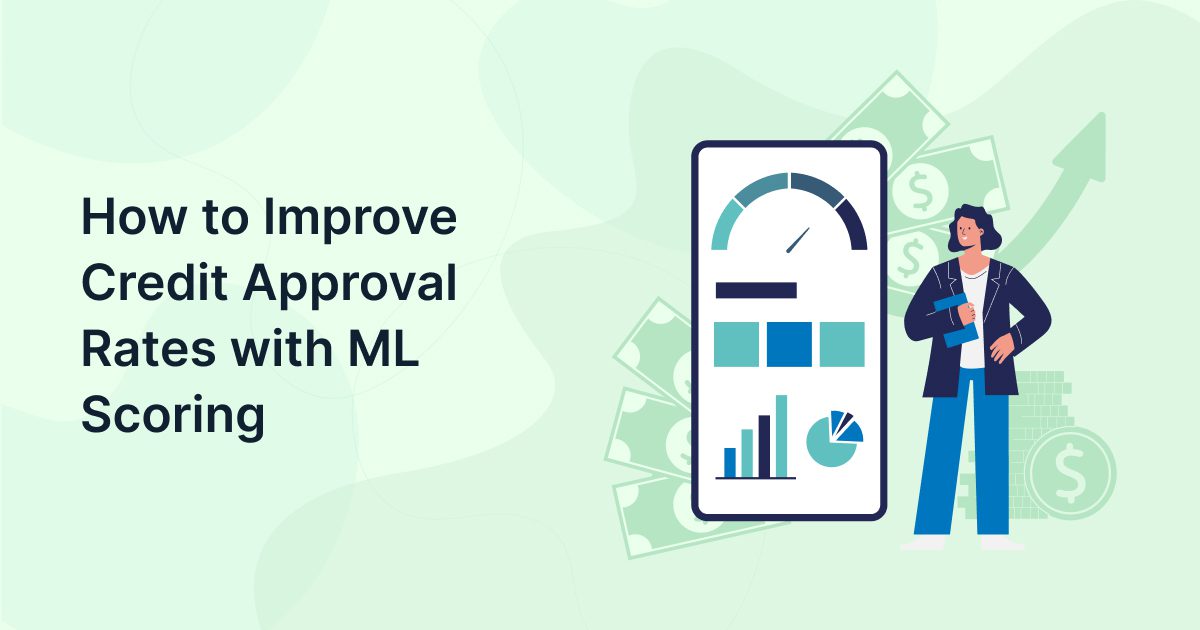
ML scoring can improve credit approval rates by analysing more than bureau history. It uses signals such as cash flow, transaction behaviour, repayment patterns, and business activity to identify creditworthy applicants that traditional models often reject, without removing risk controls.
A rejected loan application is not always a bad loan. Sometimes, it is simply an application with incomplete information.
This is a common problem for Indian banks, NBFCs, and fintechs. Traditional credit scores work well when a borrower has a long bureau history, stable income records, and complete documentation. They are less effective for first-time borrowers, self-employed applicants, small merchants, and MSMEs with irregular but healthy cash flows.
Fintly’s machine learning scoring solution helps lenders analyse additional borrower signals, assess risk more accurately, and make faster credit decisions.
The result is a difficult trade-off. Lenders tighten approval rules to control defaults, but they also reject borrowers who could have repaid successfully.
Key Takeaways
- Traditional credit scores can reject good borrowers because they rely heavily on bureau history, declared income, and standard documentation.
- ML scoring analyses additional signals, including cash flow, digital transactions, repayment behaviour, GST records, and business activity.
- Lenders can use predictive scoring to identify creditworthy thin-file borrowers, self-employed applicants, small merchants, and MSMEs.
- Higher approval rates should always be measured alongside delinquency, fraud, first-payment default, collection costs, and profitability.
- ML scoring works best when combined with affordability checks, fraud controls, policy rules, human review, and continuous model monitoring.
- The goal is not to approve every applicant. It is to help lenders make faster, more accurate, and better-informed credit decisions.
Why Traditional Credit Scores Reject Good Borrowers
Traditional credit scoring depends heavily on bureau records, declared income, existing loans, and repayment history. These indicators are useful, but they do not provide a complete picture of every borrower.
A borrower may be rejected because –
- They have no previous loan history.
- Their bureau file is too short to generate a reliable score.
- Their income comes from multiple sources.
- Their business has seasonal revenue.
- They lack audited financial statements.
- Their documents are incomplete or inconsistent.
- They have missed one payment but remain financially stable.
- They operate mainly through digital transactions instead of formal payroll records.
These limitations affect small businesses.
|
Did you Know? “According to the Small Industries Development Bank of India (SIDBI), India’s MSME sector had an addressable credit gap of about ₹30 lakh crore in 2025, equal to roughly 24% of addressable debt demand. The gap was higher for women-owned MSMEs, at about 35%.” |
This does not mean every rejected applicant should be approved. It does mean that a lender should distinguish between high risk and insufficiently understood risk.
What is the cost of conservative approval?
A highly conservative policy can protect a lender from some losses. It can also create hidden costs –
- Lost interest income from good borrowers.
- Lower customer lifetime value.
- Higher customer acquisition costs.
- More manual reviews and exception handling.
- Reduced reach in underserved segments.
- Customer migration to faster digital lenders.
- Lower portfolio growth despite strong market demand.
The question is not whether lenders should control risk. The question is whether they are using enough relevant information to control it accurately.

How Does AI Credit Scoring Work?
AI credit scoring uses machine learning models to identify relationships between borrower characteristics and repayment outcomes.
Machine learning is a method in which software learns patterns from historical data. Instead of relying only on a fixed set of rules, the model evaluates how different signals interact and how those combinations relate to past repayment behaviour.
A typical ML scoring process includes –
- Collecting consented borrower and financial data.
- Cleaning and standardising the information.
- Creating relevant variables, such as average monthly cash inflow.
- Comparing applicant patterns with historical repayment outcomes.
- Generating a risk score or probability of repayment.
- Combining the score with lender policy rules.
- Routing the application for approval, review, or rejection.
The output is not a simple “good borrower” or “bad borrower” label. It is a structured estimate of risk that helps the lender decide what to do next.
For example, an applicant with a thin bureau file may still show stable monthly inflows, regular supplier payments, low cheque bounce frequency, and consistent digital collections. Traditional scoring may not capture all of this. Predictive scoring can bring these signals into the decision.
What data does ML scoring analyse?
Depending on the product, consent framework, and regulatory requirements, lenders can evaluate:
- Bank account inflows and outflows.
- Income regularity.
- GST and invoice information.
- UPI and digital payment activity.
- Repayment behaviour on existing credit.
- Business transaction volume.
- Seasonal changes in revenue.
- Debt obligations and cash-flow pressure.
- Account balance trends.
- Customer application behaviour.
Alternative data means information beyond conventional bureau and declared-income records. It is useful only when it has a clear relationship with repayment ability and is collected lawfully.
How Can ML Increase Loan Approval Rates?
ML can increase loan approvals by reducing uncertainty. It gives lenders more evidence when traditional records are limited or incomplete.
The model does not need to approve every borderline application. Instead, it can separate applicants into more precise risk groups –
- Applicants who meet the policy for automatic approval.
- Applicants who need a document or affordability check.
- Applicants suitable for a lower loan amount or shorter tenure.
- Applicants who require manual review.
- Applicants who should be rejected because of clear risk signals.
This approach is more effective than using one strict score cut-off for everyone.
Which borrowers can ML help lenders assess?
Machine Learning scoring is particularly useful for –
- New-to-credit customers.
- Self-employed professionals.
- Small retailers and merchants.
- Micro and small enterprises.
- Borrowers with irregular monthly income.
- Businesses with seasonal sales.
- Customers with limited formal documentation.
- Applicants whose financial activity is visible through digital payments.
India’s formal financial footprint has expanded significantly.
|
Industry Stat The World Bank’s Global Findex 2021 found that account ownership among Indian adults increased from 35% in 2011 to 78% in 2021. The same country brief also reported that 35% of accounts were inactive, which shows why account ownership alone is not enough; lenders must examine actual usage and financial behaviour. |
How does ML reduce false rejections?
A false rejection occurs when a lender declines an applicant who could have repaid successfully.
Traditional rules can produce false rejections when they treat missing data as negative data. For example, an applicant with no bureau history might automatically fall below the approval threshold. ML scoring can examine other evidence before reaching that decision.
The model may detect –
- Stable account credits over several months.
- Regular customer payments.
- Low dependence on short-term borrowing.
- Consistent repayment of utility or financial obligations.
- Healthy revenue despite seasonal fluctuations.
- A gradual improvement in cash flow.
This creates a more detailed view of the applicant. It also allows lenders to apply risk-based decisions, such as approving a smaller amount initially and increasing the limit after good repayment performance.
For lenders evaluating machine learning scoring for faster credit decisions, the focus should be on improving decision quality, not simply increasing the approval percentage.
What guardrails keep approval growth safe?
Approval growth should always be measured with portfolio quality. Important controls include –
- Minimum bureau and repayment checks.
- Income or cash-flow affordability thresholds.
- Identity and fraud screening.
- Exposure limits for new borrower segments.
- Human review for borderline cases.
- Fairness testing across relevant customer groups.
- Model explainability for internal teams.
- Monitoring of early delinquency and first-payment default.
- Regular validation against actual repayment outcomes.
An approval-rate increase is valuable only when it produces acceptable risk-adjusted returns.
What Alternative Data Should Lenders Use?
Not all data improves credit decisions. More data can create more noise, bias, and privacy risk if lenders do not establish clear controls.
The most useful signals are those that help answer three questions –
- Does the borrower have reliable income or business inflows?
- Can the borrower afford the proposed repayment?
- Has the borrower shown a pattern of meeting financial obligations?
| Alternative signal | What it can indicate | Important control |
| Regular account credits | Stability of income or business inflows | Separate genuine revenue from transfers |
| Payment frequency | Customer demand and operating activity | Account for seasonal businesses |
| Expense patterns | Cash-flow pressure | Distinguish necessary costs from financial distress |
| GST or invoice activity | Reported sales and business continuity | Check filing consistency and data quality |
| Repayment behaviour | Willingness and ability to repay | Consider loan size and previous context |
| Digital transaction history | Collection regularity and operating activity | Obtain consent and protect personal data |
A lender should also avoid using signals that act as indirect proxies for protected or sensitive characteristics. Every input needs a business reason, governance process, and performance test.
The best practice is to combine alternative data with existing credit information. A borrower’s cash flow can explain what a bureau score does not show, while bureau history can provide valuable evidence of past repayment.
How Should Lenders Build an ML Approval Strategy?
A successful ML programme starts with a specific lending problem. “Use AI for credit” is too broad to guide implementation.
A better starting point is –
“Which applicants are we currently rejecting because we lack sufficient information, and how have similar borrowers performed in the past?”
Lenders can follow this process –
- Define the target outcome
Decide whether the model will predict repayment, delinquency, fraud, loss severity, or another measurable outcome. The target must match the lending decision.
- Study rejected applicants
Review historical applications that were rejected under traditional rules. Identify whether some later received credit elsewhere and repaid successfully.
- Audit data quality
Check whether the available data is complete, accurate, timely, and legally usable. Poor data produces unreliable scores.
- Build and test the model
Train the model on historical cases with known outcomes. Test it on separate data to check whether it performs consistently.
- Create approval bands
Avoid using only one cut-off. Create different bands for automatic approval, manual review, conditional approval, and rejection.
- Add policy rules
Use the model alongside affordability, fraud, product, exposure, and regulatory rules. ML scoring should not override mandatory controls.
- Run a controlled pilot
Start with a limited product, geography, borrower segment, or loan amount. Compare the pilot with the existing policy.
- Monitor the portfolio
Track approval rate, turnaround time, delinquency, fraud, collection cost, profitability, and customer retention.
For lenders planning the technical and operational rollout, this guide on how to build an ML scoring system for faster credit decisioning provides a useful next step.
Illustrative Case Study
Note: This is an illustrative example, not a reported Fintly customer result.
An NBFC receives 10,000 small-ticket loan applications each month. Its traditional policy approves 3,500 applications. Many of the rejected applicants have short bureau histories, irregular income, or incomplete business records.
The NBFC adds an ML scoring layer using:
- Bureau history.
- Bank cash-flow patterns.
- Digital collection activity.
- Existing repayment behaviour.
- Fraud indicators.
- Affordability measures.
The model identifies 1,000 applicants who were previously rejected but appear suitable for additional review. After affordability and fraud checks, 600 receive approval with controlled loan amounts.
The lender does not declare success merely because approvals increased. It monitors:
- First-payment default.
- 30-, 60-, and 90-day delinquency.
- Fraud rate.
- Collection costs.
- Net interest margin.
- Repeat borrowing.
- Performance by borrower segment.
If the additional 600 loans perform within the lender’s risk limits, the approval strategy can expand. If early delinquency rises, the lender can adjust the score threshold, loan amount, or product terms.
That is the right way to increase loan approvals with AI: expand access through evidence, then validate the outcome through portfolio performance.
What Are the Limits of ML Scoring?
ML scoring is not a replacement for credit judgment. It is a decision-support system.
There are situations where manual underwriting still makes sense:
- Complex business loans.
- High-value exposures.
- Unusual income patterns.
- New industries with limited historical data.
- Restructuring or hardship cases.
- Applications requiring qualitative business assessment.
Machine learning also has limitations:
- Poor source data leads to poor predictions.
- Historical bias can be repeated by the model.
- Economic shocks can change borrower behaviour.
- A high score does not guarantee repayment.
- Models can become less accurate as products and customer segments change.
- Automated decisions can be difficult to explain without proper documentation.
A sound operating model combines model output, policy controls, human review, and continuous monitoring.
What Happens If Lenders Do Nothing?
The cost of inaction is not limited to missed applications.
When traditional approval rules remain unchanged:
- Good borrowers continue to be rejected.
- Manual teams handle more exceptions.
- Processing costs remain high.
- Competitors acquire underserved customers.
- MSMEs depend on informal or expensive credit.
- Lenders lose valuable repayment and transaction data.
- Portfolio growth slows without a clear improvement in risk.
A lender that cannot distinguish between “high risk” and “not enough information” will keep rejecting opportunities. Over time, this weakens both customer acquisition and market coverage.
How Fintly Supports ML-Based Credit Decisioning
Fintly helps banks, NBFCs, and fintechs use machine learning in credit decisioning workflows. Its approach is focused on using borrower data to support faster, more consistent, and better-informed decisions.
Lenders can use an ML-based scoring layer to:
- Assess applications using multiple data signals.
- Identify applicants who need additional review.
- Route cases according to configured policies.
- Support faster loan sanctions.
- Monitor decisions and portfolio outcomes.
- Reduce unnecessary manual intervention.
The objective is not automatic approval of every applicant. It is to give credit teams better evidence before they approve or reject an application.
You can also read how lenders can accelerate loan sanctions with Fintly’s ML ScoreEngine to understand how ML-based decisioning can fit into a faster lending process.
Conclusion
ML scoring can help lenders improve credit approval rates by using relevant financial and behavioural data beyond traditional bureau records. It is especially useful for thin-file borrowers, self-employed applicants, small merchants & MSMEs that conventional models often assess poorly.
The right strategy is not to lower standards. It is to improve the quality of evidence behind each decision, combine predictive scoring with affordability and fraud controls, and monitor repayment outcomes after approval.
If your lending team wants to identify more creditworthy applicants without losing control of risk, contact Fintly’s team to discuss your credit decisioning requirements.
 QUICK ANSWERS
Frequently Asked Questions
Your most common questions, answered with precision and insight
ML scoring analyses data beyond traditional bureau records, such as cash flow, transaction activity, and repayment behaviour. This helps lenders identify creditworthy applicants who may otherwise be rejected because they have limited credit history or incomplete documentation.
AI credit scoring studies patterns in historical borrower data and repayment outcomes. It then assigns a risk score to each applicant, helping lenders decide whether to approve, review, or reject the application.
Traditional scores often depend on bureau history, declared income, and standard documents. Borrowers with no credit history, irregular income, or seasonal business revenue may be rejected even when they can repay the loan.
Yes. ML scoring can assess signals such as bank cash flows, digital payments, income patterns, and business activity. Lenders can combine these insights with smaller loan amounts, affordability checks, and repayment monitoring.
Lenders can assess consented data such as bank inflows, transaction activity, GST records, invoice history, digital collections, and repayment patterns. The data should be relevant, accurate, secure, and legally obtained.
ML scoring is safer when combined with data-quality checks, fraud controls, model monitoring, fairness testing, and human review. It should support credit policy rather than operate as an unchecked approval system.
Yes, if lenders use ML to identify overlooked low-risk borrowers and monitor repayment performance. Approval rates should be measured alongside delinquency, fraud, first-payment default, and collection costs.
Manual underwriting is useful for complex loans, high-value applications, unusual income patterns, and exception cases. ML scoring works best for repeatable applications where relevant historical data is available.

Author
Subject Matter Expert (Lending) Fintly.co
Vijay Mali is a results-driven professional with deep expertise in HFC/NBFC startups, compliance, and underwriting. He specializes in delivering end-to-end solutions for financial institutions, focusing on Business Rule Engines (BRE), workflow automation, and AI-driven credit decision-making. He is passionate about leveraging Machine Learning (ML) scorecards and AI-powered risk assessment to optimize lending processes and drive digital transformation in the financial sector.