Summary
Integrating model risk management AI is the crucial bridge between cutting-edge data science and strict regulatory adherence. For institutions looking to scale safely, relying on standard manual audits isn’t enough. By deploying advanced tools like Fintly Machine Learning Scoring, which brings transparency to complex algorithms, lenders can continuously monitor their decision engines, ensuring responsible AI finance remains at the core of every automated credit approval.
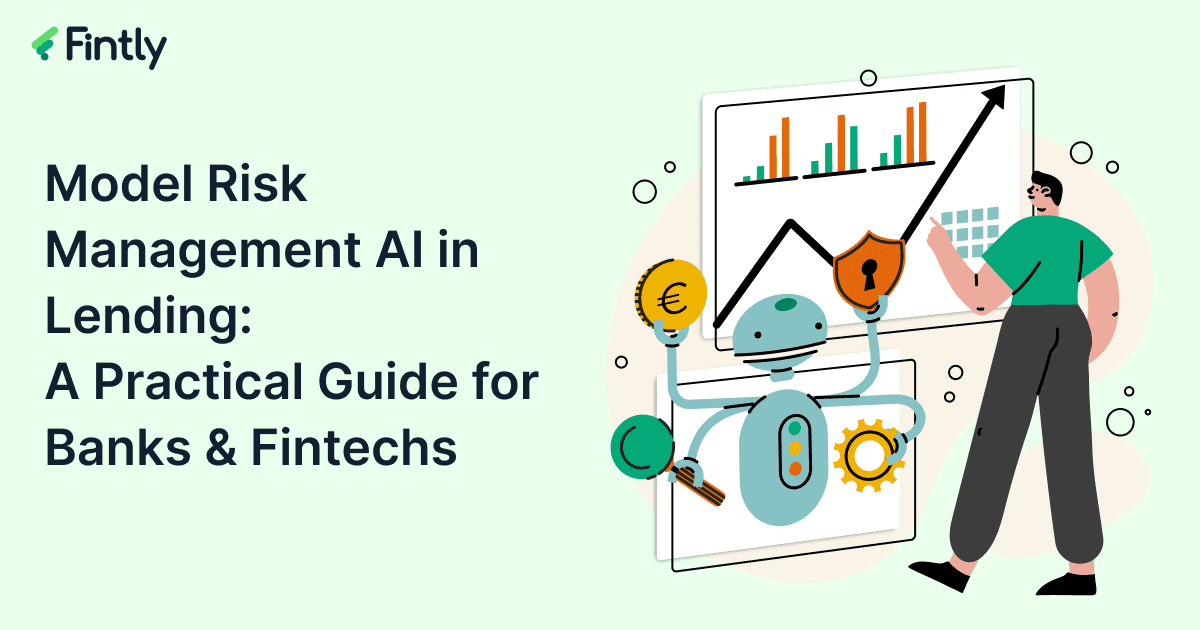
Banks are replacing decades-old credit scorecards with machine learning. It makes sense: algorithms process thousands of data points in seconds, expanding credit access and catching hidden fraud. But what happens when the algorithm is wrong, biased, or simply unexplainable? The financial fallout and regulatory fines can be devastating. This is why mastering model risk management AI is no longer optional for modern financial institutions.
In this guide, you will learn exactly what is model risk management, how hidden algorithmic biases threaten your loan portfolio, and the steps required to build a resilient framework. Whether you are a Chief Risk Officer at a traditional bank or a fintech founder, understanding model risk management AI ensures your automated credit decisions remain both innovative and legally sound.

What is model risk management AI?
What is model risk management AI? It is the continuous process of identifying, measuring, and mitigating the financial, operational, and regulatory risks created by artificial intelligence models used in automated credit decisioning.
Traditional risk management looked at static spreadsheets and simple regression models. You knew exactly why an applicant was denied. Model risk management AI deals with dynamic, self-learning systems. Because these machine learning models evolve as they ingest new data, the risk of “concept drift” (where a model’s predictions degrade over time because the real-world environment changed) is incredibly high.
Understanding what is model risk management in this new era means realizing that algorithms are not set-it-and-forget-it tools. Proper AI governance lending strategies require constant mathematical validation to ensure these models do not accidentally discriminate or violate fair lending laws.
The Hidden AI Risks in Modern Lending
When a human loan officer makes a bad call, you can retrain the officer. When an algorithm makes a bad call at scale, it can cost millions before anyone notices it. Effective model risk management AI targets three specific hidden threats:
- Concept Drift: As macroeconomic conditions shift (like sudden inflation or unemployment spikes), the historical data your model trained on becomes obsolete.
- Algorithmic Bias: If historical lending data contains human prejudices, the AI will learn, operationalize, and amplify them.
- The Black Box Problem: Complex neural networks often cannot explain the exact weighted variables that led them to deny a specific loan.
In 2023, the Consumer Financial Protection Bureau (CFPB) explicitly warned lenders that using complex, opaque algorithms does not absolve them from providing specific, accurate reasons for denying credit. The agency noted that non-compliance with adverse action notice requirements leads directly to fair lending violations. This regulatory stance illustrates exactly why ML compliance banking is an urgent priority.
If your system is flagged for bias, you don’t just face financial penalties; you lose consumer trust. This is where active model risk management AI steps in to flag anomalies early, much like the systematic monitoring strategies discussed in our breakdown on machine learning based anomaly detection for fraud prevention.
Building a Resilient AI Governance Lending Framework
How do banks govern AI models efficiently? They build layered, continuous defense systems. A strong AI governance lending framework ensures that every algorithm is stress-tested before launch and monitored daily thereafter.
To effectively implement AI governance lending, institutions must break down silos between the data scientists who build the models and the risk officers who police them. How do banks govern AI models in practice? They establish cross-functional AI ethics boards and demand strict documentation for every alternative data variable an algorithm considers. This level of AI governance lending ensures you never have to guess why a model made a specific choice during a regulatory audit.
Here is how traditional model risk compares to modern framework requirements:
| Feature | Traditional Model Risk | Modern AI Governance Lending |
| Model Updates | Manual, periodic (yearly) | Dynamic, continuous monitoring |
| Explainability | High (linear rules) | Low without specific “explainable AI” tools |
| Data Sources | Internal credit history | Alternative data (rent, utility, behavior) |
| Primary Risk | Human data entry errors | Algorithmic bias and concept drift |
This structured approach is a cornerstone of responsible AI finance, ensuring that as your algorithms learn, they remain within the guardrails of your institution’s risk appetite. By prioritizing responsible AI finance, you protect your balance sheet and your reputation simultaneously.
Navigating ML Compliance Banking & Regulatory Shifts
Regulators are actively catching up to data scientists. ML compliance banking is no longer just about avoiding obvious redlining; it is about mathematically proving fairness across protected classes.
When banking leaders ask, “how do banks govern AI models,” they are usually reacting to strict guidelines like the Federal Reserve’s SR 11-7, which set the historical baseline for model validation. However, ML compliance banking is rapidly evolving. Regulators now demand total transparency into alternative data sources. If an algorithm denies a loan based on factors like an applicant’s digital footprint or peer network, similar to the complex behavioral risks seen in detecting P2P lending fraud, the lender must be able to justify the business necessity of that variable.
A recent survey by the Bank of England found that 72% of financial firms are already using or developing ML applications. As adoption scales, ML compliance banking frameworks must scale proportionately. Effective model risk management AI requires automated compliance checks that run concurrently with your credit decision engine. Without strict ML compliance banking protocols, digital innovation rapidly becomes a legal liability.
Best Practices for Responsible AI Finance
True responsible AI finance requires much more than a compliance checklist. It demands a culture where ethical data usage is prioritized directly alongside predictive accuracy. Implementing responsible AI finance means actively looking for ways your model might fail minorities, low-income earners, or small businesses before a regulator does it for you.
Here are the best practices for embedding model risk management AI into your daily operations:
- Implement “Human-in-the-Loop” Systems: Never let an algorithm make a final, unappealable rejection on a borderline case without human review.
- Conduct Routine Bias Audits: Stress-test your models against protected class data to ensure mathematical fairness. This is a core pillar of responsible AI finance.
- Prioritize Explainability: Use interpretable machine learning techniques (like SHAP values) so you can generate clear adverse action notices for consumers.
- Leverage Automated Trust Tools: Manual audits are simply too slow. Utilize continuous monitoring solutions like Fintly TrustAudit to automatically detect drift and bias in real-time.
How do banks govern AI models effectively? By combining these best practices into a unified strategy. Understanding what is model risk management is only the first step; executing it through responsible AI finance is the ongoing operational reality.
Conclusion
Embracing artificial intelligence in lending offers unprecedented speed and accuracy, but it introduces complex systemic vulnerabilities. Mastering model risk management AI is the only way to scale your loan portfolio without multiplying your regulatory exposure. By establishing a rigorous AI governance lending framework and committing to responsible AI finance, institutions can protect both their consumers and their bottom line. The question is no longer whether you will use machine learning, but how safely you can deploy it.
To ensure your credit algorithms remain fair, compliant, and transparent, Contact Us to schedule a demo of our automated AI auditing solutions today.

QUICK ANSWERS
Frequently Asked Questions (FAQs)
Your most common questions, answered with precision and insight
It is the practice of identifying, evaluating, and mitigating the risks associated with using predictive mathematical models. In the context of model risk management AI, it specifically focuses on preventing algorithmic bias, data drift, and regulatory violations in automated credit decisions
They implement strict frameworks that require comprehensive documentation, independent validation, and continuous performance monitoring. This ensures models comply with fair lending laws and stay within internal risk limits.
ML compliance banking is challenging because deep learning models act as “black boxes,” making it hard to explain exactly why a specific credit decision was made. Regulators require clear explanations for credit denials, forcing banks to adopt explainable AI techniques.
Responsible AI finance involves fairness, transparency, accountability, and privacy. It means actively testing models for bias against protected groups and ensuring that AI-driven financial products do not cause unintended consumer harm.
Traditional models were audited annually, but model risk management AI requires continuous, real-time monitoring. Because economic conditions and consumer behaviors change rapidly, continuous auditing is the only way to maintain strict ML compliance banking standards.

Author
Subject Matter Expert (Lending) Fintly.co
Vijay Mali is a results-driven professional with deep expertise in HFC/NBFC startups, compliance, and underwriting. He specializes in delivering end-to-end solutions for financial institutions, focusing on Business Rule Engines (BRE), workflow automation, and AI-driven credit decision-making. He is passionate about leveraging Machine Learning (ML) scorecards and AI-powered risk assessment to optimize lending processes and drive digital transformation in the financial sector.