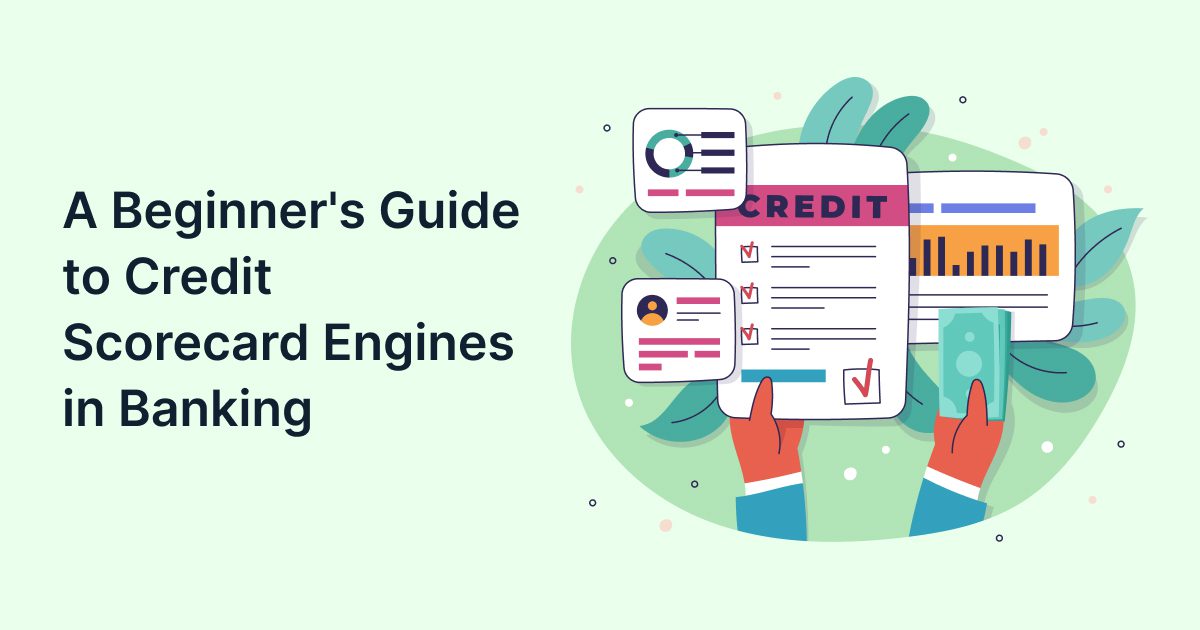
A scorecard engine is software that automatically calculates a borrower’s credit score using a defined set of rules and data inputs, then maps that score to a risk band and decision (approve, reject, or refer) so lenders can make fast, consistent credit decisions.
If your risk team is still relying on spreadsheets, gut feel, or static scoring sheets, you already know the pain: inconsistent decisions, long turnaround times, and portfolios that are hard to predict. In India’s fast-growing digital lending environment, that approach does not scale.
In this guide, you’ll learn what a scorecard engine is, how it differs from a simple credit score, and how banks and NBFCs in India use it to automate underwriting while staying in control of risk policy. We’ll also look at where manual review still makes sense, what can go wrong, and how to measure whether your scorecard is working.
For lenders evaluating platforms, Fintly’s machine learning scoring and risk automation capabilities provide a configurable foundation to deploy credit scorecards and rule engines without building from scratch.
What is a scorecard engine, and why does it matter now?
A scorecard engine is the “brain” behind your credit scorecard. It takes applicant data (income, existing EMIs, bureau score, bank statement signals, etc.), runs it through a pre-defined scoring model, and outputs:
- A numeric credit score (for that specific product or segment)
- A risk band (e.g., low/medium/high)
- A recommended decision (approve, reject, or refer for manual review)
- Sometimes, inputs for pricing (interest rate, fees) or limits
Unlike a raw credit score from a bureau, which is a generic number, a scorecard engine applies your risk logic, cut-offs, and business rules. It is a core part of a credit decisioning engine, the system that moves an application from “received” to “approved/rejected” in seconds.

Why does this matter now?
- Digital lending volumes in India have grown sharply, with regulators pushing for clearer, data-driven underwriting and fair treatment of borrowers.
- Lenders are expected to process high volumes of small-ticket loans with tight turnaround times and consistent risk standards.
- Manual or semi-manual scoring breaks down at scale: it is slow, inconsistent, and hard to audit.
If your credit team is drowning in applications and still debating each file, a scorecard engine is not a “nice-to-have”; it is basic infrastructure for disciplined growth.
How is a credit scorecard different from a credit score?
People often use “credit score” and “credit scorecard” interchangeably, but they are not the same.
- Credit score: A single number (e.g., 750) generated by a credit bureau or an internal model, summarising a borrower’s creditworthiness based on historical data.
- Credit scorecard: The structured model (variables, weights, cut-offs) that turns raw data into that score and then into a decision. Think of the scorecard as the recipe; the score is the dish.
In practice, lenders use multiple types of scorecards across the loan lifecycle:
- Application scorecard: Used at the time of a new loan application to predict approval likelihood and default risk.
- Behavioural scorecard: Used for existing customers, based on repayment history, utilisation, and account behaviour.
- Fraud scorecard: Flags suspicious applications using identity, device, and behavioural signals.
- Collection scorecard: Prioritises overdue accounts based on recovery probability.
A scorecard engine is what runs these scorecards in production, consistently and at scale.
What are the core components of a scorecard engine?
A production-grade scorecard engine typically has five core components:
1. Data inputs
- Applicant details (age, occupation, city)
- Income and employment stability
- Bureau data (score, delinquencies, inquiries)
- Bank statement or cash-flow signals (for MSMEs and salaried)
- Internal data (past loans, repayments, complaints)
2. Scoring logic and weights
- Variables selected based on statistical analysis (e.g., logistic regression, decision trees)
- Weights assigned to each variable based on predictive power
- Transformation rules (e.g., binning income into ranges, handling missing values)
3. Rule engine layer
- Hard policy rules (e.g., “reject if CIBIL < 600”, “refer if DTI > 55%”)
- Overrides and exceptions (e.g., high-income professionals with thin files)
- Segmentation rules (different scorecards for salaried vs self-employed)
4. Cut-off and decision mapping
- Score bands mapped to decisions:
- Low risk → approve, standard pricing
- Medium risk → approve with higher pricing or lower limit, or refer
- High risk → reject
- Alignment with risk appetite and capital constraints (Basel norms, internal risk limits)
5. Outputs and integration
- Score, risk band, decision, and reason codes
- API responses to loan origination systems (LOS), core banking, or mobile apps
- Logs for audit, model monitoring, and regulatory reporting
Fintly’s machine learning scoring and risk automation capabilities are built around this structure: you define your risk logic, Fintly’s engine executes it consistently across channels, and your team gets real-time visibility into decisions and risk metrics.
How do banks in India actually use scorecard engines today?
Indian banks, NBFCs & fintechs use scorecard engines across multiple products:
- Personal loans and consumer finance
- High-volume, small-ticket lending where manual underwriting is impossible.
- MSME working capital loans
- “Working capital” here means short-term funds used for day-to-day operations (inventory, salaries, receivables). Scorecards help assess cash-flow stability and repayment capacity.[idfy]
- Credit cards and BNPL
- Instant or near-instant approval decisions at point of sale or in-app.
- Pre-approved offers and top-ups
- Behavioural scorecards identify existing customers eligible for pre-approved limits.
- Portfolio monitoring
- Early warning signals for deteriorating accounts using behavioural and collection scorecards.
A 2020 World Bank technical guide on credit scoring notes that well-designed scorecards can improve both access to credit and portfolio quality, especially when combined with strong data and governance. In India, where digital credit is expanding rapidly, scorecard engines are becoming table stakes for any serious lender.
Rule engine vs model-based scoring: which should you use?
Not all scorecard engines are built the same. Some rely mostly on a rule engine (if-then logic), while others use statistical or machine learning models to generate scores. Most mature setups use a hybrid.
Rule-based scorecards
- Use explicit business rules: “If CIBIL < 650 and DTI > 50%, then reject.”
- Easy to explain to regulators, auditors, and business stakeholders.
- Work well when you have clear, stable policies and limited data.
Model-based (ML/statistical) scorecards
- Use statistical techniques (e.g., logistic regression, gradient boosting) to estimate probability of default (PD) based on historical data.
- Can capture complex, non-linear relationships between variables.
- Require good-quality historical data, ongoing monitoring & model governance.
Hybrid approach (recommended for most lenders)
- Use a statistical model to generate a base score.
- Layer a rule engine on top for policy constraints, hard decliners & exceptions.
- Periodically recalibrate the model as your portfolio and market conditions evolve.
| Aspect | Rule-based scorecard | ML-based scorecard |
| Data requirements | Moderate; can work with limited history | Higher; needs robust historical data |
| Interpretability | Very high; rules are transparent | Moderate; needs explainability tools |
| Setup time | Faster for simple policies | Longer; requires model development and validation |
| Maintenance | Easier to tweak rules | Requires model monitoring and periodic retraining |
| Best use cases | Simple products, clear policies, early stage | High-volume, complex segments, mature data |
For many Indian lenders, starting with a rule-based or simple statistical scorecard, then gradually introducing more advanced ML components, is a pragmatic path. Fintly supports both: you can start with a rule engine for clear policy enforcement and layer in machine learning models as your data and risk maturity grow.
Illustrative example (How does a typical scorecard workflow look like): Small NBFC, 1,000 applications/day
Imagine a small NBFC offering ₹50,000–₹2,00,000 personal loans to salaried customers in metro cities.
- Daily volume: Approximately 1,000 applications
- Current process: Manual underwriting for all, average TAT 2–3 days.
- Problem: Inconsistent decisions, high operational cost, lost customers who drop off.
After implementing a scorecard engine:
- Inputs used: CIBIL score, monthly income, existing EMIs, company category, city, bank statement ITR-linked income.
- Scorecard logic:
- Base score from a logistic regression model (PD estimation).
- Rules:
- Reject if CIBIL < 620.
- Refer if DTI > 55% but income > ₹60,000.
- Auto-approve if score > 700 and no recent delinquencies.
- Result:
- 60–70% of applications auto-approved or auto-rejected in seconds.
- Manual team focuses only on borderline cases.
- Turnaround time drops from days to minutes for most customers.
- Portfolio performance becomes easier to track by score band.
This is the kind of workflow Fintly helps lenders implement: clear policy, automated decisions & a feedback loop to continuously refine the scorecard.
Why are manual or static scoring processes a problem?
Many lenders start with manual or spreadsheet-based scoring. That can work at very small scale. But as volumes grow, the cracks show:
- Inconsistent decisions
- Two underwriters can reach different conclusions on similar files.
- Hard to enforce a coherent risk appetite across branches or channels.
- Slow turnaround times
- Each file takes 30–60 minutes (or more) of human time.
- Customers drop off; competitors with faster processes win the business.
- Poor scalability
- To double loan volumes, you almost double your underwriting team.
- Hiring, training, and supervising large underwriting teams is expensive and risky.
- Regulatory and audit risk
- Regulators increasingly expect documented, data-driven credit processes and fair treatment of borrowers.[atlantis-press]
- Manual processes are harder to audit and explain.
Industry analyses of credit risk in India highlight that lenders using structured scorecards and automated decisioning can better manage portfolio risk while scaling volumes. The cost of inaction is real: lost market share, higher operational costs, and a portfolio whose risk profile you do not fully understand until defaults start rising.
Lenders that move from manual checks to automated scorecards routinely see loan approval times drop by 35–65%, depending on product complexity and data quality. For a practical breakdown of how this works in real implementations, see our guide on reducing loan approval time using automated credit scoring.
What are the risks and limitations of scorecard engines?
Scorecard engines are powerful, but they are not magic. A contrarian but important view: automation does not eliminate the need for human judgment.
Key limitations and risks:
- Data quality dependence
- A scorecard is only as good as the data it is built on.
- Incomplete, biased, or outdated data will produce unreliable scores.
- Model drift
- Economic conditions, customer behaviour, and fraud patterns change over time.
- A scorecard that worked well last year may degrade if not monitored and recalibrated.
- Over-reliance on auto-decisions
- Complex MSMEs, high-ticket loans, or unusual profiles may need nuanced assessment beyond what a standard scorecard can capture.
- Blindly trusting the engine can lead to systematic mispricing or missed opportunities.
- Explainability and fairness
- Regulators and customers expect reasons for rejection.
- Highly complex ML models without proper explainability can create compliance and reputational risk.
Where does manual review still make sense?
- High-value corporate or MSME loans with complex cash flows.
- Applicants with thin files but strong contextual signals (e.g., new business in a known ecosystem).
- Cases flagged by fraud or collection scorecards that need human investigation.
The goal is not “fully automated, no humans”. The goal is consistent, data-driven decisions with humans focused on exceptions and judgment-heavy cases.
How do you measure if your scorecard engine is working?
You cannot manage what you do not measure. For a scorecard engine, track both risk and operational metrics:
- Approval rate
- % of applications approved overall and by segment.
- Default rate by score band
- Are higher-score bands actually seeing lower defaults?
- If not, your scorecard may be mis-calibrated.
- Portfolio loss and PD/LGD/EAD metrics
- “PD” (probability of default), “LGD” (loss given default), and “EAD” (exposure at default) are core risk metrics used under Basel norms.
- Compare actual losses to expected losses by score band.
- Turnaround time (TAT)
- Average time from application to decision.
- % of applications decided within target SLA (e.g., <5 minutes).
- % auto-decided cases
- Proportion of applications handled without manual intervention.
- Helps quantify operational efficiency gains.
- Override rates and outcomes
- How often do underwriters override the engine’s recommendation?
- Do overridden cases perform better or worse than engine-recommended ones?
If these metrics are not improving over time, your scorecard or its governance needs attention.
How can Fintly help you implement a scorecard engine?
Fintly is an AI lending and finance automation platform built for banks, NBFCs, and fintechs in India. Our machine learning scoring and risk automation module is designed to help you:
- Define and deploy credit scorecards for different products and segments.
- Configure a flexible rule engine around your risk policies and cut-offs.
- Integrate with your existing loan origination, core banking & data sources via APIs.
- Monitor score performance, overrides, and portfolio risk in real time.
Instead of building a scorecard engine from scratch, which can take months and significant data science and engineering bandwidth. Fintly gives you a configurable platform with best practices baked in. You focus on risk strategy; we handle the execution layer.
What should you do next if you’re still using spreadsheets or ad‑hoc scoring?
If your current process relies on gut feel, ad-hoc Excel models, or inconsistent manual checks, start with these steps:
1. Audit your current process
- Map how decisions are made today.
- Identify where inconsistency and delays occur.
2. Define your risk appetite
- What approval rates and default rates are acceptable for each product?
- What segments are priority vs no-go?
3. Choose your tooling approach
- Decide whether to build in-house or use a platform like Fintly.
- Ensure the tool supports both rule-based and model-based scoring.
4. Start with a pilot
- Pick one product (e.g., salaried personal loans).
- Build or configure a scorecard, run it in parallel with existing process, and compare outcomes.
5. Iterate and scale
- Refine variables, cut-offs, and rules based on performance.
- Gradually expand to other products and segments.
For deeper guidance on specific tactics, you can explore our post on optimizing credit approval rates using scorecard cutoff strategies which walk through practical levers to improve both risk and speed.
Conclusion
A scorecard engine is not just a technical module; it is the operational backbone of disciplined, scalable lending. It turns your risk policy into consistent, auditable decisions, fast enough for digital channels, robust enough for regulators & flexible enough for a changing market.
If you are still relying on manual or static scoring, the risk is not just slower growth. It is a portfolio whose risk you do not fully understand and a customer experience that will increasingly look outdated. The right scorecard engine helps you fix both.
Talk to our team to see how Fintly can help you design, deploy & monitor a scorecard engine tailored to your products and risk appetite.
 QUICK ANSWERS
Frequently Asked Questions (FAQs)
Your most common questions, answered with precision and insight
A scorecard engine is software that automatically calculates a borrower’s credit score using your own rules and data, then converts that score into a decision like approve, reject, or refer. It removes guesswork and ensures every application is judged by the same standards.
A credit score is just a number; a scorecard engine is the system that creates that number and decides what to do with it. The engine applies your risk logic, cut-offs & business rules on top of the raw score.
Yes, if they want to lend at scale with consistent risk and fast decisions. Even small lenders face high application volumes and regulatory expectations for documented, data-driven underwriting.
It can, if designed with alternative data (bank statements, cash flows, employment signals) and appropriate rules. However, thin-file segments often need a hybrid approach with some manual review.
Neither is “better” in all cases. Rule-based scorecards are simpler and more transparent; ML-based scorecards can capture complex patterns but need more data and governance. Most lenders use a hybrid.
At least once a year, or whenever you see significant changes in portfolio performance, economic conditions, or customer behaviour. Regular monitoring and periodic recalibration are essential.

Author
Subject Matter Expert (Lending) Fintly.co
Vijay Mali is a results-driven professional with deep expertise in HFC/NBFC startups, compliance, and underwriting. He specializes in delivering end-to-end solutions for financial institutions, focusing on Business Rule Engines (BRE), workflow automation, and AI-driven credit decision-making. He is passionate about leveraging Machine Learning (ML) scorecards and AI-powered risk assessment to optimize lending processes and drive digital transformation in the financial sector.