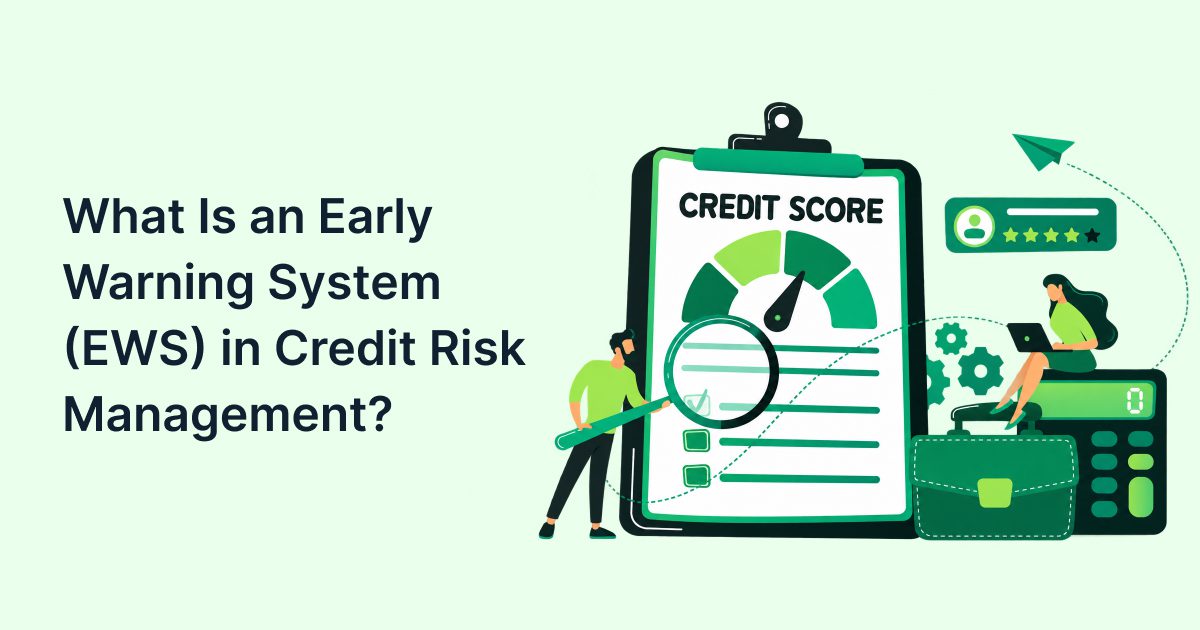
An Early Warning System (EWS) in credit risk management helps lenders detect signs of borrower stress before problems develop into serious delinquency or non-performing exposures. It monitors repayment behaviour, bank transactions, financial statements, bureau activity & other risk signals so risk teams can investigate, prioritise, and act earlier.
Lenders do not want to discover risk only after an account is 30 or 60 days past due. By that point, the borrower’s options are narrower, recovery costs are higher & the loss provision is more likely to be hit.
This guide explains what an Early Warning System credit risk framework is, which signals matter most, how to turn alerts into actions, and how to avoid common implementation mistakes. You will also see where an EWS fits alongside credit scoring, loan monitoring, and fraud detection in a modern lending stack.
For teams looking to operationalise continuous monitoring, Fintly’s AI-powered Early Warning System for credit risk monitoring combines transaction, financial-statement, behavioural, and portfolio-level signals into one workflow.
What is an Early Warning System in credit risk management?
An Early Warning System in credit risk management is a structured process and technology framework that helps lenders identify deteriorating borrower risk early enough to intervene. It brings together data, indicators, thresholds, review workflows & escalation rules so that risk signals do not sit in a dashboard but lead to documented action.
It is useful to separate four related ideas that are often mixed up –
- Early Warning System (EWS): The end-to-end framework for monitoring, prioritising, and acting on borrower risk signals.
- Early warning signal: A single trigger, such as a payment bounce, falling bank balance, or sudden rise in credit enquiries.
- Watchlist: A set of accounts that require closer monitoring or specific risk actions because they show early stress.
- Red-flagged account: An account that must be reviewed under the lender’s fraud-risk process because it meets defined fraud indicators.
RBI’s fraud-risk management directions require regulated entities to maintain an Early Warning Signals (EWS) framework for identifying potentially fraudulent accounts and a red-flagging process. This fraud-focused EWS should be distinguished from broader credit-risk early warning monitoring.

How does an EWS in banking work?
A practical EWS in banking follows a simple four-step cycle.
1. Collect data
The system pulls information from loan-management systems, repayment records, bank statements, credit-bureau feeds, financial statements & relevant external sources such as industry or macro indicators.
2. Detect signals
Predefined rules, thresholds, and analytical models scan this data for patterns that suggest rising risk, such as repeated payment failures or sustained cash-flow deterioration.
3. Prioritise accounts
Not all alerts are equal. The EWS scores each signal by materiality, exposure, severity, and confidence, then surfaces the accounts that need attention first.
4. Trigger action and track outcomes
Relationship managers, underwriters, or collections teams receive a review case with the reason for the alert, suggested next steps, and an assigned owner. The system records whether the account was reviewed, what action was taken, and whether the risk improved.
This closed-loop design: detect, explain, assign, act, and learn, is what separates a real EWS from a static risk report.
Which credit risk early warning signals should lenders track?
A single warning is not proof of default. Related signals appearing together are much more useful for prioritising review. An effective early warning system in lending tracks multiple layers of information and looks for consistent patterns rather than one-off events.
Repayment and behavioural signals
These are often the first visible signs of stress –
- EMI delays or partial payments
- Repeated NACH/ACH or cheque failures
- Rising days past due on any facility
- First-payment default on a new loan
- Frequent restructuring or rescheduling requests
- Consistent credit-limit overuse
Cash-flow and bank-statement signals
For business and MSME loans, bank statements often show stress before payments start missing –
- Sustained drop in average daily balance
- Reduced turnover or irregular customer receipts
- Increased cash withdrawals or unusual outflows
- Vendor or salary cheque returns
- A widening gap between inflows and fixed outflows
Financial and operational signals
These signals come from financial statements, management information, and operational data –
- Weakening debt-service coverage or interest coverage
- Delayed statutory payments such as GST or TDS
- Falling margins or persistent losses
- Loss of key customers or suppliers
- Management or promoter changes
- Missed covenants or reporting deadlines
Bureau, fraud, and external signals
External data adds another layer of context –
- Sharp rise in credit enquiries or new leverage
- Collateral irregularities or documentation gaps
- Adverse legal or regulatory news about the borrower
- Industry-wide stress or commodity-price shocks
- Unusual transaction patterns that suggest possible fraud
Credit Risk Early Warning Signals: What They Mean and What to Do Next
| Signal category | Example signal | What it could indicate | Suggested first action |
| Repayment | Repeated EMI delays | Cash-flow pressure or repayment prioritisation issues | Contact borrower; request updated cash-flow view; consider temporary relief only with evidence |
| Bank transactions | Sustained, material drop in average balance over a short period | Business slowdown or fund diversion | Validate with recent statements; pause additional drawdowns pending review |
| Financials | Declining debt-service coverage ratio | Reduced ability to service debt from operations | Reassess limit; request collateral top-up or promoter support |
| Operational | Loss of a major customer | Revenue concentration risk | Review concentration; adjust projections; consider restructuring if structural |
| Bureau | Sudden rise in credit enquiries | New leverage or liquidity stress | Check bureau report; discuss new borrowings with borrower |
| Fraud indicators | Multiple cheque returns with inconsistent explanations | Possible misrepresentation or cash-flow manipulation | Escalate to fraud review; initiate red-flagging process as per policy |
For a deeper look at how proactive monitoring differs from older reporting models, see what makes early warning services different from traditional risk systems.
Why does an early warning system matter in banking risk management?
An early warning system in banking risk management shifts the focus from “what went wrong” to “what needs attention next.” Instead of waiting for monthly MIS or delinquency buckets to reveal problems, risk teams can act while the borrower still has options.
Key benefits include –
- Earlier borrower engagement: Lenders can reach out while restructuring, additional documentation, or temporary relief still makes sense.
- Better prioritisation: Collections and relationship teams spend time on accounts with the highest risk and exposure, not just the oldest overdue amount.
- Portfolio visibility: Leaders can see stress patterns across products, geographies, industries, and vintages, not just at the individual account level.
- Stronger governance: With documented reviews, actions, and outcomes, it becomes easier to demonstrate timely risk management to auditors and regulators.
EWS vs credit score vs loan monitoring: What is the difference?
Many readers confuse an Early Warning System credit risk framework with credit scoring or basic loan monitoring. A simple comparison helps.
| Capability | Main question answered | Typical timing | Example output |
| Credit score | Should this borrower receive credit? | Before origination | Score, risk band, approve/refer/decline decision |
| Loan monitoring | Is the account meeting agreed terms? | During loan life | Payment status, covenant compliance, limit utilisation |
| Early Warning System credit risk | Is the borrower’s ability or willingness to repay deteriorating? | Before serious delinquency | Alert, severity level, reason, assigned owner, action |
| Fraud monitoring | Is there suspicious activity or possible deception? | Before or after disbursement | Fraud alert, investigation case, red-flagged account |
A credit score helps decide whether to lend. Loan monitoring checks whether the borrower is following the agreement. An EWS asks whether the borrower’s underlying risk profile is worsening. Fraud monitoring looks for possible misrepresentation or manipulation. These capabilities may coexist within a modern lending stack, but they answer different risk questions.
How should a lender build an early warning system?
Building an early warning system for credit risk is less about buying a tool and more about designing a process that the tool then supports.
1. Define portfolio and use cases
Decide which products, segments, and risk decisions the EWS must support. For example, MSME working-capital loans may need different signals than consumer personal loans.
2. Select data sources
Choose timely, reliable, and permissible data: loan systems, repayment records, bank statements, bureau feeds, financials & relevant external indicators.
3. Set indicators and thresholds
Define which signals matter, at what level they trigger an alert, and how severity is graded (for example, amber, high, critical). Thresholds can differ by product or segment.
4. Design workflow and ownership
Specify who reviews each alert, who acts, and within what time. Document the expected actions: borrower call, document request, limit pause, restructuring assessment, or watchlist placement.
5. Create watchlist and escalation rules
Define when an account moves onto a watchlist, what additional monitoring applies, and when it must be escalated to senior credit or fraud committees.
6. Measure and refine
Track alert quality, action completion, cure rates, and false positives. A false positive is an alert that appears risky but does not require intervention after review. Use these metrics to tune thresholds and rules.
Illustrative example: How an NBFC can spot SME stress earlier
Consider an NBFC that provides working-capital loans to small trading and distribution businesses.
Over two weeks, one borrower’s account shows –
- A sharp fall in average daily balance compared to the prior quarter
- Two supplier cheque returns
- Lower customer receipts in the latest bank statement
- A sudden increase in credit-bureau enquiries
The EWS creates a high-priority review case and assigns it to the relationship manager. The manager validates whether the issue is seasonal, operational, or structural by speaking to the borrower and reviewing recent sales data.
Based on the findings, the credit team may –
- Pause additional drawdowns until the situation is clear
- Request updated receivables and payables data
- Consider a short-term repayment adjustment only if cash-flow evidence supports it
The system does not “approve” a restructuring. It highlights the account early enough for a controlled human decision, with a clear audit trail.
What is the cost of not using an EWS?
The cost of inaction is often hidden until it shows up in higher credit costs.
Without an Early Warning System credit risk framework –
- Teams discover risk after accounts age into tougher delinquency buckets, when recovery is harder and costlier.
- Collections capacity gets spent on accounts that could have been prioritised earlier.
- Portfolio reports show what happened rather than what needs attention next.
- Risk leaders cannot consistently prove whether alerts were reviewed or acted upon.
- Concentrated stress can remain hidden until it affects a product, region, or borrower segment.
Contrary view: Manual monitoring can still be reasonable for a very small, low-volume portfolio with stable borrowers and direct relationship oversight. But once the loan book grows, data arrives from multiple systems, or risk teams must demonstrate timely action, spreadsheets become difficult to govern, audit, and scale.
How can technology make an early warning system more useful?
Technology should make the EWS faster, more consistent, and easier to audit, not replace human judgement.
Useful capabilities include –
- Rules engines for transparent thresholds and easy policy changes
- Bank-statement analysis for current cash-flow visibility
- Portfolio dashboards for segment-level stress patterns
- API connections to avoid manual data movement between systems
- Explainable scoring so teams can see why an account was prioritised
- Workflow management to record review, action, and outcome
Fintly’s EWS capability is designed to bring together borrower transactions, financial statements, bureau information, behavioural patterns, configurable rules, and risk dashboards so teams can move from alerts to documented action. Fintly’s published product information describes capabilities including configurable monitoring, risk scoring, notifications, audit trails, and integration options.
Which EWS metrics should risk teams review?
An EWS is only as good as the decisions it improves. Risk teams should track both activity and outcome metrics.
Useful EWS metrics include –
- Trigger activation rate (how many accounts generate alerts)
- High-risk account volume and exposure
- Alert-to-review time
- Review-to-action completion rate
- Cure rate after intervention
- Migration from early stress to 30+ days past due
- False-positive rate
- Stress concentration by product, geography, industry, or vintage
Teams building an EWS scorecard can use Fintly’s guide to the credit intelligence metrics every risk team should track to extend monitoring beyond overdue-loan reports.
Conclusion: Turn early signals into timely decisions
An Early Warning System credit risk framework is not simply a list of alerts. It requires reliable data, clear severity logic, accountable owners, and a response workflow that turns signals into decisions.
The aim is not to predict every default perfectly. It is to identify material borrower stress early enough to make a better decision: whether to engage the borrower, pause additional exposure, request more information, or restructure under controlled conditions.
If your risk team needs a practical way to connect early signals with portfolio action, contact us to learn how Fintly can operationalise credit risk early warning monitoring about an EWS workflow suited to your lending operation.
 QUICK ANSWERS
Frequently Asked Questions
Your most common questions, answered with precision and insight
An early warning system in credit risk management is a structured process and technology framework that helps lenders identify deteriorating borrower risk early enough to intervene. It combines data, indicators, thresholds, review workflows, and escalation rules so that risk signals lead to documented action rather than sitting in a dashboard.
Common credit risk early warning signals include repeated EMI delays, falling average bank balances, reduced turnover, vendor or salary cheque returns, weakening debt-service coverage, delayed statutory payments, sudden rises in credit-bureau enquiries, and unusual transaction patterns. These signals become more meaningful when they appear together across repayment, cashflow, financial, and external data layers.
An EWS can help lenders identify deteriorating accounts earlier and intervene before they reach NPA status. By surfacing early stress signals in repayment behaviour, cash flow, financials, and external data, it enables risk and collections teams to prioritise reviews, engage borrowers while options still exist, and take controlled actions such as document requests, limit pauses, or restructuring assessments. This does not guarantee that NPAs will not occur, but it reduces the likelihood and potential severity of accounts slipping into non-performing status.
A credit score helps decide whether to lend at origination by summarising historical risk. An early warning system monitors existing borrowers over time to detect whether their ability or willingness to repay is deteriorating. In short, a score supports the lend-or-not decision; an EWS supports ongoing risk monitoring and intervention.
Review frequency should match the product, data availability, risk appetite, and severity of the signals. High-severity alerts may require immediate review, while portfolio-level monitoring can follow a defined daily, weekly, or monthly cadence. The exact cadence depends on product type, data frequency, and risk appetite.High-severity alerts should trigger immediate review by the assigned owner, while lower-severity signals can be batched into regular risk meetings. The exact cadence depends on product type, data frequency, and risk appetite.
An early warning system can flag patterns that may indicate fraud, such as multiple cheque returns with inconsistent explanations, unusual transaction flows, or documentation irregularities. However, it does not itself determine fraud. Suspected cases must be escalated to the lender’s fraud-risk team and handled under the institution’s red-flagging and investigation process.
To build an early warning system, a lender typically needs loan-level data, repayment history, bank statements or transaction data, credit-bureau information, financial statements for business borrowers, and relevant external indicators such as industry or macro data. The exact mix depends on the portfolio and the risk decisions the EWS must support.
Banks and NBFCs can implement an early warning system by integrating it with their existing loan management system through APIs or secure data feeds. The EWS consumes data from the core system and other sources, applies its own rules and models, and returns alerts and workflows to risk and operations teams without requiring a full system replacement.

Author
Subject Matter Expert (Lending) Fintly.co
Vijay Mali is a results-driven professional with deep expertise in HFC/NBFC startups, compliance, and underwriting. He specializes in delivering end-to-end solutions for financial institutions, focusing on Business Rule Engines (BRE), workflow automation, and AI-driven credit decision-making. He is passionate about leveraging Machine Learning (ML) scorecards and AI-powered risk assessment to optimize lending processes and drive digital transformation in the financial sector.