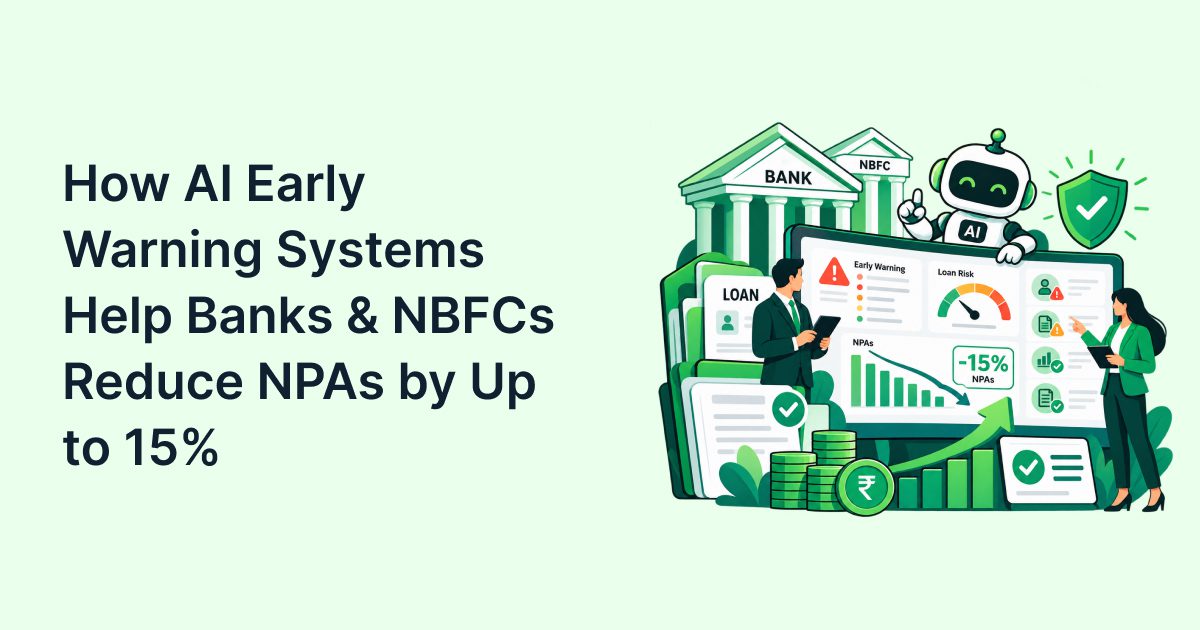
AI early warning systems help banks and NBFCs reduce non-performing assets by identifying repayment stress before an account becomes an NPA. By combining financial intelligence, risk scoring, and an automated retention workflow, lenders can intervene earlier, improve cure rates & reduce fresh NPA formation by up to 15%.
Why NPAs cost more than the headline ratio suggests
A non-performing asset, or NPA, is a loan where the borrower has not made scheduled payments for 90 days or more. But the real cost begins well before that classification.
When an account slips into NPA status, the lender must set aside more capital as provisioning, spend more on recovery, and lose the opportunity to lend that capital to a performing customer. Recovery is also slower and less predictable than prevention.
India’s banking system has improved materially. The Reserve Bank of India’s June 2026 Financial Stability Report reported that the gross NPA ratio of scheduled commercial banks fell to a multi-decadal low of 1.8% in March 2026.
That improvement is encouraging, but it does not remove portfolio-level risk. RBI’s stress testing shows that adverse conditions can push the banking system’s gross NPA ratio to 4.1% by March 2028.
For an individual bank or NBFC, the question is not only, “How many loans have already gone bad?” It is also, “How many accounts are moving toward default right now and what are we doing about them?”

What is an AI early warning system?
An AI early warning system continuously reviews borrower, account, transaction, and portfolio data to identify accounts that show early signs of repayment stress. Instead of waiting for an EMI to bounce or an account to enter a higher days-past-due bucket, it flags risk while intervention is still possible.
A traditional credit score is largely a point-in-time assessment. It ans wers one question: how risky was this borrower at the time of underwriting?
An AI early warning system answers a different question: how is this borrower’s repayment capacity and behaviour changing now?
This is where financial intelligence becomes practical. The system combines repayment history, cash-flow patterns, credit behaviour, and portfolio signals to create a current view of risk—not a historical one.
Fintly’s AI early warning system for credit risk monitoring is built around this shift: detect stress early, prioritise the right accounts, and trigger a defined retention or recovery action.
What signals show a loan may become an NPA?
Early warning signals are not always dramatic. Often, stress appears as small changes across several data points.
| Signal category | Example signal | What it may indicate | Recommended intervention |
| Payment behaviour | Repeated NACH or mandate bounces | Temporary cash-flow stress or repayment unwillingness | Pre-due reminder, alternate debit date, payment-plan offer |
| Cash flow | Falling monthly inflows or irregular balances | Reduced income, business slowdown, or liquidity pressure | Risk review, restructuring assessment, agent follow-up |
| Credit behaviour | New borrowing or rising credit utilisation | The borrower may be using additional credit to manage expenses | Portfolio monitoring and exposure review |
| Engagement | Ignored reminders or reduced app activity | Higher probability of missed payment | High-priority outreach and human intervention |
| Portfolio signal | Stress appearing across a geography, sector, or cohort | A wider credit-quality issue | Targeted portfolio review and exposure control |
No single signal should automatically label an account as a high-risk account. The value comes from combining signals, weighing them against the borrower’s history, and converting the result into a clear action.
How does an automated retention workflow reduce NPA formation?
An alert alone does not reduce NPAs. A lender reduces NPAs when the alert leads to the right intervention at the right time.
That is the role of an automated retention workflow.
- Detect the signal: The system identifies unusual repayment behaviour, cash-flow stress, or credit-risk movement.
- Score the account: AI assigns a risk score and estimates the likelihood of slippage.
- Segment the account: The lender separates accounts that can self-cure from those that need structured support.
- Trigger the action: The workflow sends a personalised reminder, offers a revised payment date, proposes a repayment plan, or assigns the account to an agent.
- Measure the outcome: The lender tracks whether the customer paid, accepted a plan, or continued to deteriorate.
This approach supports proactive loan recovery. Instead of treating every overdue account the same way, the collections team focuses on accounts where early action can still change the outcome.
It also makes lending automation operationally useful. Routine monitoring, segmentation, reminders, and follow-up tasks run automatically, while credit and collections teams handle exceptions and sensitive conversations.
Illustrative example
Consider a mid-sized NBFC with a ₹1,000 crore retail loan book.
Suppose 2% of accounts: ₹20 crore, show early stress signals such as repeated mandate failures, falling inflows, and ignored reminders. Without early intervention, a portion of these accounts may move into SMA and later NPA status.
With an automated retention workflow, the NBFC can identify these accounts 30–45 days earlier, offer a revised payment date or short-term repayment plan, and assign only the highest-risk accounts to agents.
If the lender prevents one-third of those stressed accounts from rolling into NPA status, it avoids roughly ₹6.7 crore in fresh NPA formation. This is an illustrative calculation, not a guaranteed result; actual outcomes depend on portfolio mix, data quality, intervention design, and execution discipline.
Can AI really reduce NPAs by up to 15%?
Yes, but the 15% figure should be understood as a potential reduction in fresh NPA formation, not a promise that every lender will cut its total NPA stock by 15%.
AI early warning systems can reduce NPAs through five mechanisms –
- Earlier identification of accounts showing repayment stress
- Higher contact rates before the account becomes severely overdue
- Better prioritisation of collections and retention resources
- Lower roll rates from SMA buckets into NPA status
- Faster feedback into credit policy, underwriting, and portfolio monitoring
The result depends on the conditions. A lender with clean repayment data, clear intervention playbooks, and enough operational capacity to act on alerts is more likely to see measurable improvement than one that simply deploys a scoring model without changing workflows.
AI cannot create repayment capacity where none exists. If a borrower has lost income permanently or has no ability to repay, an early warning system can help the lender act sooner, but it cannot make the underlying risk disappear.
Which NPA reduction strategies work best with AI?
The most effective NPA reduction strategies combine early detection with practical borrower support.
- Risk-based pre-due outreach: Contact accounts based on risk, not only due date.
- Flexible payment scheduling: Offer revised debit dates for borrowers facing temporary cash-flow gaps.
- Structured repayment plans: Convert a growing overdue amount into a manageable plan where appropriate.
- Agent prioritisation: Send high-risk or high-value accounts to trained collections or relationship teams.
- Portfolio-level controls: Identify clusters of stress by sector, geography, product, or borrower cohort.
- Fraud and connected-risk checks: Detect patterns that may indicate coordinated or concealed credit risk.
Portfolio-level monitoring matters because individual account signals can hide broader risk. For example, Fintly’s approach to detecting P2P lending fraud and group-funding risks shows why connected-borrower behaviour deserves attention: a risk that looks isolated at the account level may be part of a larger pattern.
This is also where proactive loan recovery differs from conventional collections. Traditional collections often begin after default. Proactive recovery begins when the lender can still preserve the customer relationship and prevent slippage.
What KPIs prove the system is working?
A lender should measure AI-led NPA prevention with outcome metrics, not alert volume.
Track these indicators –
- NPA formation rate: New NPAs as a share of the performing book.
- SMA migration: Movement from SMA-0 to SMA-1 and SMA-2.
- Roll rate: The share of accounts moving from one DPD bucket to the next.
- Cure rate: The share of stressed accounts that return to regular repayment.
- Pre-SMA contact rate: The share of at-risk accounts contacted before significant delinquency.
- Promise-to-pay conversion: The share of contacted customers who commit to a payment date or plan.
- Collection cost per account: The operational cost of preventing or recovering delinquency.
- Provisioning impact: The capital released or preserved because fewer accounts become NPAs.
The objective is simple: fewer accounts moving into later DPD buckets, not more dashboards or alerts.
For a deeper measurement framework, read Fintly’s guide on how to measure early warning system performance for banks and NBFCs.
When should banks and NBFCs still rely on human judgement?
AI is strongest at processing many signals consistently and surfacing risk early. It is not a replacement for judgement in every credit decision.
Human review remains important for –
- Large corporate exposures with complex group structures
- Restructuring decisions with long-term financial implications
- Suspected fraud or connected-party lending
- Sensitive borrower conversations
- New products or borrower segments with limited historical data
RBI’s draft Guidance on Regulatory Principles for Model Risk Management, 2026 also reinforces this direction. It proposes board-approved model governance, lifecycle management, independent validation, continuous oversight, and human oversight for AI-driven decisions.
The practical model is human-in-the-loop: AI identifies and prioritises risk; people review exceptions, approve major actions, and retain accountability.
How should a bank or NBFC implement AI early warning systems?
Start with a narrow, measurable use case rather than attempting to transform the entire credit book at once.
- Consolidate repayment, transaction, bureau, and business data.
- Define the intervention playbook before deploying alerts.
- Begin with a portfolio segment where early action has clear commercial value.
- Establish model documentation, validation, monitoring, and override controls.
- Compare outcomes against a baseline or control group.
- Retrain and recalibrate models as borrower behaviour changes.
The implementation question is not only, “Can we build a model?” It is, “Can our teams act on the model’s output quickly, consistently, and responsibly?”
Key Takeaways
- AI early warning systems help banks and NBFCs reduce non-performing assets by identifying repayment stress before an account becomes an NPA.
- The biggest savings come from preventing fresh NPA formation, not from recovering loans after they have already defaulted.
- Effective early warning signals include mandate bounces, falling cash inflows, rising credit utilisation, new borrowing, and reduced customer engagement.
- An automated retention workflow turns risk alerts into action through reminders, revised payment dates, repayment plans & agent follow-up.
- AI should support, not replace, credit and collections teams, especially for restructuring, fraud review, and sensitive borrower conversations.
- Measure success through NPA formation rate, SMA migration, roll rate, cure rate, pre-SMA contact rate, and provisioning impact.
- AI-led NPA reduction of up to 15% is possible when strong data, clear intervention playbooks, and consistent execution are in place.

Conclusion: Preventing NPAs is an operating discipline
The biggest NPA savings come before default, not after classification. AI early warning systems help lenders reduce non-performing assets by turning scattered signals into timely, measurable action.
The lenders that benefit most will not merely deploy a model. They will connect early risk signals to an automated retention workflow, give teams clear intervention rules, and measure whether fewer accounts are slipping into NPA status.
If you want to assess where your portfolio is most exposed to avoidable slippage, contact Fintly to discuss an early-warning and retention-workflow assessment.

Author
Subject Matter Expert (Lending) Fintly.co
Vijay Mali is a results-driven professional with deep expertise in HFC/NBFC startups, compliance, and underwriting. He specializes in delivering end-to-end solutions for financial institutions, focusing on Business Rule Engines (BRE), workflow automation, and AI-driven credit decision-making. He is passionate about leveraging Machine Learning (ML) scorecards and AI-powered risk assessment to optimize lending processes and drive digital transformation in the financial sector.