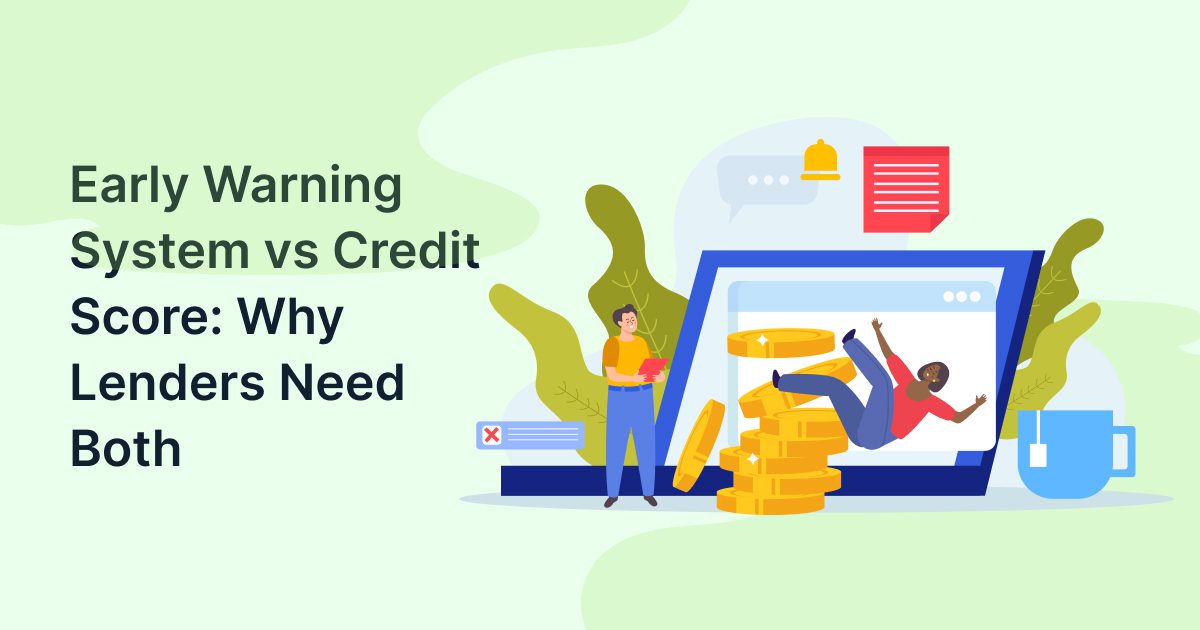
Credit scores help lenders assess borrower risk before approving a loan, while early warning systems help monitor borrower risk after disbursal. Together they support both underwriting and ongoing credit risk monitoring, helping lenders identify potential repayment problems earlier.
A strong credit score can get a loan approved. It cannot tell a lender whether the borrower’s financial position will remain strong over the next six, twelve, or twenty-four months.
That gap is where many loan losses begin. The borrower looks acceptable at approval, but cash flow weakens, repayments become irregular, and the lender notices only after the account turns delinquent.
This article explains the difference between an early warning system and a credit score, shows where each fit in the loan lifecycle, and explains how lenders can use both for better credit risk monitoring.
Fintly’s AI lending and finance automation platform helps banks, NBFCs, and fintechs connect borrower data, risk signals, and lending workflows so risk teams can act earlier.
Key Takeaways
- A credit bureau score supports the lending decision; an early warning system protects the loan after disbursal. The score establishes baseline borrower risk, while the EWS tracks whether that risk is changing.
- A good score does not guarantee continued financial health. Borrower cash flow, repayment behaviour, and external conditions can deteriorate after approval, even before the bureau’s score reflects it.
- An EWS turns risk signals into timely action. It helps lenders prioritise alerts, trigger borrower outreach, review limits, restructure repayments, or escalate accounts before delinquency worsens.
- Neither tool works well alone. A score without monitoring leaves lenders exposed after disbursal; an EWS without sound underwriting and reliable data lacks a dependable risk baseline.
- Continuous credit risk monitoring is a lifecycle discipline. Lenders should use scores at origination and EWS signals across servicing, early stress, delinquency, restructuring, and recovery.
- The cost of late detection is higher than the cost of early intervention. Delayed visibility can lead to higher delinquency, weaker recovery, greater provisioning pressure, and missed restructuring opportunities.
- Fintly helps lenders connect scores, signals, and actions. Its AI lending and finance automation platform supports credit risk monitoring workflows across banks, NBFCs, and fintechs.
What Is a Credit Bureau Score in Lending?
A credit bureau score is a numerical assessment of a borrower’s creditworthiness based mainly on past credit behaviour. It considers factors such as repayment history, outstanding obligations, credit utilisation, credit mix, and recent credit enquiries.
For lenders, the score answers a basic underwriting question: based on available credit history, how likely is this borrower to repay?
Lenders typically use bureau scores to:
- Screen loan applications
- Support approval or rejection decisions
- Set credit limits
- Inform interest pricing and risk-based segmentation
- Build scorecards and underwriting rules
- Monitor portfolio quality at a high level
A bureau score is useful because it provides a consistent, widely understood baseline. However, it is largely backward-looking. It reflects what has already happened in the borrower’s credit history, not necessarily what is happening in their finances today.
Credit monitoring has also become mainstream among borrowers. TransUnion CIBIL reported that 183 million Indians had self-monitored their CIBIL Score as of December 2025, a 27% year-on-year increase. Borrowers are therefore more aware of their scores, but lenders still need a broader view of risk than the score alone can provide.
Risk teams also need to track metrics beyond the score, such as repayment behaviour, exposure concentration, delinquency movement, and portfolio-level trends. Fintly’s guide to the top credit intelligence metrics every risk team should track covers these measures in detail.

What Is an Early Warning System in Credit Risk Management?
An early warning system is a structured way to identify signs of borrower or portfolio stress before they become serious delinquency or default. Instead of waiting for a missed EMI, an EWS monitors risk indicators and generates alerts when behaviour or conditions change.
In simple terms, a credit score asks, “How risky was this borrower when we assessed them?” An EWS asks, “Is this borrower becoming riskier now?”
An EWS typically uses signals such as:
- Delayed or partial repayments
- Changes in repayment patterns
- Rising credit utilisation
- New credit enquiries or additional borrowings
- Declining account balances or irregular inflows, where transaction data is available
- Negative news, legal issues, or sector-level stress
- Portfolio concentration or adverse macroeconomic indicators
Fintly explains the full concept in its article on what an early warning system is in credit risk management. The practical value of an EWS is not the alert itself; it is the action that follows, such as borrower outreach, enhanced monitoring, a credit-limit review, restructuring, or escalation to collections.
Early Warning System vs Credit Score: What Is the Difference?
The main difference is timing and purpose. A credit bureau score supports the lending decision before disbursal. An early warning system supports credit risk monitoring after disbursal.
| Dimension | Credit Bureau Score | Early Warning System |
| Main purpose | Assess borrower creditworthiness | Detect changing borrower or portfolio risk |
| When used | Mainly before approval | Mainly after loan disbursal |
| Data basis | Credit history, repayment record, utilisation, enquiries | Repayment behaviour, account activity, cash-flow signals, external risk data |
| Output | Score and credit rank | Alerts, risk flags, severity levels, and recommended actions |
| Decision supported | Approve, decline, price, or set a limit | Monitor, contact, restructure, tighten limits, or escalate |
| Time orientation | Backward-looking | Ongoing and forward-looking |
| Key limitation | Can become outdated between refreshes | Needs reliable data, calibrated thresholds, and clear action workflows |
Neither tool is a substitute for the other. A score without monitoring leaves lenders exposed after disbursal. An EWS without a sound origination assessment lacks a reliable starting point for deciding what “normal” risk looks like for each borrower.
Is an Early Warning System Better Than a Credit Score?
Neither is better. They solve different problems. A credit score supports origination decisions, while an early warning system supports post-disbursal risk monitoring.
A credit bureau score helps lenders decide whether to approve, price, or size a loan. An early warning system helps lenders monitor the borrower after disbursal and identify changing repayment or cash-flow stress.
The main difference is timing and purpose. A credit score supports the lending decision before disbursal. An early warning system supports credit risk monitoring after disbursal.
Why Is a Credit Score Alone Not Enough After Disbursal?
A borrower’s circumstances can change quickly after a loan is approved. Income can fall, business cash flow can weaken, existing debts can rise, or sector conditions can deteriorate. A bureau score may not capture these changes immediately.
This is why lenders need continuous credit risk monitoring. It gives them an ongoing view of borrower health throughout the loan lifecycle, rather than relying only on periodic reviews or the next bureau to refresh.
Consider this illustrative example:
Illustrative example: MSME working-capital loan
A lender approves an MSME borrower based on a healthy bureau score, filed financials, and satisfactory banking conduct. Six months later, the borrower’s account shows delayed customer receipts, higher overdraft usage, and slower repayment on trade credit.
The bureau score may not yet reflect the full deterioration. But an EWS can flag the changing cashflow and repayment signals. The lender initiates an early review, confirms a temporary working-capital gap, and restructures the repayment schedule before the account becomes delinquent.
The cost of missing these signals is not limited to one account. Late detection can lead to higher delinquency, weaker recovery, higher provisioning, and pressure on collections of teams. It also reduces the lender’s ability to intervene while restructuring or repayment support can still work.
India’s banking system is currently in a strong asset-quality phase.
Why Is an Early Warning System Alone Not Enough?
An EWS is not a replacement for good underwriting, a validated scorecard, or human credit judgement. It is a monitoring layer that works best when the lender already has a clear view of borrower risk at origination.
An EWS also depends on the quality of its inputs. If data is incomplete, delayed, or inconsistent, alerts can be misleading. If thresholds are too broad, risk teams receive too many low-value alerts. If thresholds are too narrow, genuine stress signals may be missed.
A useful EWS needs:
- Reliable borrower, repayment, transaction, and external data
- Clearly defined risk indicators and thresholds
- Alert prioritisation based on severity and exposure
- Clear ownership for every alert
- Documented escalation and intervention steps
- Regular review of alert accuracy and outcomes
For a small lender with a limited portfolio, a manually reviewed monthly watchlist can still be a reasonable starting point. The challenge appears as loan volumes, products, and borrower segments grow. Manual monitoring becomes slower, less consistent, and harder to audit.
That is where automation becomes useful; not to remove credit judgement, but to make sure the right people see the right risk signal at the right time.
When Do Lenders Need an Early Warning System Most?
An early warning system is most valuable when loan exposure is high; borrower’s cash flows can change quickly, or portfolios are growing faster than manual reviews can track.
Lenders should prioritise EWS adoption for:
- MSME portfolios, where cash-flow stress often appears before formal delinquency
- Business lending, where borrower performance depends on operational and market conditions
- Working-capital facilities, where account balances, inflows, and utilisation can change frequently
- Large-ticket loans, where even a single deterioration event can materially affect portfolio quality
- Revolving credit products, where utilisation and repayment behaviour can shift quickly
- Rapidly growing portfolios, where manual watchlists become difficult to maintain consistently
For these portfolios, waiting for a missed EMI or the next bureau to refresh can mean acting too late. An EWS gives risk teams earlier visibility into changing borrower behaviour so they can review, contact, restructure, or escalate accounts in time.
The need becomes even clearer as lending volumes grow. A small team may manage a monthly watchlist for a limited portfolio, but manual monitoring becomes inconsistent once the lender is tracking thousands of accounts across products, geographies, and risk bands.
This is where a lending platform becomes operationally important. Fintly helps lenders connect borrower data, early warning signals, and lending workflows so risk teams can prioritise the right accounts and act with context.
How Should Lenders Use Both Across the Loan Lifecycle?
Lenders get the best results when they use credit scores and EWS signals as complementary controls across the loan lifecycle.
At origination
Use the bureau score with application data, income or cash-flow assessment, banking conduct, and underwriting rules. The score helps establish the borrower’s baseline risk.
At disbursal
Assign the borrower to a risk band. Define the monitoring frequency, alert thresholds, and intervention approach for that band.
During servicing
Monitor repayment behaviour, account activity, utilisation, and other approved risk signals. This is where the EWS becomes the most valuable.
At early stress
When signals cross a threshold, assign the account to a watchlist, trigger borrower outreach, or initiate an enhanced review.
During delinquency and recovery
Use EWS context, such as exposure, payment behaviour, and severity, to prioritise collections and restructuring decisions.
This lifecycle approach turns credit risk management from a periodic review of exercise into a continuous decision process.

Which Early Warning Signals Should Lenders Monitor?
The right signals depend on the loan product, borrower segment, and available data. But most lenders should start with a practical set of behavioural, financial, and external indicators.
- Payment delays, part-payments, and changing repayment patterns
- Rising credit utilisation or new credit enquiries
- Falling account balances or irregular inflows, where transaction data is available
- Negative news, legal issues, regulatory action, or sector stress
- Concentration risk at the portfolio level
- Deterioration in related accounts, guarantors, or group entities where relevant
TransUnion CIBIL reported that India’s credit-active consumer base grew 9% year on year in the quarter ended June 2025, slower than the 15% growth recorded in the same quarter of 2024. As lending growth and borrower profiles change, lenders cannot assume that past performance will predict future repayment behaviour.
The goal is not to track every possible signal. It is to identify the few signals that reliably precede repayment stress for your portfolio, then build clear actions around them.
How Can a Lending Platform Turn Alerts into Action?
An alert has value only when someone acts on it. A lending platform should connect risk signals to the operational workflow that follows.
A practical workflow looks like this:
- Ingest bureau, repayment, transaction, and external data.
- Apply configured risk rules and EWS triggers.
- Score and prioritise alerts by severity and exposure.
- Attach reason codes, so risk teams understand why the alert was raised.
- Assign an owner and escalation path.
- Trigger outreach, review, limit action, restructuring, or collection of activity.
- Track outcomes to improve thresholds and intervention playbooks.
Fintly supports this workflow by bringing credit data, early warning signals, and lending operations into one platform. Instead of treating monitoring as a separate spreadsheet exercise, risk teams can connect alerts to the decisions and actions that protect portfolio quality.
Conclusion
A credit bureau score and an early warning system solve different problems. The score helps lenders decide whether to lend. The EWS helps lenders protect the loan after disbursal by identifying changing risks early.
Lenders that rely only on scores often discover stress after the borrower misses payments. Lenders that combine scores with continuous credit risk monitoring can intervene earlier, prioritise better, and reduce avoidable losses.
If you want to assess how your current credit risk monitoring workflow could identify borrower stress earlier, request a demo with Fintly to explore a solution tailored to your lending needs.
 QUICK ANSWERS
Frequently Asked Questions
Your most common questions, answered with precision and insight
No. An early warning system cannot replace a credit score because the two serve different purposes. A credit score helps a lender assess borrower’s creditworthiness before approving a loan. An EWS monitors the borrower after disbursal and flags signs of stress. Lenders need the score for origination decisions and the EWS for ongoing credit risk monitoring and timely intervention.
Yes. A credit score provides a baseline assessment of risk at the time of lending. An EWS tracks whether that risk is changing after the loan is disbursed. Using both helps lenders make better approval decisions and respond earlier to repayment stress, cash-flow deterioration, or portfolio-level risks.
Credit monitoring usually refers to tracking changes in a borrower’s credit report or score. An early warning system is broader. It monitors multiple risk signals—such as repayment behaviour, account activity, cash-flow indicators, and external events—and converts them into prioritised alerts and recommended actions for the lender.
An EWS can use repayment history, account activity, transaction data, bureau updates, credit utilisation, and external signals such as news or sector-level risk. The exact data stack depends on the loan product and data consent. The most effective systems combine internal repayment data with relevant external signals to identify stress earlier.
A lender should use an EWS from the point of loan disbursal. It is especially useful for high-value loans, revolving facilities, MSME lending, and portfolios with changing borrower behaviour. The system should run continuously so the lender can identify stress before the account becomes seriously delinquent.
An EWS helps reduce losses by identifying risk before it becomes default. When the system flags deteriorating repayment behaviour or cash-flow stress, the lender can contact the borrower, review the account, adjust limits, restructure repayments, or escalate the case. Early action gives the lender more options than waiting until the account is already delinquent.
Yes. A borrower can have a good historical score while current financial conditions are weakening. For example, falling account balances, rising utilisation, delayed supplier payments, or irregular inflows can signal stress before the bureau’s score changes. This is why lenders should not rely on the score alone after disbursal.
Lenders should look for configurable risk rules, bureau and data integrations, alert prioritisation, reason codes, workflow automation, audit trails, and portfolio dashboards. The tool should connect alerts to clear actions, such as borrower outreach, credit review, restructuring, or collections, rather than simply generating reports.

Author
Subject Matter Expert (Lending) Fintly.co
Vijay Mali is a results-driven professional with deep expertise in HFC/NBFC startups, compliance, and underwriting. He specializes in delivering end-to-end solutions for financial institutions, focusing on Business Rule Engines (BRE), workflow automation, and AI-driven credit decision-making. He is passionate about leveraging Machine Learning (ML) scorecards and AI-powered risk assessment to optimize lending processes and drive digital transformation in the financial sector.