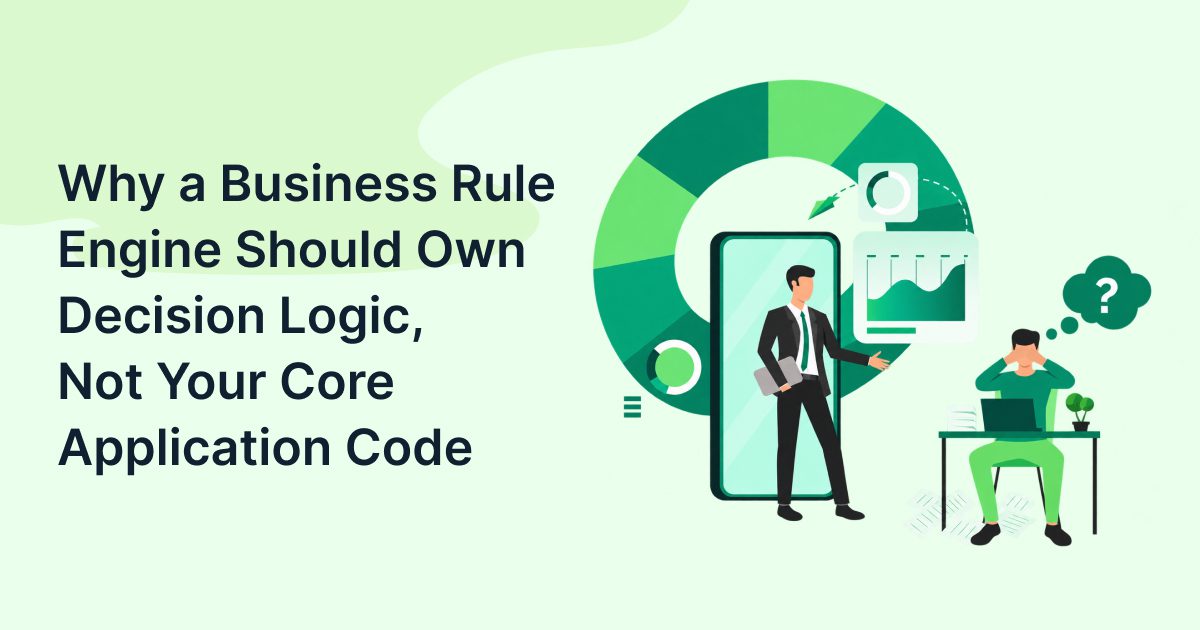
A business rule engine should own decision logic because policies change faster than software. Keeping eligibility, pricing, risk, and compliance rules inside core application code turns every policy update into a development release, while externalized logic lets business teams change decisions safely, consistently, and with an audit trail.
Every lender eventually meets the same problem: a credit policy changes on Monday, but the change cannot reach production for weeks. The rule is simple, perhaps a debt-to-income threshold moves from 45% to 42%, yet it sits inside a loan origination system, a core banking integration, or several services written by different teams.
That is the case for a business rule engine. A BRE separates the logic that decides what should happen from the application code that decides how the workflow runs. For banks, NBFCs, and fintechs, this separation is not an architectural preference. It determines how quickly you can respond to credit risk, fraud patterns, pricing changes, and regulatory expectations.
This article explains why decision logic belongs in a BRE, what should remain in application code, and how to externalize rules without creating a new governance problem.
What Is a Business Rule Engine?
A business rule engine is software that stores, evaluates, and manages business decisions separately from application code. It receives facts, such as applicant income, bureau score, transaction history, or KYC status, applies defined rules, and returns an outcome such as approve, decline, refer, price, or flag.
In lending, a rule might read: “If bureau score is at least 720, debt-to-income is below 40%, and income verification is complete, approve up to the requested limit.” The application does not need to contain that logic. It sends the applicant data to the BRE through an API and receives the decision.
This is externalized logic: business policy lives in a governed rule repository rather than being scattered through services, stored procedures, configuration files, and spreadsheets. A business rules management system, or BRMS, typically adds authoring, versioning, testing, deployment, and audit controls around that engine.

Why Embedded Decision Logic Creates Release Debt
Embedded decision logic creates release debt: the ongoing cost of needing engineering work, testing, deployment, and coordination every time a business policy changes. The rule itself may take minutes to define, but the surrounding release process can take weeks.
Consider a common NBFC scenario. Risk wants to tighten unsecured-loan eligibility for applicants with more than five bureau enquiries in 90 days. If that condition is hardcoded in the LOS, the change needs a developer, code review, regression testing, release approval, and deployment across environments. Meanwhile, the lender continues approving applications under the old policy.
The problem compounds when the same rule exists in multiple places. A web channel may apply one version, a mobile journey another, and a partner API a third. Each divergence creates inconsistent customer outcomes and makes it harder to explain why a particular applicant received a particular decision.
A BRE centralizes the decision point. The LOS, mobile app, partner portal, and collections workflow can all call the same governed rules, reducing drift and making policy changes operational rather than developmental.
What Belongs in a BRE and What Should Stay in Code?
A BRE should own decisions that express business policy, change often, require traceability, or must remain consistent across channels. Application code should own technical orchestration, system integrations, and logic that is genuinely part of the software’s behaviour.
Use this Decision Logic Boundary test before moving a rule:
| Question | If yes | If no |
| Does the logic express business policy or judgment? | Put it in the BRE. | Keep it in application code. |
| Will risk, credit, compliance, or product teams change it independently? | Put it in the BRE. | Keep it in code. |
| Must you prove which version ran for a decision? | Put it in the BRE. | Code-level logging may be enough. |
| Is it a stable technical control, such as retry handling or API routing? | Keep it in code. | A BRE adds unnecessary indirection. |
IBM makes a similar distinction: rules containing business knowledge, business judgment, or business events can be implemented in a rule engine, while transaction-processing plug-in logic that does not represent business policy is often better implemented in code.
Practical ownership split
| Decision area | Best owner | Example |
| Loan eligibility | Business rule engine | Minimum bureau score, income thresholds, employment checks |
| Risk-based pricing | Business rule engine | Rate add-ons by risk tier, tenure, product, or LTV |
| Fraud flags | Business rule engine | Multiple applications from one device; unusual enquiry patterns |
| KYC/AML routing | Business rule engine | Sanctions hit, PEP match, incomplete documentation |
| Application workflow | Application code | Screen sequencing, document upload, status transitions |
| System integration | Application code | Bureau API calls, core banking updates, notification dispatch |
| Data quality controls | Shared, with clear ownership | Field validation may be code; policy-driven rejection belongs in the BRE |
The useful boundary is not “all logic outside code.” It is “policy outside code, mechanics inside code.”
How a BRE Fits a Lending Architecture
A well-designed decision logic architecture follows a simple sequence: request, evaluate, act.
- Request: The LOS or channel application sends structured facts to the BRE—applicant profile, bureau data, income evidence, product request, and risk signals.
- Evaluate: The BRE retrieves the active, versioned rule set and evaluates decision tables, thresholds, scoring inputs, and exception conditions.
- Act: The BRE returns a decision and reason codes. The application then executes the outcome: disburse, decline, request documents, route to an underwriter, or trigger a fraud review.
For example, a digital lending journey might call the BRE after bureau retrieval. The engine finds that the applicant passes eligibility but has a high enquiry count. Instead of declining, it returns “refer with income proof” and a reason code. The LOS displays the correct checklist, while the underwriter sees the policy basis for the referral.
This pattern works because the BRE does not replace the LOS or core banking system. It becomes the decision layer between your data sources and the systems that act on decisions. Modern implementations commonly expose this capability through REST APIs, allowing a core banking platform, CRM, LOS, or custom application to request a decision without embedding policy internally.
Fintly’s Business Rule Engine is designed for this integration pattern, with API-first connectivity to existing LOS, CBS, CRM, and data-provider systems, alongside AI-assisted rule generation and immutable audit trails.
A Practical Path to Externalizing Rules from Code
Externalizing rules from code fails when teams attempt a big-bang migration. The safer route is to inventory, classify, rebuild, test, and retire logic in controlled stages.
The five-stage externalization sequence
- Inventory decision points. Identify every place where the system approves, declines, prices, flags, routes, or overrides a customer decision. Include stored procedures, service code, spreadsheets, and manual policy documents.
- Classify by volatility and ownership. Prioritize rules that change frequently, create compliance exposure, or differ across channels. Stable technical controls can remain in code.
- Rebuild as decision tables and flows. Convert conditions into named rules with explicit inputs, outputs, reason codes, owners, and approvers. Decision tables work well for threshold-based lending logic; decision flows suit multi-step routing.
- Test against historical and edge cases. Run the external rules beside the existing logic, compare outcomes, and investigate differences before switching decision authority.
- Retire embedded logic deliberately. Disable the old path only after parallel testing, rollback planning, and sign-off from risk, compliance, and engineering.
A useful threshold: if a rule has changed more than twice in the past year, affects customer outcomes, or requires audit evidence, it is a strong candidate for the BRE. If it has not changed in years and exists only to make an integration work, it probably belongs in code.
Governance Requirements Banks and NBFCs Cannot Skip
Externalized logic without governance simply moves the problem from code into a configuration tool. In financial services, the BRE must provide evidence that the right rule ran, at the right time, after the right approval.
Use this BRE Governance Scorecard during evaluation:
| Capability | Minimum standard | Why it matters |
| Version control | Every rule change is versioned and restorable | Auditors can identify the exact policy in force for a past decision |
| Maker-checker approval | No rule reaches production without independent review | Prevents unilateral or accidental policy changes |
| Audit trail | Every execution records inputs, rule version, outcome, and reason codes | Supports internal audit, dispute resolution, and regulatory review |
| Testing and sandbox | Rules can be tested before production release | Reduces the risk of policy errors reaching customers |
| Access control | Role-based permissions by team and environment | Separates authoring, approval, and deployment duties |
| Rollback | A prior approved version can be restored quickly | Limits the impact of a faulty update |
Fintly’s published BRE capabilities include version control with maker-checker approvals, immutable audit logs, and real-time execution, capabilities that map directly to these governance needs.
The Contrary View: Not Every Rule Should Be Externalized
A business rule engine is not a replacement for thoughtful software architecture. Externalizing every conditional statement creates a new problem: a rule repository so large, fragmented, and poorly owned that nobody understands it.
Keep these in application code:
- Technical resilience logic, such as retries, timeouts, circuit breakers, and API failover. These are engineering concerns, not lending policy.
- High-frequency, low-policy calculations that are tightly coupled to system performance and rarely change.
- Proprietary integration behaviour where the rule exists to make one system work with another, not to express a business decision.
- Complex human-judgment cases that should be routed to an underwriter rather than forced into a binary automated outcome.
IBM’s guidance is clear on this nuance: rules with short lifecycles or frequent change suit a rules engine, but rules that must be directly accessible to consuming programs or that act as transaction-processing plug-ins may need to remain in code.
The goal is separation of concerns, not the elimination of code.
The Cost of Leaving Decision Logic in Code
The cost of inaction is not only slower releases. It is slower risk response, inconsistent decisions, and weaker evidence when regulators, auditors, or customers ask why a decision was made.
| Delay or failure | Business consequence |
| Policy update waits for a release cycle | The lender continues taking risk under outdated criteria |
| Rules differ by channel | Customers receive inconsistent outcomes for similar profiles |
| No centralized version history | Audit requests require manual reconstruction across systems |
| Fraud rules cannot be updated quickly | Known patterns remain active until the next deployment |
| Pricing changes require engineering | Product teams lose agility and revenue timing |
Fintly’s published use-case content frames the operational risk directly: manual, spreadsheet-driven, or email-driven policy updates slow approvals, weaken early-warning controls, and increase operational drag. A BRE does not remove accountability; it makes accountability visible.
BRE or BRMS: Which Do You Need?
A business rule engine executes rules. A business rules management system adds the management layer around them: authoring, versioning, approval, testing, deployment, and audit.
| Capability | BRE | BRMS |
| Evaluate rules and return decisions | Yes | Yes |
| Central rule repository | Often | Yes |
| Business-user authoring | Varies | Usually |
| Versioning and approvals | Varies | Core requirement |
| Testing and deployment controls | Varies | Core requirement |
| Audit trail and traceability | Often | Core requirement |
For a bank or NBFC, the practical requirement is usually closer to a BRMS: an engine that can execute decisions at scale and a governance layer that can prove what ran.
Where Fintly Fits
Fintly’s Business Rule Engine addresses the specific problem this article describes: decision logic trapped in systems that business teams cannot safely change. Its published capabilities include AI-assisted rule generation, immutable audit trails, API-first integration, version control, maker-checker approvals, and real-time execution.
That matters because the value of a BRE is not the rule editor alone. It is the combination of faster policy change, consistent execution across channels, and evidence that supports audit and risk review. For lenders evaluating use cases across credit, fraud, KYC, pricing, collections, and operations, Fintly’s overview of business rule engine use cases in banking, NBFCs, and fintech provides a practical starting map.

Conclusion
A business rule engine should own the decisions that express your lending policy: who qualifies, what they pay, when to refer, and when to flag. Your application code should own the mechanics of running the journey, integrating systems, and executing the outcome.
That division keeps policy changes fast without sacrificing control. It also gives risk, compliance, and audit teams a single, versioned view of the logic behind every decision. If embedded rules are slowing releases or creating inconsistent customer outcomes, book a demo with Fintly to see how a Business Rule Engine can simplify decision management and improve operational efficiency.
 QUICK ANSWERS
Frequently Asked Questions
Your most common questions, answered with precision and insight
A business rule engine is software that applies business rules to data and returns a decision. Instead of writing “if the applicant meets these conditions, approve the loan” inside application code, the rule is maintained in a separate engine and called through an API. This lets policy teams update decisions without changing the underlying application.
Because business decisions change more often than application functionality. A BRE allows credit, risk, fraud, and compliance teams to update governed rules without a full software release. It also creates one decision point across channels, reducing inconsistent outcomes and making every decision easier to trace.
Externalized logic is business logic stored and managed outside the core application codebase. In lending, this usually includes eligibility criteria, pricing rules, fraud thresholds, KYC routing, and exception policies. The application supplies data, the BRE evaluates it, and the application acts on the returned decision.
Yes. Most modern BREs integrate through APIs, so the LOS sends applicant and risk data to the engine and receives a decision, reason codes, and any required next action. The BRE does not need to replace the LOS, core banking system, CRM, or data providers; it sits between them as the decision layer.
Not exactly. A business rule engine focuses on evaluating defined rules, while a broader decision engine may also orchestrate machine-learning models, data enrichment, strategy champion-challenger testing, and workflow decisions. A BRE is often a core component within a wider decisioning architecture.
Start with rules that change frequently and affect customer outcomes: credit eligibility, risk-based pricing, document exceptions, fraud flags, KYC/AML routing, limit enhancement, collections treatment, and cross-sell eligibility. These decisions benefit from centralized ownership, versioning, testing, and auditability.
Yes, provided the platform maintains version history and execution logs. A governed BRE should show which rule version was active, who approved it, what inputs were evaluated, and what outcome and reason codes were returned. That evidence is central to internal audit, model governance, and regulatory review.
It depends on the number of decision points, data quality, integration complexity, and testing requirements. A phased approach is safer: begin with one high-volume, frequently changed decision area, run parallel testing, then expand. Fintly’s guidance on externalizing loan decision logic without releasing new code outlines this transition in more detail.

Author
Co-Founder, Fintly.co
Vijay Mali is a results-driven professional with deep expertise in HFC/NBFC startups, compliance, and underwriting. He specializes in delivering end-to-end solutions for financial institutions, focusing on Business Rule Engines (BRE), workflow automation, and AI-driven credit decision-making. He is passionate about leveraging Machine Learning (ML) scorecards and AI-powered risk assessment to optimize lending processes and drive digital transformation in the financial sector.