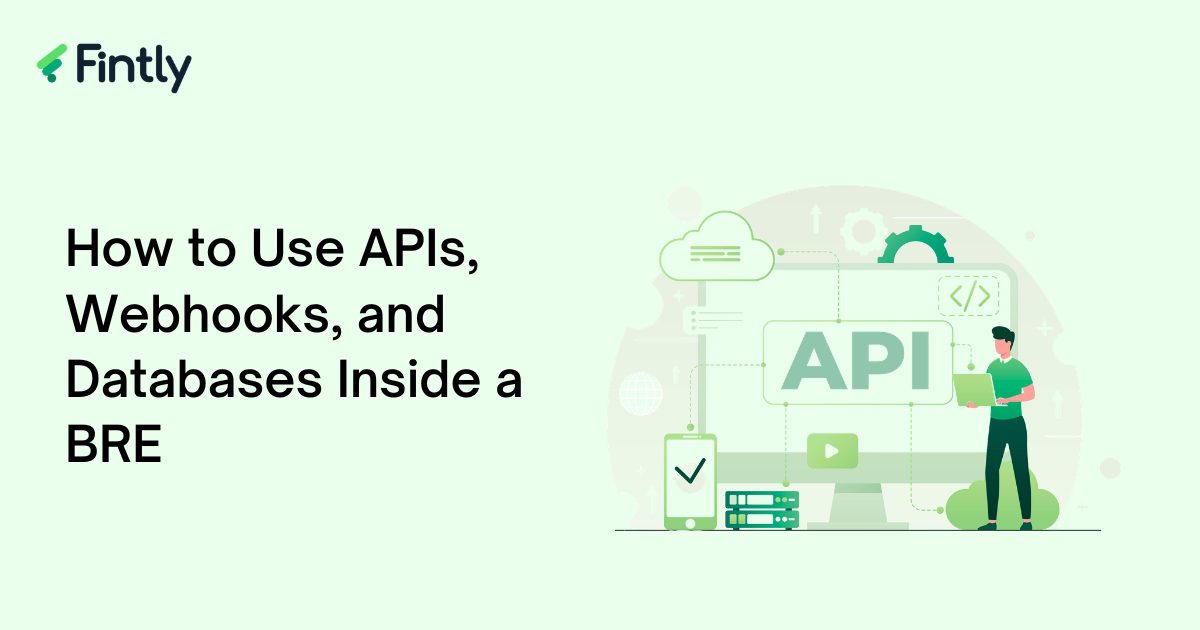
BRE integrations let your business rule engine pull live data from external systems, via APIs, webhooks & database lookups. So, decisions execute in real time without manual handoffs or stale data.
If you’re running a lending or finance operation in India, you already know the pain: your decisioning logic sits in one system, customer data lives in three others & by the time everything lines up, the customer has moved on. Digital personal loans now make up 80% of all personal loan volumes & sanction values jumped 53% year-on-year in Q3 FY26. Speed isn’t a nice-to-have anymore; it’s table stakes.
In this post, you’ll learn how to wire your business rule engine (BRE) to external systems using APIs, webhooks, and database lookups. We’ll cover when to use each pattern, what can go wrong, and how teams at banks, NBFCs, and fintechs are using these integrations to cut turnaround time without compromising on risk or compliance. Along the way, we’ll tie this back to how a modern platform like Fintly’s Business Rule Engine handles these integrations out of the box.
Why do BRE integrations matter for lending and finance teams in India?
Your loan approval, credit limit increase, or fraud check is only as good as the data feeding it. If your rule engine can’t talk to your credit bureau, account aggregator, or core banking system in real time, you end up with one of three outcomes –
- Decisions based on last week’s data (stale and risky)
- Manual ops teams pulling reports and pasting into spreadsheets (slow and error-prone)
- Customers dropping off because approval takes days instead of minutes
The numbers – digital lending is already the default
According to Fintech Association for Consumer Empowerment (FACE), Q3 FY26 report (2026), digital personal loans now make up 80% of all personal loan volumes in India, with sanction values up 53% year-on-year in Q3 FY26. At this scale, slow or disconnected decisioning directly costs you applications. BRE integrations that fetch live data in real time are now table stakes, not a differentiator.

What exactly are BRE integrations?
Before we dive into patterns, let’s align on terms.
A business rule engine (BRE) is the part of your tech stack where you encode your lending or finance policies as “if-then” rules. For example: “If the applicant’s CIBIL score is above 750 and their bank statement shows consistent salary credits, approve the loan up to ₹2 lakh.” If you’re new to this, we’ve broken down what a business rule engine is and how it works in plain language.
BRE integrations are the connections that let your rule engine fetch or receive data from other systems while it’s evaluating those rules. There are three main types –
- API-triggered decisions: Your BRE calls an external system (like a credit bureau or account aggregator) via an API, waits for the response & uses that data in the rule.
- Webhook rule execution: An external system sends data to your BRE when something happens (e.g., “bank statement parsed successfully”) & your BRE reacts by running specific rules.
- Database lookup rules: Your BRE queries an internal or external database (like a customer master table or product catalog) to enrich the decision.
These integrations turn your BRE from a static rule book into a live decisioning hub.
How do APIs, webhooks, and databases work inside a BRE?
API-triggered decisions – Synchronous calls for real-time enrichment
In an API integration, your BRE acts as the caller. When a loan application comes in, the rule engine –
- Receives the application payload (customer ID, loan amount, product type)
- Calls external APIs (credit bureau, account aggregator, GSTN, etc.)
- Waits for responses (usually within a few hundred milliseconds to a couple of seconds)
- Uses the returned data to evaluate rules and reach a decision
This pattern works best when –
- You need an immediate answer (e.g., instant personal loan approval)
- The external system is reliable and fast
- You can afford to wait for all critical data before deciding
The downside: if an API times out or fails, your entire decision flow can stall unless you’ve built fallback logic.
Webhook rule execution: Event-driven decisions for async events
Webhooks flip the model. Instead of your BRE calling out, external systems call your BRE when something happens. Common examples –
- Account aggregator sends a webhook when bank statement parsing completes
- Payment gateway notifies you that an EMI was successfully collected
- Fraud detection system flags a transaction as suspicious
Your BRE then –
- Receives the webhook payload
- Validates the signature and source
- Triggers the relevant rules (e.g., “if statement shows 3 bounces in last 30 days, reduce credit limit by 20%”)
- Executes actions (update customer profile, send notification, adjust limits)
Webhooks shine when –
- The external process takes time (minutes to hours)
- You don’t need to hold the customer’s request open while waiting
- You want to react to events that happen outside your application flow
Database lookup rules – Enrichment from internal or reference data
Not all data lives in external APIs. A lot of it sits in your own databases –
- Customer master data (KYC status, existing products, relationship tenure)
- Product catalogs (interest rates, fees, eligibility criteria)
- Historical behaviour (past delinquencies, utilisation patterns, prepayment behaviour)
With database lookup rules, your BRE queries these tables during rule execution. For example –
- “If customer has 2+ active products and no delinquency in last 12 months, offer pre-approved limit increase”
- “If product type is ‘gold loan’ and LTV is above 75%, require additional documentation”
This pattern is fast, reliable & under your control, but it only covers data you already own.
Key statistics
As per the citing from Economic Times article on FACE / CRIF High Mark analysis (2026), the 90-day past due ratio for digital personal loans fell to around 1.9% by late 2025. Better real-time data from bureaus, account aggregators & fraud checks is a big part of that story. When your BRE integrates cleanly with these sources, you get faster decisions and safer portfolios.
Which integration pattern should you use for which use case?
Here’s a quick way to think about it –
| Pattern | Best for | Latency | Complexity | Failure handling |
| API-triggered decisions | Instant decisions needing live external data (bureau, AA) | Low (ms to seconds) | Medium | Needs timeouts, retries, fallback logic |
| Webhook rule execution | Asynchronous events (payment confirmations, document ready) | Variable (sec–hrs) | Medium–High | Idempotency, duplicate handling |
| Database lookup rules | Internal enrichment (customer profile, product rules) | Very low (ms) | Low | Standard DB error handling |
In practice, you’ll use all three in the same workflow. A single loan decision might call two APIs, wait for one webhook & run five database lookups.
How to design API-triggered decisions that don’t break under load
APIs are powerful, but they’re also a common point of failure. Here’s how to keep your BRE stable –
Set realistic timeouts and retries
- Don’t wait forever for an API. A 5–10 second timeout per call is usually enough for credit and banking APIs.
- Implement retries with exponential backoff (e.g., retry after 1s, then 2s, then 4s) for transient failures.
- Cap the number of retries to avoid cascading delays.
Build fallback logic for critical data sources
If your primary credit bureau API is down –
- Fail over to a secondary bureau (if you have one)
- Or move the application to a “manual review” queue with a clear SLA
- Don’t let the entire decision pipeline freeze
Monitor and alert on API health
Track –
- Average and P95 latency per API
- Error rates and timeout rates
- Impact on decision turnaround time
If your API latency spikes from 300ms to 3 seconds, your TAT will reflect that quickly.
When should you use webhooks instead of polling APIs?
Polling, where your BRE repeatedly asks an external system “Is it ready yet?”, is simple but inefficient. It wastes resources and introduces delays.
Use webhooks when –
- The external process duration is unpredictable (e.g., bank statement parsing can take 30 seconds or 10 minutes)
- You’re dealing with high volumes and can’t afford constant polling
- You want to react to events you don’t control (e.g., payment retries, chargebacks)
The trade-off: webhooks require you to expose an endpoint and handle security (signature verification, IP allowlists, replay protection). But for event-driven workflows, they’re usually worth it.
How do database lookup rules fit into real-time decisioning?
Database lookups are the quiet workhorses of BRE integrations. They’re fast, predictable & don’t depend on external uptime.
Common use cases –
- Customer 360 views: Pull existing relationship data to offer cross-sell or limit increases.
- Product-specific rules: Apply different interest rates or fees based on product type and risk tier.
- Historical behaviour: Use past repayment patterns to adjust credit limits or pricing.
One caveat: your database must be kept in sync. If your customer’s KYC status changes in the core system but not in your BRE’s lookup table, you’ll make decisions on outdated info. Event-driven updates (via webhooks or change data capture) help keep everything aligned.
What does a real-world BRE integration workflow look like?
Let’s walk through an instant personal loan approval at a mid-sized NBFC.
Step 1: Application received
Customer applies via mobile app. The BRE receives –
- Customer ID
- Loan amount and tenure
- Product type (e.g., “instant personal loan”)
Step 2: API calls for external data
The BRE triggers parallel API calls to –
- Credit bureau (CIBIL/Experian) for credit score and report
- Account aggregator for last 6 months’ bank statements
- Internal fraud check service for device and identity signals
Step 3: Webhook for async processing
The account aggregator doesn’t return parsed statements immediately. Instead –
- It acknowledges the request
- Sends a webhook to the BRE when parsing completes with fields like “average monthly balance”, “salary credit flag”, “bounce count”
Step 4: Database lookups for internal data
While waiting for the webhook, the BRE queries –
- Customer master table: existing products, delinquency history, tenure
- Product catalog: interest rate slabs, processing fee rules for this product
Step 5: Rule execution and decision
Once all data is in, the BRE evaluates rules such as –
- If CIBIL score ≥ 750 AND salary credited in last 3 months AND bounce count ≤ 1 in last 6 months → approve up to ₹3 lakh
- If existing customer with no delinquency and 12+ months tenure → offer 0.5% rate discount
- If any fraud signal is high → send to manual review
The entire flow, from application to decision, completes in under 2 minutes for most cases.
Are there cases where manual or batch processes still make sense?
Automation isn’t always the answer. There are scenarios where manual or batch decisioning still makes sense –
- High-ticket corporate loans: Complex structuring, multiple covenants, and relationship considerations often require human judgment.
- Regulatory exceptions: Certain cases may need compliance sign-off or additional documentation that doesn’t fit neatly into rules.
- New products with limited data: When you’re piloting a new product, you might start with manual underwriting to refine your rules before automating.
The key is to be intentional. If you’re keeping a process manual, it should be because the complexity or risk justifies it, not because integration “seems hard.”
What happens if you don’t fix your integration gaps?
If your BRE can’t talk to your other systems in real time, you’re effectively running a 2026 lending operation with 2018 infrastructure.
The consequences stack up –
- Slower TAT: Manual data pulls and handoffs add hours or days to turnaround time.
- Higher drop-offs: Customers abandon applications that take too long or require too many steps.
- Weaker asset quality: Decisions based on stale or incomplete data increase default risk.
- Operational friction: Ops teams spend time reconciling data instead of focusing on exceptions and customer experience.
We’ve seen how institutions that invest in integrated decisioning see measurable gains, as outlined in our piece on how to drive measurable value from a BRE.
How does Fintly handle BRE integrations for banks and NBFCs?
At Fintly, we’ve built our Business Rule Engine with these integration patterns in mind –
- Pre-built connectors for common Indian data sources (credit bureaus, account aggregators, GSTN, e-stamping, etc.)
- Flexible API framework to call any REST or SOAP endpoint with configurable timeouts, retries, and fallback logic
- Webhook ingestion with signature verification, idempotency checks, and replay protection
- Database lookup nodes that plug into your existing databases without requiring data duplication
- Visual workflow builder where business teams can design integration flows without writing code
The goal is to give you the power of a fully integrated decisioning stack without the years-long integration projects.
What’s next for your decisioning stack?
If you’re still running manual data pulls or siloed decisioning, the first step is to map your current workflows –
- Where are the biggest delays?
- Which data sources are critical but disconnected?
- What decisions could be instant if you had the right integrations?
From there, you can prioritise API, webhook & database integrations that move the needle on TAT, asset quality & customer experience.
If you’d like to walk through how this would work for your products, you can talk to our team and see how Fintly fits into your current stack.
 QUICK ANSWERS
Frequently Asked Questions (FAQs)
Your most common questions, answered with precision and insight
BRE integrations are the connections that let your business rule engine fetch or receive data from other systems while it’s making decisions. Instead of working with static data, your BRE can call APIs, listen to webhooks, and query databases to enrich each decision in real time.
APIs let your BRE pull live data from external systems like credit bureaus, account aggregators, or fraud detection services right when a decision is needed. This means your rules can use up-to-date information instead of relying on stale or manually entered data, leading to faster and more accurate decisions.
Use webhooks when the data you need comes from an asynchronous process, like bank statement parsing or payment confirmations, where you don’t want to keep the customer waiting. Webhooks let external systems notify your BRE when something is ready, so you can trigger rules only when the data arrives.
A database lookup rule is when your BRE queries an internal or external database during decisioning to enrich the decision with existing data, like customer profiles or product rules. You need this when critical decision data already lives in your databases and doesn’t come from external APIs.
Yes, a well-designed BRE can handle real-time decisions even for high-volume lending by using efficient API calls, caching, and parallel processing. The key is to design for latency, implement proper timeouts and retries, and ensure your infrastructure can scale with your volumes.
If an API call fails, your BRE should have fallback logic like retrying the call, using a secondary data source, or moving the case to manual review. Without this, a single API failure can stall the entire decision flow and hurt your turnaround time.
It depends on your platform. Some BREs require developers to write code for every integration, while others, like Fintly, offer visual builders and pre-built connectors that let business teams configure many integrations without coding. Complex custom integrations may still need developer support.
BRE integrations improve compliance by ensuring every decision uses consistent, auditable data from approved sources, with all API calls and lookups logged. This makes it easier to demonstrate to regulators that your decisions follow defined policies and use verified data.

Author
Subject Matter Expert (Lending) Fintly.co
Vijay Mali is a results-driven professional with deep expertise in HFC/NBFC startups, compliance, and underwriting. He specializes in delivering end-to-end solutions for financial institutions, focusing on Business Rule Engines (BRE), workflow automation, and AI-driven credit decision-making. He is passionate about leveraging Machine Learning (ML) scorecards and AI-powered risk assessment to optimize lending processes and drive digital transformation in the financial sector.