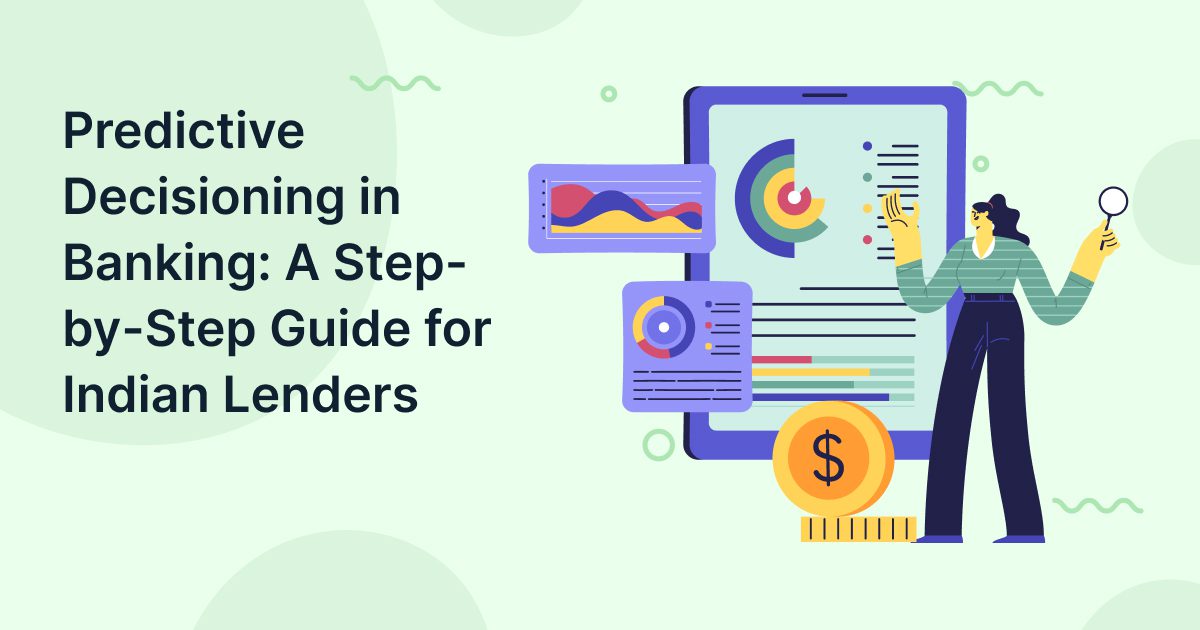
Predictive decisioning in banking means using data and machine learning models to automatically score borrowers and approve, price, or decline loans in real time. To implement it, banks move through five stages: consolidating data, designing and training ML models, deploying them as decision services, integrating with loan workflows, and continuously monitoring performance.
Most Indian banks and NBFCs still run credit decisions the way they did a decade ago: manual document checks, static scorecards, and committee approvals that stretch turnaround time (TAT) to days or weeks. Meanwhile, borrower data has exploded—UPI transactions, bank statement flows, GST filings, and digital footprints that could make lending faster, sharper, and more inclusive if used properly.
Predictive decisioning changes the game. Instead of relying on gut feel or rigid rules, lenders use historical data and machine learning to predict who will repay, price risk accurately, and automate decisions without sacrificing control.
This guide walks you through a practical, step-by-step path to implement predictive decisioning in your lending workflows, from data collection to model deployment and ongoing governance. Along the way, we’ll show where tools like Fintly’s Bank Statement Analyzer fit in as a data layer that feeds clean, structured features into your models.
What is predictive decisioning in banking, and why now?
Predictive decisioning is the practice of using data-driven models to make credit decisions: approve, decline, price, or set limits, automatically and in real time. Think of it as moving from “policy + spreadsheet” to “policy + model + audit trail.”
Traditional underwriting relies on –
- Bureau scores (CIBIL, Experian, etc.)
- Basic income proof (salary slips, ITR)
- Manual verification and committee reviews
Predictive decisioning adds –
- Alternative data (bank statements, GST, UPI, transaction logs)
- Machine learning models that learn from thousands of past loans
- Automated scoring and decisioning with explainable outputs
Why now? Three forces are pushing Indian lenders toward predictive decisioning –
- Regulatory push: RBI’s FREE-AI framework (August 2025) and Digital Lending Guidelines require auditable, explainable AI in credit assessments.
- Competitive pressure: 90% of Indian financial institutions are now focusing on AI and GenAI for innovation, with NBFCs like Bajaj Finance and L&T Finance embedding AI across underwriting and portfolio management.
- Customer expectations: Digital payments volume has surged 38x in the last decade & borrowers expect instant decisions, not week-long waits.
For lenders still using legacy processes, the cost of inaction is clear: higher acquisition costs, lost customers to faster fintechs & rising NPAs as outdated models fail to catch early stress signals.
If you’re wondering how to balance ML models with transparent policy rules, we’ve written about how decision tables simplify risk pricing and eligibility rules, a approach that lets you keep policy guardrails visible while ML handles scoring.
|
Industry Stat “A PwC India study found that 65% of Indian banks have begun adopting AI, but only 9% have reached production-grade deployment, meaning most are still stuck in pilot mode.” |

How do banks currently make lending decisions?
Before jumping into implementation, it helps to understand where most Indian lenders are today.
The legacy decision process
Typical steps in a traditional lending workflow –
- Application received: Customer submits documents (physical or digital)
- Manual verification: Ops team checks income proof, bank statements, bureau report
- Credit committee review: For larger tickets, a committee debates and approves
- Offer generation: If approved, manual pricing and documentation
- Disbursement: After all checks, funds released
Pain points for CFOs and COOs –
- High cost per loan (often ₹2,000–₹5,000 for small tickets)
- Inconsistent decisions across branches or underwriters
- TAT of 3–7 days for retail, 2–4 weeks for MSME
- Limited ability to serve thin-file or new-to-credit customers
The shift to predictive decisioning
| Dimension | Legacy process | Hybrid (rules + ML) | Full predictive decisioning |
| Data used | Bureau score + basic income proof | Bureau + bank statements + GST + transaction logs | All above + alternative data (UPI, mobile, e-commerce) |
| Decision speed | 3–7 days (retail), 2–4 weeks (MSME) | 1–2 days | Minutes to hours |
| Consistency | Varies by underwriter/branch | High (rules enforced) | Very high (model + rules) |
| Risk pricing | Broad buckets (prime, near-prime, subprime) | More granular segments | Dynamic, borrower-specific pricing |
| Auditability | Manual notes, paper trails | Rule logs + model scores | Full audit trail (model version, features, decision) |
What are the steps to implement predictive decisioning in finance?
Here’s the core five-step roadmap that Indian banks and NBFCs can follow.
Step 1 – Consolidate and prepare your data
Data is the foundation. Without clean, structured data, even the best models will fail.
Key data sources for predictive decisioning –
- Bureau data: CIBIL, Experian, Equifax, CRIF High Mark
- Bank statements: 6–12 months of transaction history
- GST returns: For MSMEs and self-employed borrowers
- UPI and payment gateway data: Cash flow patterns, transaction frequency
- Internal data: Past repayment history, delinquency flags, customer behavior
Data quality matters: RBI’s digital lending guidelines require that data used for underwriting be accurate, auditable & collected with explicit borrower consent.
Feature engineering, turning raw data into usable signals, is where platforms like Fintly add value. For example, instead of feeding raw bank statement PDFs into a model, you extract features like –
- Average monthly balance
- Cash flow volatility
- EMI-to-income ratio
- Red flags (bounced cheques, gambling transactions, etc.)
Step 2 – Design and train your ML scoring models
ML scoring means building models that learn from historical loans to predict the probability of default or repayment.
Common model types –
- Logistic regression: Simple, interpretable, good for baseline models
- Gradient boosting (XGBoost, LightGBM): Handles non-linear relationships, widely used in fintech
- Random forests: Robust to overfitting, good for feature importance analysis
Training process –
- Split data: Training set (70–80%), validation set (10–15%), test set (10–15%)
- Feature selection: Pick the most predictive variables (e.g., cash flow stability, bureau delinquency)
- Model training: Fit the model on training data
- Validation: Test on unseen data to check accuracy, AUC & fairness
- Explainability: Use tools like SHAP or LIME to explain model outputs (required under RBI’s FREE-AI framework)
Key point: ML models don’t replace policy, they inform it. You can still set hard rules (e.g., minimum CIBIL score, maximum EMI-to-income) that override model recommendations.
As your models and rules grow, you’ll want to externalize that logic so business teams can adjust parameters without every change becoming a code release. We cover this in detail in how to externalize loan decision logic without releasing new code.
Step 3 – Deploy models as real-time decision services
Once trained, models need to run in production as low-latency APIs that return scores and recommended decisions.
Deployment options –
- Cloud-native: Fastest to deploy, scalable, but requires data privacy controls
- On-premise: More control, better for sensitive data, but slower to iterate
- Hybrid: Cloud for non-sensitive workloads, on-prem for core credit models
Key considerations –
- Latency: Decision APIs should respond in <500ms for real-time workflows
- Uptime: 99.9%+ SLA for production systems
- Monitoring: Track model drift, data quality & decision distribution
When not to automate everything
Predictive decisioning works best for high-volume, standardized products (personal loans, MSME working capital, vehicle finance). But there are cases where human judgment still adds value –
- Large corporate loans with complex structures
- New-to-bank segments with no historical data
- Distressed borrowers requiring restructuring
Think of AI as augmenting underwriters, not replacing them entirely.

Step 4 – Integrate predictive decisioning into lending workflows
This is where the model meets the business. The decision flow typically looks like –
- Application received → LOS triggers decision engine
- Data fetched → Bureau, bank statements, GST pulled via APIs
- Features computed → Raw data transformed into model-ready features
- Model scored → ML model returns probability of default + recommended decision
- Policy applied → Business rules overlay model output (e.g., hard declines for fraud flags)
- Offer generated → Pricing, limit, and tenure set based on risk score
- Decision logged → Full audit trail stored for compliance
Illustrative case: A mid-size private bank in India
- Before: 5–7 days TAT for MSME loans, manual bank statement analysis, limited penetration in thin-file segments
- After predictive decisioning: TAT reduced to 4–6 hours, approval rates up 22% for thin-file MSMEs, NPA stable at 2.4%
- Key enablers: Automated bank statement analysis, ML scoring integrated with decision tables, shadow mode testing for 3 months before full cut-over
Step 5 – Monitor, retrain, and govern your models
Model deployment is not the end; it’s the beginning of ongoing governance.
What to monitor –
- Accuracy: Is the model still predicting defaults correctly?
- Drift: Are borrower profiles changing over time?
- Fairness: Are certain segments (e.g., women, rural borrowers) being unfairly penalized?
- Decision distribution: Is the model approving too many high-risk loans?
RBI’s expectations –
- Document the rationale for algorithmic features (explainable AI)
- Conduct regular model audits
- Maintain version control and rollback capabilities
- Ensure human oversight for high-risk decisionsrbidocs.rbi.org+1
Retraining cadence: Most lenders retrain models quarterly or semi-annually, depending on portfolio size and market volatility.
What results can Indian lenders expect from predictive decisioning?
Lenders that implement predictive decisioning typically see –
- Faster TAT: From days to minutes or hours
- Better risk segmentation: More granular pricing, lower NPAs
- Lower cost per loan: Automation reduces manual ops headcount
- Improved financial inclusion: Ability to serve thin-file and MSME borrowers
Cost of inaction: If you delay, you risk losing prime customers to faster lenders, facing higher NPAs due to outdated risk models, and seeing operational costs rise as volumes grow without proportional efficiency gains.
Conclusion
Predictive decisioning is no longer a luxury for Indian banks and NBFCs, it’s a baseline capability. The five-step path (data → models → deployment → workflow integration → monitoring) gives you a clear roadmap to move from manual, legacy processes to automated, AI-driven lending.
The lenders that act now will win on speed, risk accuracy, and customer experience. Those that wait will find themselves competing with one hand tied behind their back.
If you’re evaluating how to fit predictive decisioning into your existing lending stack, talk to our team at Fintly to see how our decisioning and bank statement analytics capabilities can plug into your workflow.
|
Did you Know? “Deloitte’s 2025 State of GenAI report found that 70% of Indian firms using AI for automation met or exceeded ROI estimates, with critical departments like IT, operations, and risk management leading adoption.” |

QUICK ANSWERS
Frequently Asked Questions (FAQs)
Your most common questions, answered with precision and insight
Predictive decisioning in banking is the use of data and machine learning models to automatically score borrowers and make credit decisions: approve, decline, price, or set limits, in real time. It replaces manual underwriting and static scorecards with dynamic, data-driven models that learn from historical loan performance.
Traditional credit scoring relies on bureau scores and basic income proof, often with manual verification. Predictive decisioning adds alternative data (bank statements, GST, UPI), machine learning models & automated decisioning with full audit trails. The result is faster, more accurate & more granular risk assessment.
Banks need bureau data, 6–12 months of bank statements, GST returns (for MSMEs), UPI and payment gateway transaction logs & internal repayment history. Data must be accurate, auditable, and collected with explicit borrower consent as per RBI’s digital lending guidelines.
Typical implementation takes 3–6 months: 4–8 weeks for data consolidation and feature engineering, 6–10 weeks for model development and validation, and 4–6 weeks for deployment and integration with loan workflows. Shadow mode testing adds another 8–12 weeks before full cut-over.
Yes. Predictive models can use alternative data like bank statement cash flows, GST filings & UPI transactions to assess creditworthiness for borrowers with limited bureau history. This expands financial inclusion while maintaining risk discipline.
Yes, but with conditions. RBI’s FREE-AI framework (August 2025) and Digital Lending Guidelines require that AI-driven credit assessments be auditable, explainable, and subject to human oversight. Algorithms must be documented, and data collection must have explicit borrower consent.
Models will occasionally make errors. That’s why governance matters: monitor accuracy and drift, maintain version control & keep human-in-the-loop overrides for high-risk decisions. RBI requires lenders to provide reasons for major automated decisions and maintain audit trails for compliance.
Banks track model accuracy, data drift, fairness metrics & decision distribution through dashboards. Models are retrained quarterly or semi-annually with fresh data. Version control and rollback capabilities ensure that if a new model underperforms, you can revert to the previous version quickly.

Author
Subject Matter Expert (Lending) Fintly.co
Vijay Mali is a results-driven professional with deep expertise in HFC/NBFC startups, compliance, and underwriting. He specializes in delivering end-to-end solutions for financial institutions, focusing on Business Rule Engines (BRE), workflow automation, and AI-driven credit decision-making. He is passionate about leveraging Machine Learning (ML) scorecards and AI-powered risk assessment to optimize lending processes and drive digital transformation in the financial sector.