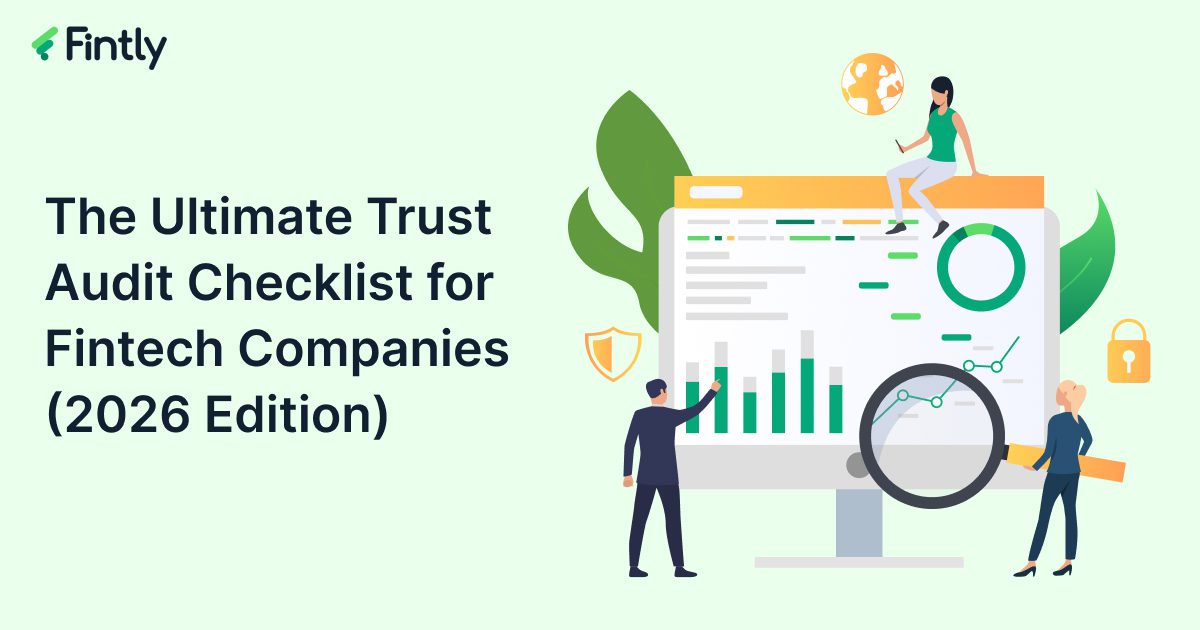
Trust is the only currency that truly matters in financial technology. You can build a seamless app with a beautiful interface, but one data leak or compliance failure will evaporate user confidence overnight. Establishing that trust does not happen by accident. It requires a rigorous trust audit checklist to verify your data privacy, security controls, and transaction integrity. If you are preparing for a regulatory review or a SOC 2 assessment this year, you need to know exactly where your vulnerabilities lie. Every solid fintech audit checklist starts with understanding that compliance is an ongoing operational standard, not just a one-time regulatory hurdle.
Executive Summary Running a comprehensive trust audit checklist manually can overwhelm internal teams and lead to costly oversights. Fintly automates this heavy lifting. By leveraging our trust audit platform, compliance officers can pinpoint risks and verify data integrity instantly, rather than spending weeks digging through fragmented logs and manual reports.

What Are the Core Risk Areas Addressed by a Trust Audit Checklist?
Before looking at specific controls, you must understand the risks your trust audit checklist is designed to mitigate. Financial technology platforms face a unique blend of cybersecurity threats and regulatory scrutiny.
According to IBM’s Cost of a Data Breach Report, the average cost of a data breach in the financial sector exceeded $6 million, making it one of the most targeted industries globally. This financial impact underscores why a reactive approach to security is no longer viable.
A thorough fintech compliance checklist targets three primary risk areas:
- Data Privacy and Security: Protecting personally identifiable information (PII) from unauthorized access. This includes encryption standards and access management.
- Regulatory Non-Compliance: Failing to adhere to anti-money laundering (AML) directives or regional privacy laws.
- Operational Resilience: Ensuring your platform stays online and accurate during high-volume trading or unexpected server outages.
When you implement a robust fintech audit checklist, you create a verifiable paper trail showing regulators and partners that you have actively mapped and mitigated these core risks.
Essential Controls for Your Fintech Compliance Checklist
To pass an audit successfully, you need standardized internal controls. These are the practical rules and software guardrails that prevent unauthorized actions and ensure data accuracy. A functional fintech compliance checklist categorizes these controls into technical, administrative, and physical safeguards.
A key component of this process involves verifying transaction data accurately. Misread financial data can trigger false compliance alerts or obscure actual fraud. This is why bank statement parsing matters in digital audits. When your parsing is accurate, your audit trail becomes indisputable.
Furthermore, monitoring the overall financial health of your platform and your corporate clients requires dedicated reporting tools. If you are unsure where to begin with reporting infrastructure, review our guide on how to integrate financial statement analysis tools into your business.
By locking down your data ingestion and reporting first, the rest of your trust audit checklist becomes much easier to execute.
The Complete 2026 Trust Audit Checklist
The best way to approach your fintech compliance checklist is to break it down into actionable phases. Use the table below to structure your internal reviews. This trust audit checklist covers the essential checkpoints required for modern financial platforms.
| Audit Phase | Focus Area | Specific Actions for your Trust Audit Checklist |
| Phase 1: Access | Identity Management | Enforce Multi-Factor Authentication (MFA) across all employee and user accounts. Review role-based access control (RBAC) logs quarterly. |
| Phase 2: Data | Encryption & Storage | Verify end-to-end encryption for data in transit and at rest. Ensure cryptographic keys are rotated every 90 days. |
| Phase 3: Transactions | AML & KYC Integrity | Audit the automated flags in your Know Your Customer (KYC) onboarding flow. Test transaction monitoring for false positives. |
| Phase 4: Vendors | Third-Party Risk | Require SOC 2 Type II reports from all API providers. Assess cloud hosting partners for data residency compliance. |
| Phase 5: Recovery | Incident Response | Run a simulated data breach tabletop exercise. Document the average time to recovery (TTR) for core services. |
Following this structured fintech compliance checklist ensures that you don’t miss critical technical details while preparing for external auditor reviews.
Real-World Case Study: Streamlining the Fintech Audit Checklist
To understand the practical application of a trust audit checklist, look at how scaling platforms handle compliance debt.
Illustrative Example: Consider a lending Platform AuraPay, a mid-sized peer-to-peer lending startup. Which struggled to pass its initial SOC 2 audit. Their internal fintech audit checklist was fragmented across spreadsheets, leading to a failure in proving that offboarded employees immediately lost database access.
By standardizing their fintech compliance checklist into a single automated dashboard, they reduced their evidence-gathering time from three weeks to four days. According to research by McKinsey & Company on compliance productivity, institutions that automate their compliance testing and auditing workflows can reduce operational costs by up to 30%. For AuraPay, adopting a rigid trust audit checklist fundamentally lowered their cash burn rate (the speed at which a company consumes its capital).
Conclusion
Passing an audit is not about checking boxes; it is about proving that your platform respects and protects user data. By implementing a standardized trust audit checklist, you eliminate blind spots in your security posture and build genuine credibility with your partners. Whether you are addressing third-party vendor risks or enforcing strict access controls, a reliable fintech compliance checklist is your blueprint for sustainable growth. If you rely on an outdated fintech audit checklist, you risk missing the sophisticated vulnerabilities that define today’s financial landscape.
Ready to automate your risk management and ensure flawless compliance? Contact us today to see how Fintly can streamline your trust audit checklist and protect your bottom line.
 QUICK ANSWERS
Frequently Asked Questions (FAQs)
Your most common questions, answered with precision and insight
A trust audit checklist is a structured document used by financial platforms to verify that their internal security, data privacy, and operational controls meet regulatory and industry standards. It ensures that a company can securely manage user funds and data.
Your fintech compliance checklist must include access management reviews, data encryption verification, third-party vendor risk assessments, and anti-money laundering (AML) transaction monitoring tests. It should cover both technical safeguards and employee policies.
You should review and update your fintech audit checklist at least annually, or immediately following any major change to your software architecture or regional financial regulations. Continuous monitoring is preferred over annual scrambles.
Typically, the Chief Information Security Officer (CISO) or the Head of Compliance oversees the trust audit checklist. However, execution requires collaboration between engineering, legal, and risk management teams.
Corporate clients demand proof of security before integrating financial software. A completed trust audit checklist provides the necessary evidence, often leading to SOC 2 or ISO 27001 certifications that your platform is a safe vendor.

Author
Subject Matter Expert (Lending) Fintly.co
Vijay Mali is a results-driven professional with deep expertise in HFC/NBFC startups, compliance, and underwriting. He specializes in delivering end-to-end solutions for financial institutions, focusing on Business Rule Engines (BRE), workflow automation, and AI-driven credit decision-making. He is passionate about leveraging Machine Learning (ML) scorecards and AI-powered risk assessment to optimize lending processes and drive digital transformation in the financial sector.