
Maker-Checker Approvals
Ensure business rules are reviewed and approved before deployment through controlled approval workflows.
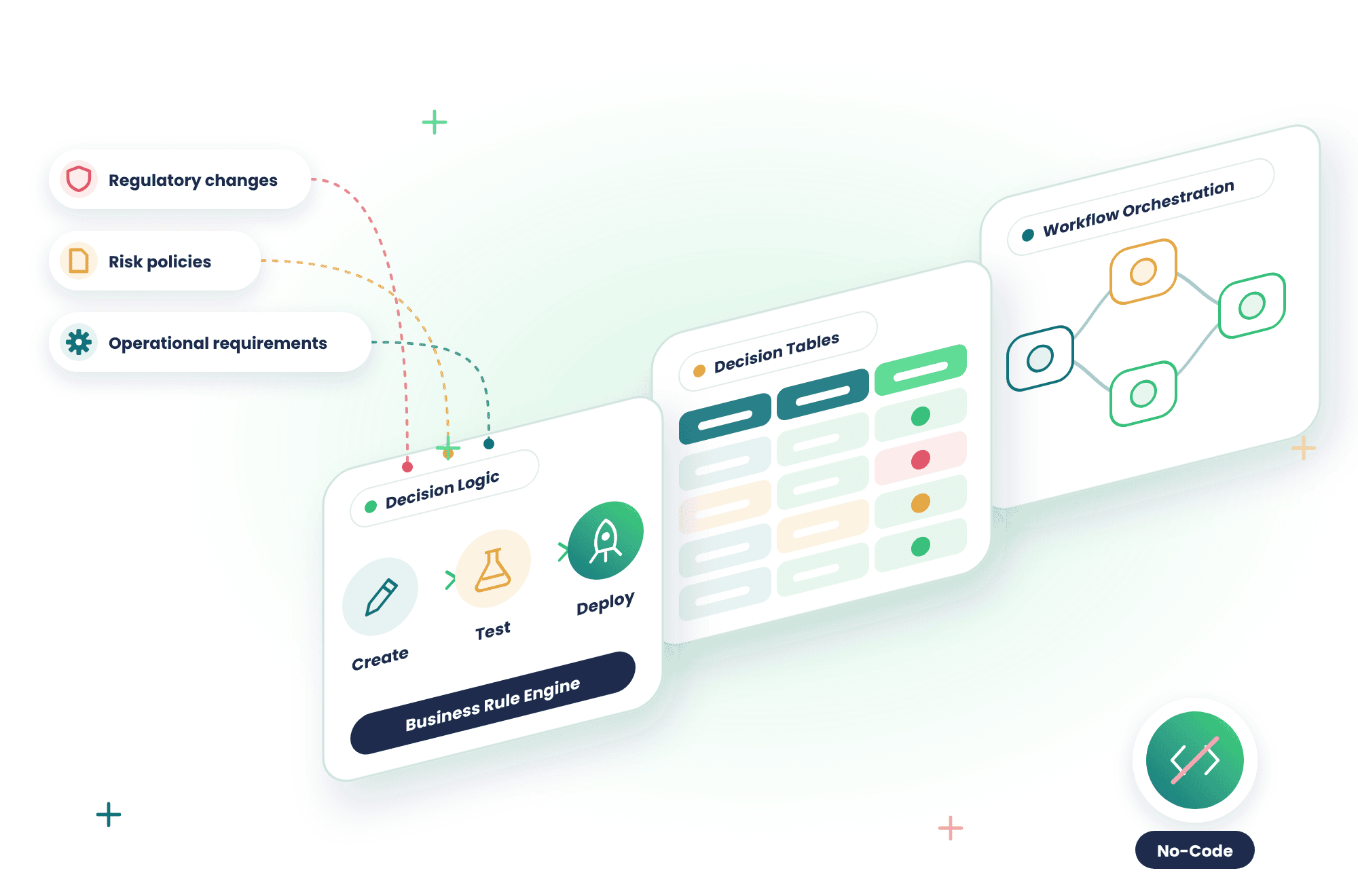
When business decisions depend on development backlogs, organisations lose agility. Credit policies, approval criteria, risk controls and operational workflows can take weeks or months to update, creating delays across lending and customer-facing processes. Fintly Business Rule Engine (BRE) helps financial institutions automate business decisions through configurable rules, decision tables and workflow orchestration. Business teams can create, test and deploy decision logic without relying on application code, helping organisations respond faster to regulatory changes, evolving risk policies and operational requirements. Built for banks, finance companies, digital lenders, fintech platforms, licensed moneylenders and pawnbrokers, BRE combines decision automation, workflow management and governance in one platform.
256+
Customers Worldwide
99.999%
Uptime
Global Presence
Across 40+ Countries
As business rules become more complex, governance becomes increasingly important. Financial institutions need confidence that decision logic is reviewed, tested and controlled before reaching production environments. Fintly BRE provides built-in governance controls designed to help organisations maintain accountability across rule management and workflow execution.
Ensure business rules are reviewed and approved before deployment through controlled approval workflows.
Track every rule change and maintain historical versions with the ability to revert when required.
Maintain complete visibility into decision execution, workflow outcomes, and user actions.
Control who can create, edit, test and deploy decision logic across departments and teams.
Build decision rules through an intuitive interface that enables business teams to manage policy changes independently.
Configure lending policies, pricing logic, eligibility criteria and risk strategies through structured decision tables.
Connect rules, approvals, APIs, databases and operational processes through a visual workflow designer.
Convert policy documents and business requirements into structured, editable business rules using AI-assisted rule creation.
Execute decisions instantly through APIs, event triggers, and workflow automation.
Validate business rules before deployment through simulations, execution previews, and testing workflows.
Maintain one source of truth for business logic, decision rules, and approval workflows.
Start from configurable rule templates for common Singapore lending policies, such as TDSR and MSR thresholds, loan-to-value limits, Moneylenders Act loan and fee caps, and pawnbroking pledge rules. Your policy and compliance teams review and adapt every template before deployment.
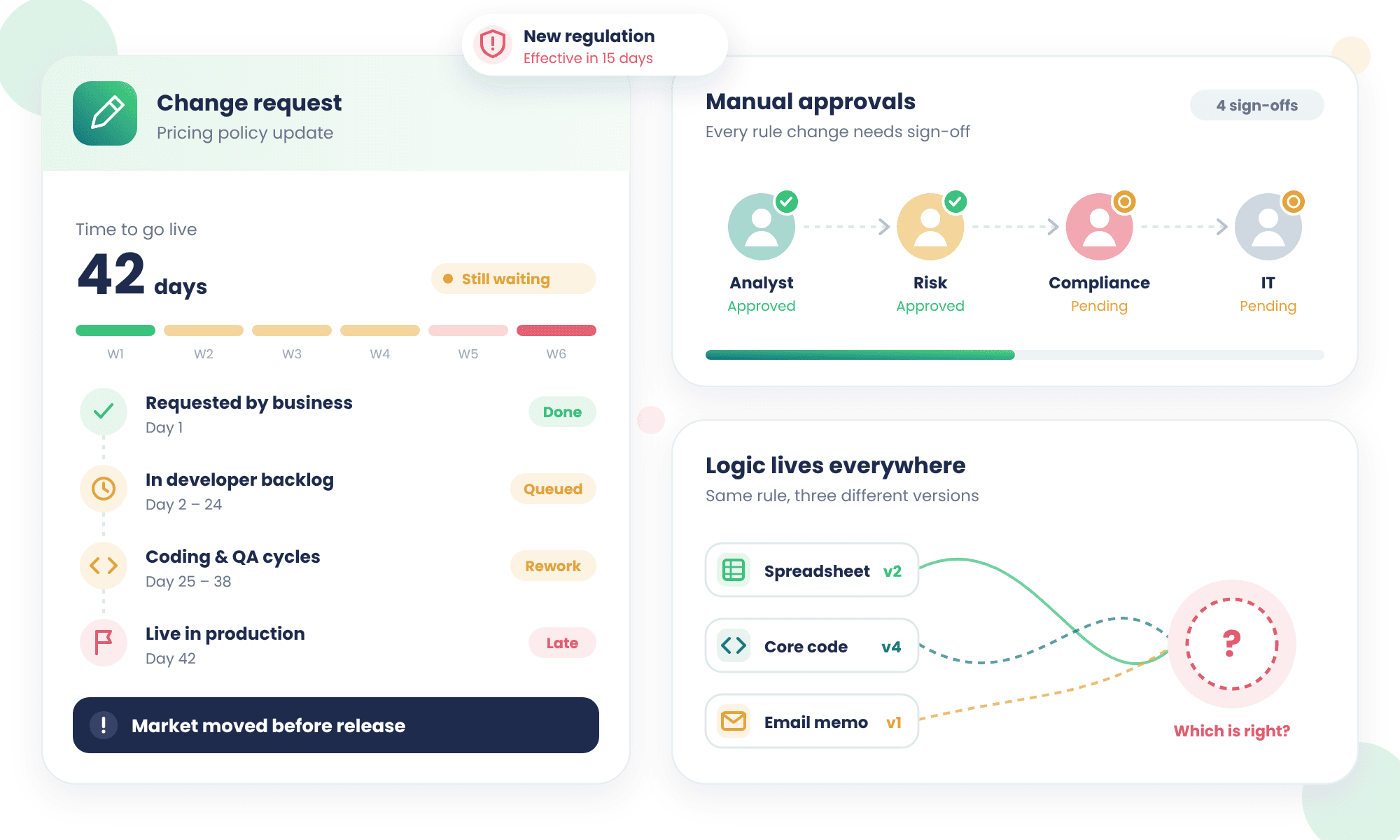
Many organisations still rely on hardcoded application logic, spreadsheets, and manual reviews to manage business decisions. This creates operational bottlenecks, slows policy updates, and makes it difficult to respond quickly to changing business or regulatory requirements. For financial institutions in Singapore, delayed decision-making can impact lending operations, risk management frameworks and customer experience.
Create business rules, rule sets, and decision tables using a no-code interface built for business users.
Connect rules with APIs, databases, approvals and operational processes through visual workflow orchestration.
RRun simulations, review execution outcomes, and validate business logic before publishing changes.
Deploy approved rules into live environments and automate decisions in real time across connected systems.
Automate credit policy execution, lending eligibility assessments, and risk-based decision-making processes.
Reduce operational bottlenecks by enabling rapid updates to lending policies and approval criteria.
Support automated decision-making and scalable customer onboarding journeys through configurable workflows.
Accelerate product innovation by allowing business teams to implement changes without waiting for development cycles.
Configure income-based loan limits, interest and fee caps and mandatory MLCB checks as governed by rules that can be updated without code changes.
Apply pledge valuation, loan-to-value and redemption rules consistently across branches, with version-controlled changes and audit logs.
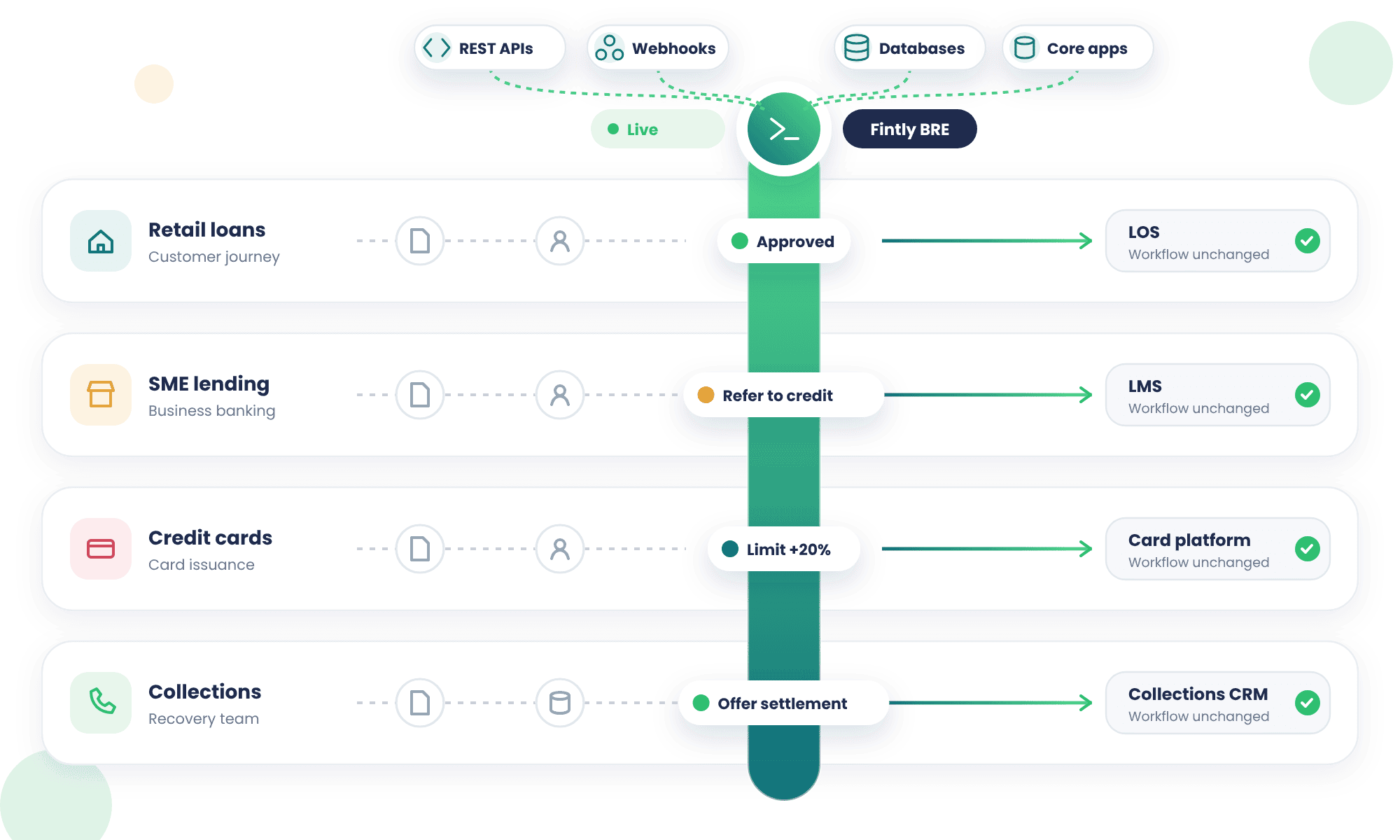
Fintly BRE is designed to integrate with lending platforms, operational systems and enterprise applications, enabling organisations to embed automated decision-making into existing workflows without replacing core systems.
Comparison of traditional decision processes versus Fintly BRE

A Business Rule Engine (BRE) is software that automates decision-making by executing configurable business rules independently from application code. This allows organisations to modify decision logic without requiring software development changes.
A BRMS helps organisations create, manage, govern, test and deploy business rules from a central platform. It provides oversight, version control, and governance for operational decision-making processes.
Yes. Fintly BRE is designed with no-code capabilities that allow authorised business users to define, modify and deploy decision rules through a visual interface.
BRE can automate eligibility checks, credit policy assessments, approval routing and decision execution by combining configurable business rules with workflow automation.
Yes. The platform includes decision tables that help organisations manage complex lending policies, risk criteria, pricing structures, and eligibility rules through configurable tabular logic.
Yes. BRE supports APIs, webhooks, databases and enterprise application integrations, enabling organisations to automate decisions across their existing technology ecosystem.
The platform includes maker-checker approvals, role-based permissions, version control, rollback capabilities, and audit logs to help organisations maintain visibility and control over rule changes and decision execution.
BRE is designed to provide governance controls, approval workflows and audit logs that may support internal risk management, operational oversight and policy governance frameworks. Institutions remain responsible for meeting their own regulatory obligations.
Fintly provides configurable starting templates for common Singapore policies, including TDSR and MSR thresholds and Moneylenders Act caps. Templates are a starting point only. Institutions review and approve every rule against current regulations before use.
Eliminate manual bottlenecks, reduce reliance on developers, and implement policy changes faster with a business rule engine designed for modern financial institutions. See how Fintly BRE helps organisations automate business decisions while maintaining transparency, governance and operational control.